Question
In $YDSE$ experiment, when two light rays make third minima, then they have

Answer

For minima, path difference $\Delta=(2 n-1) \frac{\lambda}{2}$

For third minima $n=3 \Rightarrow \Delta=(2 \times 3-1) \frac{\lambda}{2}=\frac{5 \lambda}{2}$

Need a full question paper?

Generate a complete, print-ready paper with questions like this in minutes — across 16+ boards, with answer keys.

Start Generating Free

Similar questions

Match the List$-I$ with List$-II$.

List $I$ List $II$
$A$ $AC$ generator $I$ Presence of both $L$ and $C$
$B$ Transformer $II$ Electromagnetic Induction
$C$Resonance phenomenon to occur $III$ Quality factor
$D$Sharpness of resonance $IV$ Mutual Inductance

Choose the correct answer from the options given below:
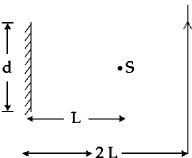
A point source of light, $S$ is placed at a distance $L$ in front of the centre of plane mirror of width $d$ which is hanging vertically on a wall. A man walks in front of the mirror along a line parallel to the mirror, at a distance $2\, L$ as shown below. The distance over which the man can see the image of the light source in the mirror:
Bob of a simple pendulum of length $l$ is made of iron . The pendulum is oscillating over a horizontal coil carrying direct current. If the time period of the pendulum is $T$ then
A sphere of radius $1\,cm$ has potential of $8000\,V$, then energy density near its surface will be
According to Joule's law, if the potential difference across a conductor having a material of specific resistance remains constant, then the heat produced in the conductor is directly proportional to
The speed of a homogeneous solid sphere after rolling down an inclined plane of vertical height $h$, from rest without sliding, is
$A$ beam of diameter $‘d’$ is incident on a glass hemisphere as shown. If the radius of curvature of the hemisphere is very large in comparison to $d$, then the diameter of the beam at the base of the hemisphere will be:
The potential at a point $x$ (measured in $μ\ m$) due to some charges situated on the $ x$-axis is given by $V(x)$ =$\frac{{20}}{{{x^2} - 4}}$ $volt$ The electric field $E$ at $x = 4\ μ m$ is given by
Two simple harmonic motions are represented by the equations $x_{1}=5 \sin \left(2 \pi t+\frac{\pi}{4}\right), x_{2}=5 \sqrt{2}(\sin 2 \pi t+\cos 2 \pi t)$ The ratio of the amplitude of $x_{1}$ and $x_{2}$ is
A man can see only between $ 75 \,cm$ and $100\, cm$. The power of lens to correct the near point will be