A sphere of radius $1\,cm$ has potential of $8000\,V$, then energy density near its surface will be
Easy


Download our appand get started for free
Experience the future of education. Simply download our apps or reach out to us for more information. Let's shape the future of learning together!No signup needed.*
Similar Questions
- 1A particle $A$ has charge $+q$ and particle $B$ has charge $+ 4q$ with each of them having the same mass $m$. When allowed to fall from rest through same electrical potential difference, the ratio of their speed $V_A : V_B$ will be :-View Solution
- 2An electric dipole has the magnitude of its charge as $q$ and its dipole moment is $p$. It is placed in a uniform electric field $E$. If its dipole moment is along the direction of the field, the force on it and its potential energy are respectivelyView Solution
- 3A $500\,\mu F$ capacitor is charged at a steady rate of $100\,\mu C/sec$ . The potential difference across the capacitor will be $10\,V$ after an interval of......$sec$View Solution
- 4Two capacitors connected in parallel having the capacities ${C_1}$ and ${C_2}$ are given $'q'$ charge, which is distributed among them. The ratio of the charge on ${C_1}$ and ${C_2}$ will beView Solution
- 5View SolutionA metallic rod is placed in a uniform electric field. Select the correct option.
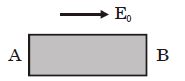
- 6View SolutionForce of attraction between the plates of a parallel plate capacitor is
- 7Two identical charged spheres are suspended by strings of equal lengths. The strings make an angle $\theta$ with each other. When suspended in water the angle remains the same. If density of the material of the sphere is $1.5 \mathrm{~g} / \mathrm{cc}$, the dielectric constant of water will beView Solution
(Take density of water $=1 \mathrm{~g} / \mathrm{cc}$ )
- 8An air filled parallel plate capacitor has capacity $C$. If distance between plates is doubled and it is immersed in a liquid then capacity becomes twice. Dielectric constant of the liquid isView Solution
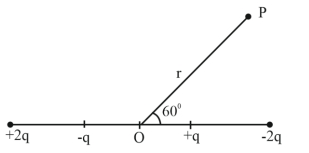
- 9The distance between charges $+\mathrm{q}$ and $-\mathrm{q}$ is $2 l$ and between $+2 \mathrm{q}$ and $-2 \mathrm{q}$ is $4 l$. The electrostatic potential at point $P$ at a distance $r$ from centre $O$ is $-\alpha\left[\frac{q l}{r^2}\right] \times 10^9 \mathrm{~V}$, where the value of $\alpha$ is____. (Use $\left.\frac{1}{4 \pi \varepsilon_0}=9 \times 10^9 \mathrm{Nm}^2 \mathrm{C}^{-2}\right)$View Solution
- 10Two metal pieces having a potential difference of $800 \;V$ are $0.02\; m$ apart horizontally. A particle of mass $1.96 \times 10^{-15} \;kg$ is suspended in equilibrium between the plates. If $e$ is the elementary charge, then charge on the particle isView Solution