MCQ
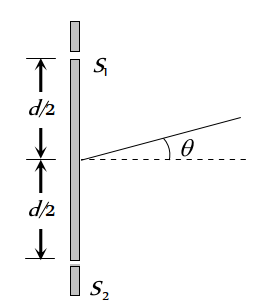
In Young's double slit experiment, if monochromatic light is replaced by white light
Image

  • A
    (a) All bright fringes become white
  • B
    (b) All bright fringes have colours between violet and red
  • C
    (c) Only the central fringe is white, all other fringes are coloured
  • D
    (d) No fringes are observed

Answer

Need a full question paper?

Generate a complete, print-ready paper with questions like this in minutes — across 16+ boards, with answer keys.

Start Generating Free

Similar questions

The magnetic moment of atomic neon is
The kinetic energy of a particle executing $\text{S.H.M.}$ is $16 J$ when it is at its mean position. If the mass of the particle is $0.32 kg$, then what is the maximum velocity of the particle
A hollow double concave lens is made of very thin transparent material. It can be filled with air or either of two liquids $L$ and $L$ having refractive indices $n$ and $n$ respectively $(n>n>1)$. The lens will diverge a parallel beam of light if it is filled with
In steel, the Young's modulus and the strain at the breaking point are $2 \times 10^{11}\  Nm ^{-2}$ and $0.15$ respectively. The stress at the breaking point for steel is therefore
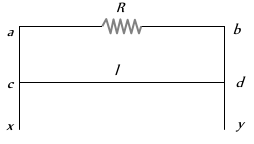
A wire $c d$ of length $l$ and mass $m$ is sliding without friction on conducting rails $a x$ and by as shown. The vertical rails are connected to each other with a resistance $R$ between $a$ and $b$. A uniform magnetic field $B$ is applied perpendicular to the plane abcd such that $c d$ moves with a constant velocity of
Image
A particle executing simple harmonic motion along $y-$ axis has its motion described by the equation $y=A \sin (\omega t)+B$. The amplitude of the simple harmonic motion is
With the propagation of a longitudinal wave through a material medium, the quantities transmitted in the propagation direction are
At N.T.P. one mole of diatomic gas is compressed adiabatically to half of its volume $\gamma=1.41$. The work done on gas will be
The kinetic energy of a body of mass $3 \mathrm{~kg}$ and momentum $2 \mathrm{Ns}$ is
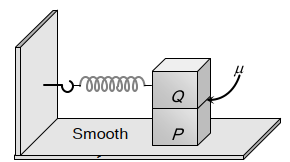
A block $P$ of mass $m$ is placed on a frictionless horizontal surface. Another block $Q$ of same mass is kept on $P$ and connected to the wall with the help of a spring of spring constant $k$ as shown in the figure. $\mu_s$ is the coefficient of friction between $P$ and $Q$. The blocks move together performing $S H M$ of amplitude $A$. The maximum value of the friction force between $P$ and $Q$ is

Image