MCQ
In Young's double slit experiment, white light is used. The separation between the slits is b. The screen is at a distance $d(d>>b)$ from the slits. Some wavelengths are missing exactly in front of one slit. These wavelengths are
  • A
     $\lambda=\frac{b^2}{d}$
  • B
     $\lambda=\frac{ b ^2}{3 d}$
  • C
     $\lambda=\frac{2 b^2}{3 d}$
  •  $a, b$

Answer

Correct option: D.
 $a, b$
$a, b$

Need a full question paper?

Generate a complete, print-ready paper with questions like this in minutes — across 16+ boards, with answer keys.

Start Generating Free

Similar questions

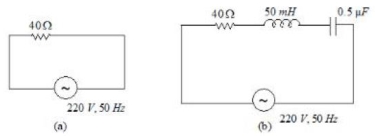
For the given figures, choose the correct options:
Hydrogen $(_1H^1),$ Deuterium $(_1H^2)$,singly ionised Helium $(_2He^4)^+$ and doubly ionised lithium ${\left( {{}_3^6Li} \right)^{ + + }}$, all have one electron around the nucleus. Consider an electron transition from $n = 2$ to $n = 1$. If the wavelengths of emitted radiation are $λ_1,λ_2,λ_3$ and $λ_4$ respectively then approximately which one of the following is correct?
Sodium light of wavelengths $650\, nm$ and $655\, nm$ is used to study diffraction at a single slit of aperture $0.5\, mm$. The distance between the slit and the screen is $2.0 \,m$. The separation between the positions of the first maxima of diffraction pattern obtained in the two cases is $\times 10^{-5} \,m$
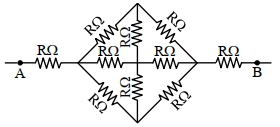
The effective resistance between $A$ and $B$, if resistance of each resistor is $R$, will be
An infinite number of charges, each of charge $1 \,\mu C$ are placed on the $x$-axis with co-ordinates $x = 1, 2,4, 8, ....\infty$. If a charge of $1\, C$ is kept at the origin, then what is the net force acting on $1\, C$ charge....$N$
Which among the following is true
A coil of Cu wire (radius $-r$, self inductance $-L$) is bent in two concentric turns each having radius The self inductance now
For intensity I of a light of wavelength 5000Å the photoelectron saturation current is 0.40 μA and stopping potential is 1.36 V, the work function of metal is
Atomic weight of boron is 10.81 and it has two isotopes $5^{\mathrm{B}^{10}}$ and $5^{\mathrm{B}^{11}}$. Then ratio of $5^{\mathrm{B}^{10}}: 5^{\mathrm{B}^{11}}$ in nature would be
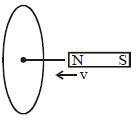
In the given figure, the magnet is moved towards the coil with speed $'v'$ and induced  $emf$ is $'e'$. If magnet and coil recede away from one another each moving with speed $'v'$, the induced $emf$ in the coil will be