Question
In Young's experiment, the separation between $5^{\text {th }}$ maxima and $3^{\text {rd }}$ minima is how many times as that of fringe width is ........ times

Answer

(c)

$5^{\text {th }} \text { maximum }=\frac{5 \lambda D}{d}$

$3^{\text {nd }} \text { minimum }=\frac{(2 n-1) \lambda . D}{2 d}=\frac{5 \lambda D}{2 d}$

$\therefore \quad \text { Distance }=\frac{5 \lambda D}{d}-\frac{5 \lambda D}{2 d}$

$=\frac{5 \lambda D}{2 d}$

$\therefore \text { Distance }=2.5 \text { times }$

Need a full question paper?

Generate a complete, print-ready paper with questions like this in minutes — across 16+ boards, with answer keys.
Start Generating Free

Similar questions

Time period of a particle executing $SHM$ is $8\, sec.$ At $t = 0$ it is at the mean position. The ratio of the distance covered by the particle in the $1^{st}$ second to the $2^{nd}$ second is :
A body starts from rest and travels a distance $S$ with uniform acceleration, then moves uniformly a distance $2S$ and finally comes to rest after moving further $3S$ under uniform retardation. The ratio of the average velocity to maximum velocity is
The nuclide $^{131}I$ is radioactive, with a half-life of $8.04$ days. At noon on January $1$, the activity of a certain sample is $60089$. The activity at noon on January $24$ will be
A man of mass $80\ kg$ is standing inside a lift moving upward with a uniform velocity of $4\ m/s$ then the apparent weight of the person will be
A capacitor of capacitance $15 \,nF$ having dielectric slab of $\varepsilon_{r}=2.5$ dielectric strength $30 \,MV / m$ and potential difference $=30\; volt$ then the area of plate is ....... $ \times 10^{-4}\; m ^{2}$
One gm mol of a diatomic gas $(\gamma = 1.4)$ is compressed adiabatically so that its temperature rises from ${27^o}C$ to ${127^o}C$. The work done will be
A current carrying small loop behaves like a small magnet. If $A$ be its area and $M$ its magnetic moment, the current in the loop will be
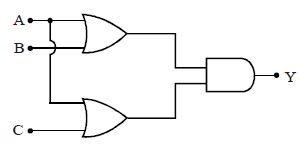
The output of given logic circuit is
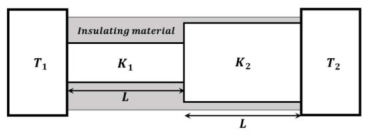
Two conducting cylinders of equal length but different radii are connected in series between two heat baths kept at temperatures $T _1=300 K$ and $T _2=100 K$, as shown in the figure. The radius of the bigger cylinder is twice that of the smaller one and the thermal conductivities of the materials of the smaller and the larger cylinders are $K _1$ and $K _2$ respectively. If the temperature at the junction of the two cylinders in the steady state is $200 K$, then $K _1 / K _2=$ . . . . .
A body is thrown vertically upwards. If air resistance is to be taken into account, then the time during which the body rises is