MCQ
In Young's interference experiment, if the slits are of unequal width, then:
  • A
    No fringes will be formed
  • B
    The positions of minimum intensity will not be completely dark.
  • C
    Bright fringe as displaced from the original central position.
  • D
    Distance between two consecutive dark fringes will not be equal to the distance between two consecutive right fringes.
Answer

  1. The positions of minimum intensity will not be completely dark.

Explanation:

Unequal width of slits will cause unequal intensity of lights entering from both slits.

As a result, during interference complete cancelling of light intensity will not take place at regions of otherwise dark fringe.

As the value of $\beta$ does not depend on intensity of light, there will be no shifting of fringes as well as no change in fringe width.

Need a full question paper?

Generate a complete, print-ready paper with questions like this in minutes — across 16+ boards, with answer keys.

Start Generating Free

Similar questions

What is increased in step-down transformer

(a) Voltage

(b)  Current

(c) Power  

(d) Current density

In a double slit experiment, instead of taking slits of equal widths, one slit is made twice as wide as the other. Then in the interference pattern

(a) The intensities of both the maxima and the minima increase 

(b) The intensity of maxima increases and the minima has zero intensity

(c) The intensity of maxima decreases and that of the minima increases

(d) The intensity of maxima decreases and the minima has zero intensity

Magnitude of potential difference across L. C and R in a series LCR circuit is 100 V. If resistor is re- moved, then magnitude of current in the circuit is:
The materials having high resistance to the passage of electricity are called as:
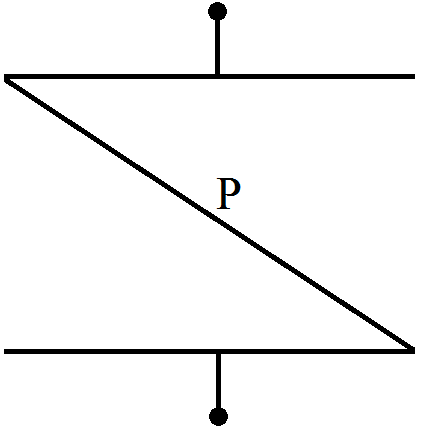
A thin metal plate P is inserted between the plates of a parallel-plate capacitor of capacitance C in such a way that its edges touch the two plates (figure). The capacitance now becomes:

The ratio of secondary to primary turns is 9 : 4. If power input is P, what will be the ratio of power output (neglect all losses) to power input

(a) 4 : 9

(b) 9 : 4

(c) 5 : 4

(d) 1 : 1

When a slow neutron goes sufficiently close to a  nucleus, then the process that takes place is

(a) Fission of

(b) Fusion of neutron

(c) Fusion of

(d) First (a) then(b)

A current I is passing through a wire having two sections P and Q of uniform diameters d and d/2 respectively.  If the mean drift velocity of electrons in sections P and Q is denoted by vP and vQ respectively, then

(a) vP = vQ

(b) vP =  vQ

(c) vP =  vQ

(d) vP = 2 vQ

The range of a projectile fired at an angle of 15° is 50m. If it is fired with the same speed at an angle of 45°, its range will be:
  1. 25m
  2. 37m
  3. 50m
  4. 100m.
Why high temperature is required for Nuclear fusion?