MCQ
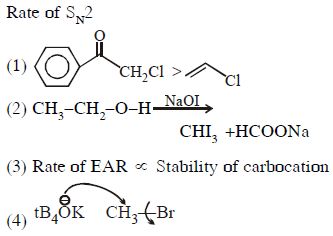
Incorrect statement is :
  • A
     shows faster rate than  with $NaI / $ acetone
  • B
    $CH_3CH_2OH$ on reaction with $NaOI$ gives yellow ppt.
  • C
     show faster rate than $CH_3CH = CHCH_3$ with $HBr / CCl_4$
  • $t-BuO^-K^+$ on reaction with $CH_3-Br$ gives  $\begin{array}{*{20}{c}}
      {C{H_3} - C = C{H_2}} \\ 
      {|\,\,} \\ 
      {C{H_3}} 
    \end{array}$ as major product
Answer

Correct option: D.
$t-BuO^-K^+$ on reaction with $CH_3-Br$ gives  $\begin{array}{*{20}{c}}
  {C{H_3} - C = C{H_2}} \\ 
  {|\,\,} \\ 
  {C{H_3}} 
\end{array}$ as major product
d

Need a full question paper?

Generate a complete, print-ready paper with questions like this in minutes — across 16+ boards, with answer keys.

Start Generating Free

Similar questions

The hypothetical reaction : $2A + B \to C + D$ is catalyzed by $E$ as indicated in the possible mechanism below -

Step$-1$ : ${\text{A  +  E }} \rightleftharpoons AE$ (fast)

Step$-2$ :${\text{AE  +  A }} \to {A_2} + E$ (slow)

Step$-3$ :${{\text{A}}_2}{\text{ +  B }} \to {\text{D}}$ (fast)

what rate law best agrees with this mechanism

Which metal is present in brass, bronze and German silver
Alkyl halides are prepared from alcohols by treating with
$a. \ce{HCl + ZnCl_2}$
$b.$ Red $\ce{P + Br_2}$
$c. \ce{H_2SO_4 + KI}$
$d.$ All the above
The standard electrode potential $({E^o})$ for $OC{l^ - }/C{l^ - }$ and $C{l^ - }/\frac{1}{2}C{l_2}$ respectively are $0.94\,V$ and $ - 1.36\,V$. The ${E^o}$ value for $OC{l^ - }/\frac{1}{2}C{l_2}$ will be ............... $\mathrm{V}$
In a first order reaction, the concentration of the reactant, decreases from $0.8\, M$ to $0.4\, M$ in $15 $ minutes. The time taken for the concentration to change from $0.1 \,M$ to $ 0.025\, M$ is .......... $\min.$
In a reaction, $2X \to Y$ , the concentration of $X$ decreases from $0.50\, M$ to $0.38\, M$ in $10\, min$ . what is the rate of reaction in $Ms^{-1}$ during the interval ?
Which salt produces white ppt. with $AgNO_3$ solution which becomes black on standing?
The electrode potentials for

$Cu^{2+}_{(aq)} + e^- \rightarrow Cu^+_{(aq)}$ and $Cu^+_{(aq)} + e^- \rightarrow Cu_{(s)}$ are $+ 0.15\, V$ and $+ 0.50\, V$ respectively. The value of $E^o_{Cu^{2+}/Cu}$ will be ........ $V$

One mole of calcium phosphide on reaction with excess of water gives
Phenol reacts with bromine water in carbon disulphate at low temperature to give: