MCQ
Which salt produces white ppt. with $AgNO_3$ solution which becomes black on standing?
  • A
    $Na_2CO_3$
  • B
    $Na_2S_2O_3$
  • $KNO_2$
  • D
    $K_2S$

Answer

Correct option: C.
$KNO_2$
c
$\begin{array}{*{20}{c}}
  {\begin{array}{*{20}{c}}
  {O\,\,\,\,\,\,\,\,\,\,\,\,\,\,\,\,\,\,\,\,\,\,\,\,\,\,\,\,O} \\ 
  {||\,\,\,\,\,\,\,\,\,\,\,\,\,\,\,\,\,\,\,\,\,\,\,\,\,\,\,\,\,\,\,||} 
\end{array}} \\ 
  {H - O - S - O - O - S - O - H} \\ 
  {||\,\,\,\,\,\,\,\,\,\,\,\,\,\,\,\,\,\,\,\,\,\,\,\,\,\,\,\,\,\,\,||} \\ 
  {O\,\,\,\,\,\,\,\,\,\,\,\,\,\,\,\,\,\,\,\,\,\,\,\,\,\,\,O} 
\end{array}$

No $S-S$ linkage

Need a full question paper?

Generate a complete, print-ready paper with questions like this in minutes — across 16+ boards, with answer keys.

Start Generating Free

Similar questions

$\begin{array}{*{20}{c}}
  {O\,\,\,\,\,\,\,\,\,\,\,\,\;\;\;\;\;\;\;\;\;\;\;\;\;\;\;\;\;\;\;\;\;\;\;\;\;\;\;\;\;\;\;\;\;\;\;\;\;\;\;\;\;\;\;\;\;\;\;\;\;\;\;} \\ 
  {||\,\,\,\,\,\,\,\,\,\,\,\,\;\;\;\;\;\;\;\;\;\;\;\;\;\;\;\;\;\;\;\;\;\;\;\;\;\;\;\;\;\;\;\;\;\;\;\;\;\;\;\;\;\;\;\;\;\;\;\;\;\;\;} \\ 
  {Ph - C - O - H + C{H_3} - {O^{18}} - H\xrightarrow{{{H^ + }}}(X) + {H_2}O} 
\end{array}$ Identify $X$
Given below are two statements :

Statement $I :$ The limiting molar conductivity of $\mathrm{KCl}$ (strong electrolyte) is higher compared to that of $\mathrm{CH}_{3} \mathrm{COOH}$ (weak electrolyte).

Statement $II :$ Molar conductivity decreases with decrease in concentration of electrolyte.

In the light of the above statements, choose the most appropriate answer from the options given below:

Which one will give $F{e^{3 + }}$ ions in solution
A gaseous reaction $A_{2(g)} \to B_{(g)} +\frac{1}{2} C_{(g)}$ shows increase in pressure from $100\, mm$ of  $Hg$ to $120\, mm$ of  $Hg$  in $5\,\min$ ; what will be rate of disappearance of $A_2$ ? ......... $mm$ of  $Hg/\min$
Water is oxidised to oxygen by
$A + {H_2}O \to B + HCl$

$B + {H_2}O \to C + HCl$

Compound $(A),\,(B)$ and $(C)$ will be respectively
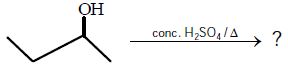
Number of possible product $(s)$ formed in above reaction :-
The molar ionic conductance of the octahedral complexes :

$(i)$ $PtCl _{4} . 5 NH _{3}$   $(ii)$ $PtCl _{4} . 4 NH _{3}$   $(iii)$ $PtCl _{4} . 3 NH _{3}$   $(iv)$ $PtCl _{4}. 2 NH _{3}$

Follow the order

Iron is
From $6.55 \mathrm{~g}$ of aniline, the maximum amount of acetanilide that can be prepared will be _ $\times 10^{-1} \mathrm{~g}$.