Question
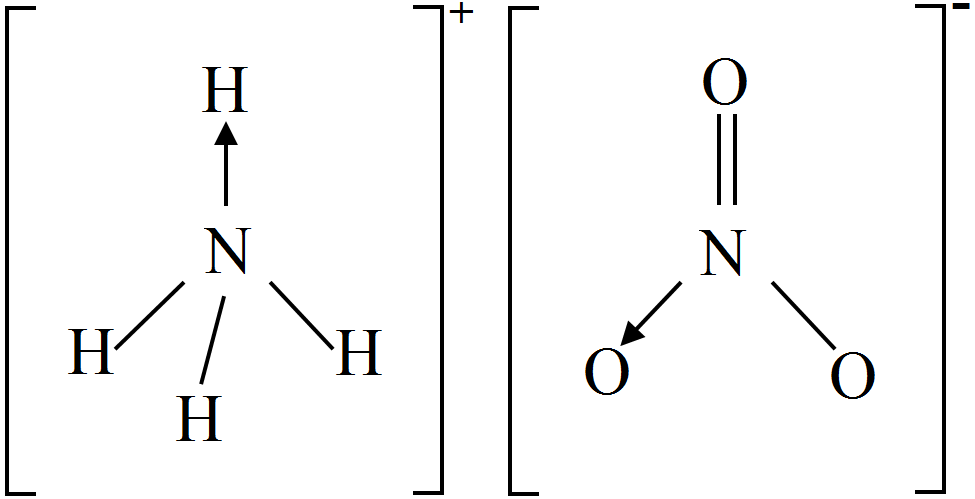
Indicate the type of bonds present in $\mathrm{NH}_4 \mathrm{NO}_3$ and state the mode of hybridisation of two N -atoms in it.

Answer


$\mathrm{NH}_4^{+}$ion contains covalent and dative bonds. (It is formed by donation of lone pair of electrons on N in $\mathrm{NH}_3$ to $\mathrm{H}^{+}$ ion). $\mathrm{NH}_3^{-}$ion also contains covalent and dative bonds. Bond between $\mathrm{NH}_4^{+}$and $\mathrm{NH}_4^{-}$ions is ionic.
N of $\mathrm{NH}_3^{+}$ion is sp hybridised and is tetrahedral. N of $\mathrm{NH}_3^{-}$ion is $\mathrm{sp}^2$ hybridised and is planar.

Need a full question paper?

Generate a complete, print-ready paper with questions like this in minutes — across 16+ boards, with answer keys.
Start Generating Free

Similar questions

Commercially available concentrated hydrochloric acid contains $38 \% \mathrm{HCl}$ by mass.
i. What is the molarity of the solution (density of solution $=1.19 \mathrm{~g} \mathrm{~mL}^{-1}$ )?
ii. What volume of the above concentrated HCl is required to make 1.0 L of 0.10 M HCl ?
The average molar mass of a mixture of methane ($CH_4$) and ethane ($C_2H_4$​​​​​​​) present in the ratio of a : b is found to be 20.0g $mol^{-1}​​​​​​​$​​​​​​​. If the ratio were reversed, what would be the molar mass of the mixture?
If 0.561g of KOH is dissolved in water to give 200mL of solution at 298K. Calculate the concentrations of potassium, hydrogen and hydroxyl ions. What is its pH?
Calculate the concentration of nitric acid in moles per litre in a sample which has a density, $1.41 g mL ^{-1}$ and the mass per cent of nitric acid in it being $69 \%$.
What happen when: (i) Methane is oxidised by oxygen in presence of M0203. (ii) Ethane is oxidised in presence of manganese acetate. (iii) Isobutane is oxidised by KMnO4.
A vessel contains 1.6g of dioxygen at STP ($273.15K, 1$ atm pressure). The gas is now transferred to another vessel at constant temperature, where pressure becomes half of the original pressure. Calculate
  1. Volume of the new vessel.
  2. Number of molecules of dioxygen.
  1. Name a compound that will be required to obtain butane using Kolbe's electrolytic method.
  2. Why does benzene show electrophilic substitution easily?
  3. Complete the following:
$\text{CH}_3-\text{C}=\text{CH}_2+\text{H}_2\text{O}\xrightarrow{\text{H}^+}\\ \ \ \ \ \ \ \ \ \ \ \ \ \ |\\ \ \ \ \ \ \ \ \ \ \ \ \ \text{CH}_3$
The electron energy in hydrogen atom is given by $\text{E}_{\text{n}}=\frac{ (–2.18 \times 10–18 )}{\text{n}^2}\text{J}.$ Calculate the energy required to remove an electron completely from the n = 2 orbit. What is the longest wavelength of light in cm that can be used to cause this transition?
What happens:
  1. When $\mathrm{F}_2$ reacts with hot water
  2. Barium peroxide reacts with phosphoric acid
  3. Hydrogen peroxide reacts with ozone.
Write the chemical reacts involved.
Threshold frequency, $v_0$ is the minimum frequency which a photon must possess to eject an electron from a metal. It is different for different metals. When a photon of frequency $1.0 \times 10^{15} \mathrm{~s}^{-1}$ was allowed to hit a metal surface, an electron having $1.988 \times 10^{-19}$ J of kinetic energy was emitted. Calculate the threshold frequency of this metal. Show that an electron will not be emitted if a photon with a wavelength equal to 600 nm hits the metal surface.