Question
  1. Name a compound that will be required to obtain butane using Kolbe's electrolytic method.
  2. Why does benzene show electrophilic substitution easily?
  3. Complete the following:
$\text{CH}_3-\text{C}=\text{CH}_2+\text{H}_2\text{O}\xrightarrow{\text{H}^+}\\ \ \ \ \ \ \ \ \ \ \ \ \ \ |\\ \ \ \ \ \ \ \ \ \ \ \ \ \text{CH}_3$

Answer

  1. $\mathrm{CH}_3 \mathrm{CH}_2 \mathrm{COONa}$ (sodium propanoate), on electrolysis will give butane.
  2. It is because benzene has $6\pi$ electrons, therefore, it attracts electrophile and undergo electrophilic substitution reactions.
  3. $\text{CH}_3-\text{C}=\text{CH}_2+\text{H}_2\text{O}\xrightarrow{\text{H}^+}\\ \ \ \ \ \ \ \ \ \ \ \ \ \ |\\ \ \ \ \ \ \ \ \ \ \ \ \ \text{CH}_3\\ \ \ \ \ \ _{2-\text{Methyl propene}}\\ \ \ \ \ \ \ \ \ \ \ \ \ \text{OH}\\ \ \ \ \ \ \ \ \ \ \ \ \ \ |\\ \text{CH}_3-\text{C}-\text{CH}_3\\ \ \ \ \ \ \ \ \ \ \ \ \ \ |\\ \ \ \ \ \ \ \ \ \ \ \ \ \text{CH}_3\\ \ \ \ \ \ _{2-\text{Methyl propan-2-ol}}$

Need a full question paper?

Generate a complete, print-ready paper with questions like this in minutes — across 16+ boards, with answer keys.
Start Generating Free

Similar questions

What is the value of equilibrium constant for the following reaction at 400K?$2\text{NOCl(g)}\rightleftharpoons2\text{NO(g)}+\text{Cl}_2(\text{g})$
$\Delta\text{H}^\circ=77.5\text{kJ mol}^{-1},$ $\text{R}=8.314\text{J mol}^{-1}\text{K}^{-1},$ $\Delta\text{S}=135\text{J K}^{-1}\text{mol}^{-1}.$

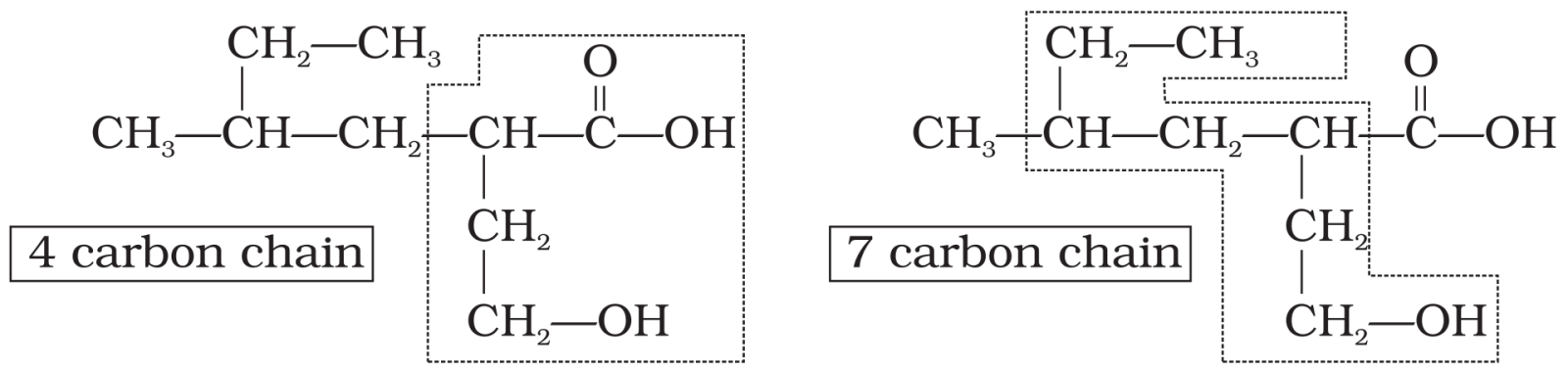
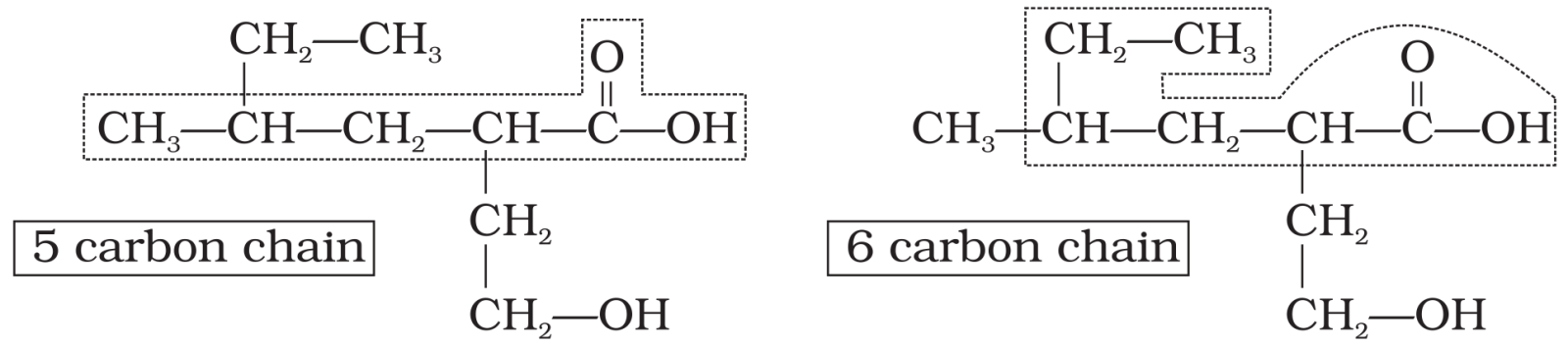
Which of the following selected chains is correct to name the given compound according to IUPAC system.

How many $\sigma$ and $\sigma-$bonds are present in $\text{CH}_2=\text{C}-\text{CH}=\text{CH}_2?$
Enthalpy of combustion of carbon to $CO _2$ is $-393.5 kJ mol ^{-1}$. Calculate the heat released upon formation of 35.2 g of $CO _2$ from carbon and dioxygen gas.
$6.72 \mathrm{dm}^3$ of an unknown gas at STP requires 113.35 J of heat to raise its temperature by $15^{\circ} \mathrm{C}$ at constant volume. Calculate $\mathrm{C}_{\mathrm{V}}, \mathrm{C}_{\mathrm{p}}$, and atomicity of the gas.
For the reaction, $\text{CH}_4(\text{g})+2\text{H}_2\text{S(g)}\rightleftharpoons\text{CS}_2\text{(g)}+4\text{H}_2(\text{g})$ at 1173K, the magnitude of the equilibrium constant, $K_c$​​​​​​​ is 3.6. For each of the following compositions, decide whether reaction mixture is at equilibrium. If it is not, decide in which direction the reaction should go?
  1. $[\text{CH}_4]=1.07\text{M},[\text{H}_2\text{S}]=1.20\text{M},[\text{CS}_2]$
$=0.90\text{M},[\text{H}_2]=1.78\text{M}$
  1. $[\text{CH}_4]=1.45\text{M},[\text{H}_2\text{S}]=1.29\text{M},[\text{CS}_2]$
$=1.25\text{M},[\text{H}_2]=1.75\text{M}$
Calculate the pH of the following solutions:
0.3g of NaOH dissolved in water to give 200mL of solution.
  1. What happens when $H_2O_2$ is passed through alkaline solution of Chromium sulphate? Write the chemical reaction involved.
  2. Compare the structures of $H_2O$ and $H_2O_2$.
Explain the following reactions:
  1. Silicon dioxide is treated with hydrogen fluoride.
  2. Carbon is heated with ZnO.
  3. Hydrated Alumina is treated with aqueous NaOH solution.
Define electron gain enthalpy. What are its units?