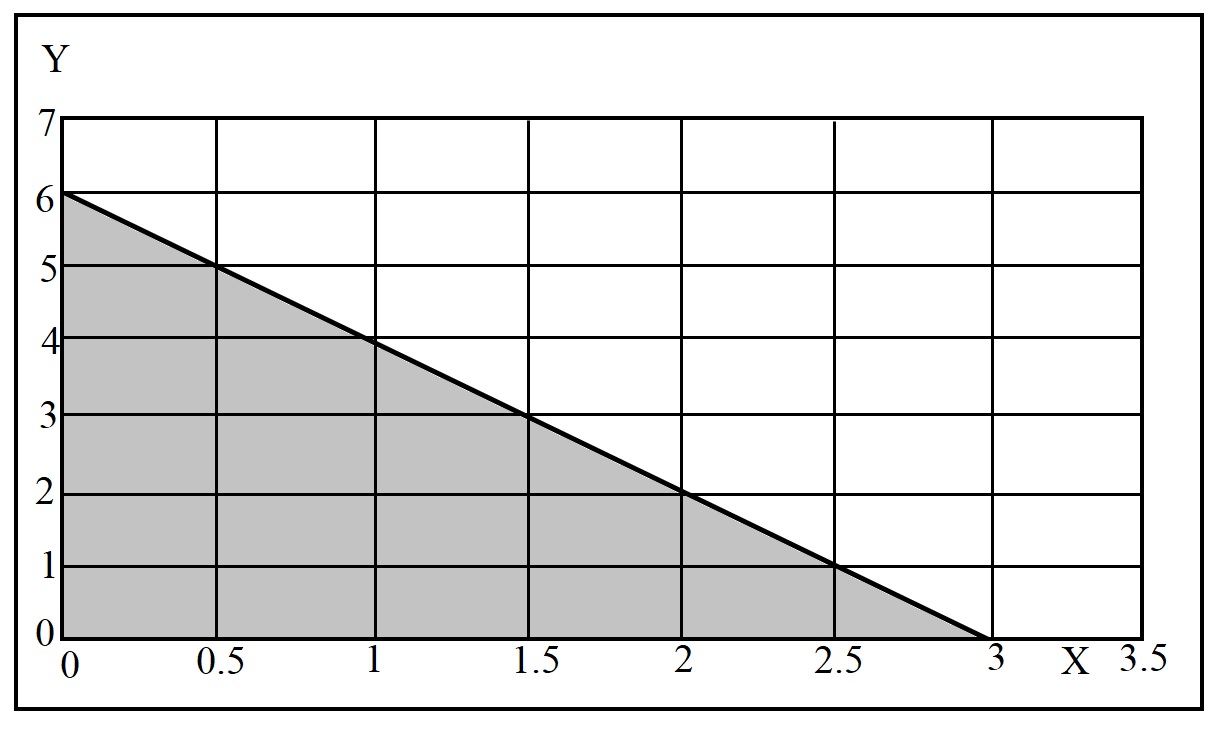
- A$2\text{x}+\text{y}\geq6,\text{x}\geq0,\text{y}\geq0$
- B$2\text{x}+\text{y}>,\text{x}\geq0,\text{y}\geq0$
- C$2\text{x}+\text{y}<6,\text{x}\geq0,\text{y}\geq0$
- D$2\text{x}+\text{y}\leq6,\text{x}\geq0,\text{y}\geq0$

Solution:
Since region involves 1st quadrant so $\text{x}\geq0,\text{y}\geq0.$
Two points on line are $(0,6)$ and$(3,0)$
$\frac{(\text{y}-6)}{(0-6)} =\frac{(\text{x}-0)}{(3-0)}$
$\Rightarrow\frac{(\text{y}-6)}{(-6)}=\frac{\text{x}}{3}$
$\Rightarrow\text{y}-6=2\text{x}\Rightarrow2\text{x}+\text{y}=6$
$2\text{x}+\text{y}\leq6$ since $(0,0) $ should also satisfy.
So, $ 2\text{x}+\text{y}\leq6, \text{x}\geq0, \text{y}\geq0.$
Generate a complete, print-ready paper with questions like this in minutes — across 16+ boards, with answer keys.
The distance between A (-6, 7) and B (-1, -5) is:
Choose the correct answer.
The coordinates of the foot of perpendiculars from the point (2, 3) on the line y = 3x + 4 is given by
$\text{x}=\frac{\text{n}\pi}{7}+\frac{\pi}{3},\ \text{n}\in\text{Z}$