MCQ 11 Mark
The number of the real solutions of the equation x2 -3 |x| + 2 = 0 is:
MCQ 21 Mark
If the roots of the quadratic equation x2 + px + q = 0 are tan 30° and tan 15° then the value of 2 + q - p is:
MCQ 31 Mark
Which of the following statements is correct:
- A
If x > y and b < 0, then bx < by
- B
If x > y, then x > 0 and y < 0
- C
If xy < 0, then x > 0 and y > 0
- D
Answer - If x > y and b < 0, then bx < by
View full question & answer→MCQ 41 Mark
ax + b > 0 is, ___________________?
Answer - linear inequality
Solution:
Since it has highest power of x ‘1’ and has inequality sign so, it is called linear inequality.
It is not numerical inequality as it does not have numbers on both sides of inequality.
It does not have two inequality signs so it is not double inequality.
View full question & answer→MCQ 51 Mark
Choose the correct answer.
If x is a real number and |x| < 3, then:
- A
$\text{x}\geq3$
- B
$-3<\text{x}<3$
- C
$\text{x}\leq-3$
- D
$-3\leq\text{x}\leq3$
Answer - $-3\leq\text{x}\leq3$
Solution:
Given that |x| < 3
⇒ -3 < x < 3 | x | < a
⇒ -a < x < a.
View full question & answer→MCQ 61 Mark
If $−5\leq\frac{5 – 3\text{x}}{2}\leq8, $ then $\text{x}\in$
- A
$\big[\frac{11}{3},5\big]$
- B
$\big[-5,5\big]$
- C
$\big[\frac{-11}{3},\infty\big]$
- D
$\big(-\infty,\infty\big)$
Answer - $\big[\frac{11}{3},5\big]$
View full question & answer→MCQ 71 Mark
If the roots of the equation x2 - bx + c = 0 be two consecutive integers, then b2 - 4c equals:
MCQ 81 Mark
Choose the correct answer.
Solution of a linear inequality in variable x is represented on number line.

- A
$\text{x}\in[-\infty,5) $
- B
$\text{x}\in(-\infty,5) $
- C
$\text{x}\in(5,\infty) $
- D
$\text{x}\in[5,\infty) $
Answer - $\text{x}\in[5,\infty) $
Solution:
The given graph represents all value of x greater than 5 including 5 on the real number line.
So, $\text{x}\in[5,\infty). $
View full question & answer→MCQ 91 Mark
If x is a whole number and $10\text{x}\leq50$ then find solution set of x.
Answer - {0,1, 2, 3, 4, 5}
Solution:
$10\text{x}\leq50$
Dividing by 10 on both sides, $\text{x}\leq\Big(\frac{50}{10}\Big)=\Rightarrow\text{x}\leq5$
Since x is a whole number so x = 0, 1, 2, 3, 4, 5.
View full question & answer→MCQ 101 Mark
The length of a rectangle is three times the breadth.If the minimum perimeter of the rectangle is 160cm, then:
Answer - breadth x ≥ 20cm
Solution:
Let x be the breadth of a rectangle.
So, length = 3x
Given that the minimum perimeter of a rectangle is 160cm.
Thus, $2(3\text{x}+\text{x})\geq160$
$\Rightarrow4\text{x}\geq80$
$\Rightarrow\text{x}\geq20$
View full question & answer→MCQ 111 Mark
Solution of $|3\text{x}+2| <1$ is:
- A
$\big[-1,\frac{-1}{3}\big]$
- B
$\big(\frac{-1}{3},-1\big)$
- C
$\big(-1,\frac{-1}{3}\big)$
- D
$\text{None of these}$
Answer - $\big(-1,\frac{-1}{3}\big)$
View full question & answer→MCQ 121 Mark
If $ 7\text{x} + 3 < 5\text{x} + 9$ then$\text{x}\in$
View full question & answer→MCQ 131 Mark
If − 3x + 17 < -13, then:
Answer - $\text{x}\in(10,\infty)$
Solution:
− 3x + 17 < −13
Subtracting 17 on both sides, we get
⇒ −3x + 17 − 17 < −13 − 17
⇒ −3x < − 30
Dividing −3 on both sides, we get
$\Rightarrow\frac{-3\text{x}}{-3}>\frac{-30}{-3}$
$\Rightarrow\text{x}>10$
$\Rightarrow\text{x}\in(10,\infty)$
View full question & answer→MCQ 141 Mark
The solution set of the inequation $|\text{x}+2|\leq5$ is:
Answer - [-7, 3]
Solution:
$|\text{x}+2|\leq5$
$\Rightarrow-5\leq\text{x}+2\leq5$
$\Rightarrow-5-2\leq\text{x}+2-2\leq5-2$
$\Rightarrow-7\leq\text{x}\leq3$
$\Rightarrow\text{x}\in[-7,3]$
View full question & answer→MCQ 151 Mark
The inequality representing the following graph is: 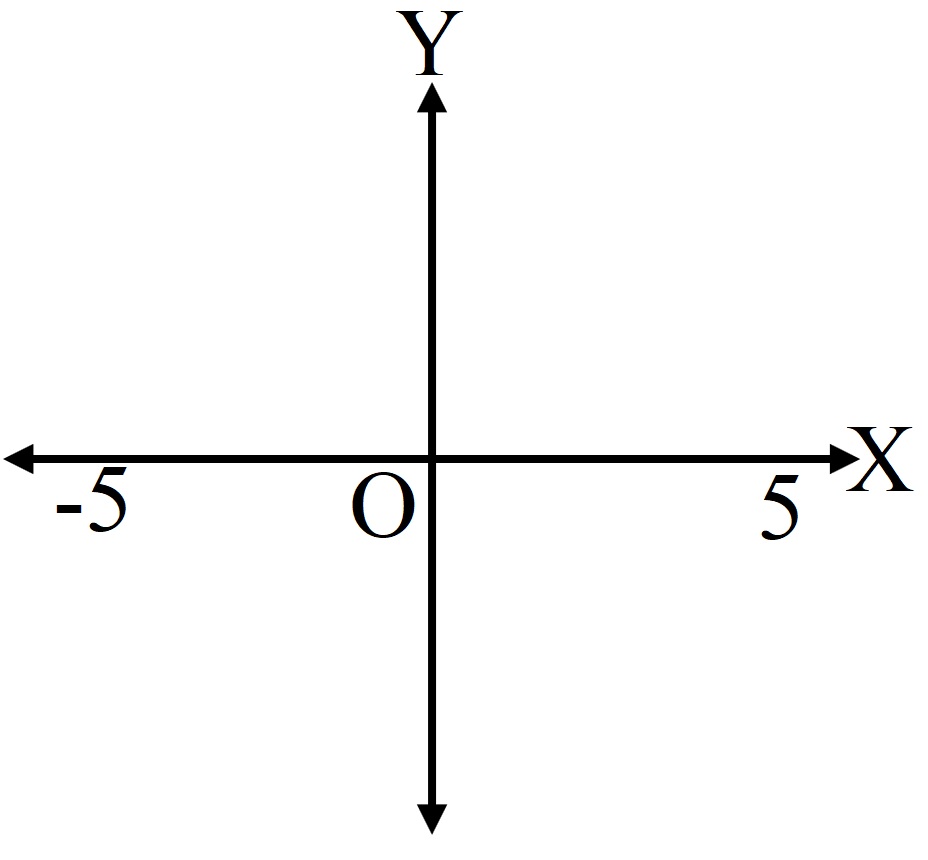
Answer - |x| < 5
Solution:
The given graph shows the shaded region corresponding to x > – 5 and x < 5.
Therefore, by combining the above two inequalities, we get |x| < 5.
View full question & answer→MCQ 161 Mark
Solution of $(\text{x}-1) 2 (\text{x}+4)<0$ is:
- A
$(-\infty, 1)$
- B
$(\infty, –4)$
- C
$(– 1, 4)$
- D
$(1, 4)$
View full question & answer→MCQ 171 Mark
Sum of two rational numbers is, ______ number:
Answer - rational
Solution:
The sum of two rational numbers is a rational number.
Ex: Let two rational numbers are $\frac{1}{2}$ and $\frac{1}{3}$Now, $\frac{1}{2}+\frac{1}{3}=\frac{5}{6}$ which is a rational number:
View full question & answer→MCQ 181 Mark
Ordered pair that satisfy the equation x + y + 1 < 0 is:
Answer - Both (B) and (C)
Solution:
Given inequation is x + y + 1 < 0
From option A, 0 + (-1) + 1 < 0
⇒ 0 < 0 which is false
Hence, (0, -1) is not a solution.
From option B, -2 + 0 + 1 < 0
⇒-1 < 0 which is true
Hence, (-2,0) there is a solution.
From option C, 2 - 4 + 1 < 0
⇒ -1 < 0 which is true.
Hence, (2,-4) is a solution.
View full question & answer→MCQ 191 Mark
Observe the figure given below:

The interval at which the value of x lies is:
- A
$\text{x}\in(-\infty,-2)$
- B
$\text{x}\in(-\infty,-2\big]$
- C
$\text{x}\in(-2,\infty\big]$
- D
$\text{x}\in\big[-2,\infty)$
Answer - $\text{x}\in(-\infty,-2\big]$
Solution:
In the given figure, the circle is filled with dark colour at -2 which means -2 is included and the highlighted is towards the left of -2.
So, $\text{x}\in(-\infty,-2\big]$
View full question & answer→MCQ 201 Mark
Choose the correct answer.
If $|\text{x}+2|\leq9,$ then:
- A
$\text{x}\in(-7,11)$
- B
$\text{x}\in[-11, 7]$
- C
$\text{x}\in[-\infty,-7)\cup(11,\infty) $
- D
$\text{x}\in(-\infty,-7)\cup[11,\infty) $
Answer - $\text{x}\in[-11, 7]$
Solution:
Given that $|\text{x}+2|\leq9$
$\Rightarrow-9\leq\text{x}+2\leq9$
$\Rightarrow-9-2\leq\text{x}\leq9-2[|\text{x}\leq\text{a}|]$
$\Rightarrow-11\leq\text{x}\leq7$
$\Rightarrow\text{x}\in[-11, 7]$
View full question & answer→MCQ 211 Mark
If the expression $\big(\text{mx} – 1 +\frac{1}{\text{x}}\big)$is always nonnegative, then the minimum value of m must be:
- A
$\frac{-1}{2}$
- B
$0$
- C
$\frac{1}{4}$
- D
$\frac{1}{2}$
View full question & answer→MCQ 221 Mark
The solution of the function f(x) = |x| > 0 is:
Answer - R – (0)
Solution:
Given, f(x) = |x| > 0
We know that modulus is non negative quantity.
So, x ∈ R except that x = 0
$\Rightarrow\text{x}\in\text{R}-(0)$
This is the required solution
View full question & answer→MCQ 231 Mark
The point which does not belong to the feasible region of the LPP:
Minimize: $\text{Z}=60\text{x}+10\text{y}$
subject to $3\text{x}+\text{y}\geq18$
$2\text{x}+2\text{y}\geq12$
$\text{x}+2\text{y}\geq10$
$\text{x,y}\geq0$ is.
- A
$(0,8)$
- B
$(4,2)$
- C
$(6,2)$
- D
$(10,0)$
Answer - $(4,2)$
Solution:
We test whether the inequalities are satishfied or not
$(0,8),3(0)+8\geq 83(0)+8\geq8 8\geq8$ is true.
$2(0)+2(8)=16\geq12$ is true.
$0+2(8)=16\geq10$ is true.
$\therefore(0,8)$ is in the feasible region.
$(4,2), 3(4)+2=14\geq 83(4)+2=14\geq8$
$2(4)+2(2)=16\geq12$
$4+2(2)=8\geq10$ is not true.
$\therefore(4,2)$ is not a point in the feasible region.
$\therefore(2)$ is correct.
View full question & answer→MCQ 241 Mark
If $|\text{x} – 1| > 5$ then:
- A
$\text{x}\in(-4,6)$
- B
$\text{x}\in\big[-4,6\big]$
- C
$\text{x}\in(-\infty,-4)\cup(6,\infty)$
- D
$\text{x}\in\big[-\infty,-4)\cup\big[6,\infty)$
Answer - $\text{x}\in(-\infty,-4)\cup(6,\infty)$
Solution:
$|\text{x} – 1| > 5$
$\text{x} – 1 < - 5 $ and $\text{x} – 1 > - 5 $
$\text{x} < -4 $ and $\text{x} > 6 $
$\therefore\text{x}\in(-\infty,-4)\cup(6,\infty)$
View full question & answer→MCQ 251 Mark
Choose the correct answer.
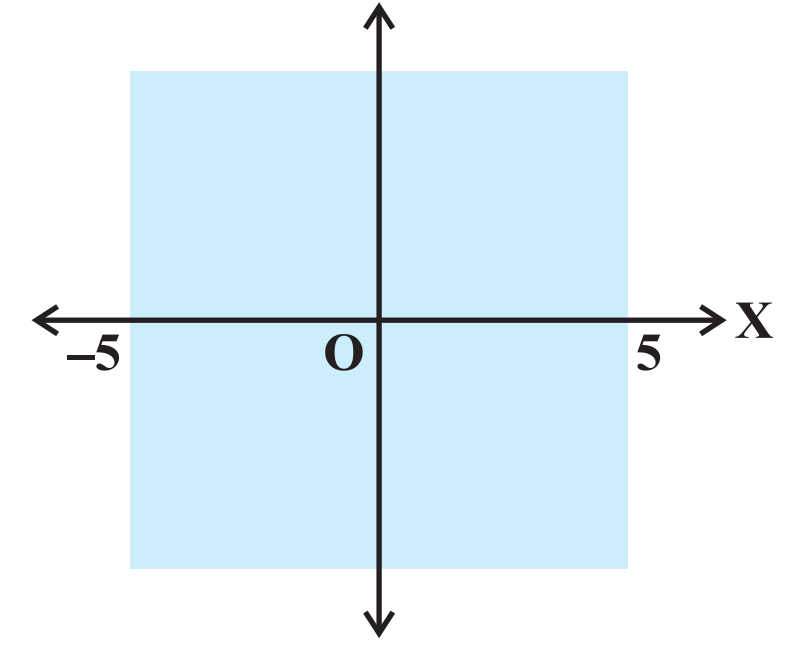
The inequality representing the following graph is:
- A
$|\text{x}|>5$
- B
$|\text{x}|\leq5$
- C
$|\text{x}|>5$
- D
$|\text{x}|\geq5$
Answer - $|\text{x}|>5$
Solution:
The given graph represents
x > -5 and x < 5
Combining the two inequalities
|x| > 5.
View full question & answer→MCQ 261 Mark
If $4\text{x}+3<6\text{x}+7$ then x belongs to the interval:
- A
$(2,\infty)$
- B
$(-2,\infty)$
- C
$(-\infty, 2)$
- D
$(-4,\infty)$
Answer - $(-2,\infty)$
Solution:
$4\text{x}+3<6\text{x}+7$
Subtracting 3 from both sides,
$4\text{x}+3<6\text{x}+7-3$
$\Rightarrow4\text{x}<6\text{x}+4$
Subtracting 6x from both sides,
$4\text{x} – 6\text{x} <6\text{x} + 4 – 6\text{x}$
$\Rightarrow– 2\text{x}<4$ or
$\Rightarrow\text{x}>-2\text{ i.e..,}$ all the real numbers greater than –2, are the solutions of the given inequality.
Hence, the solution set is $(–2,\infty), \text{i}.\text{e}.\text{x}\in(-2,\infty)$
View full question & answer→MCQ 271 Mark
If |x| < -5 then the value of x lies in the interval:
- A
$(-\infty,-5)$
- B
$(\infty,5)$
- C
$(-5,\infty)$
- D
$\text{No Solution}$
Answer - $\text{No Solution}$
Solution:
Given, |x| < -5
Now, LHS ≥ 0 and RHS < 0
Since LHS is non-negative and RHS is negative
So, |x| < -5 does not posses any solution
View full question & answer→MCQ 281 Mark
If$(\text{x} – 1)(\text{x}^2 – 5\text{x} + 7)<(\text{x} – 1), $ then x belongs to:
- A
$\big(1, 2\big)\cup\big(3,\infty\big)$
- B
$\big(2, 3\big)$
- C
$\big(-\infty,1)\cup\big(2, 3\big)$
- D
$\text{None of these}$
Answer - $\big(-\infty,1)\cup\big(2, 3\big)$
View full question & answer→MCQ 291 Mark
The value of a for which one root of the quadratic equation $(\text{a}^2-5\text{a}+3) \text{x}^2+3\text{a}-1)\text{x}+2$ is twice as large as the other, is:
- A
$\frac{2}{3}$
- B
$\frac{-2}{3}$
- C
$\frac{1}{3}$
- D
$\frac{-1}{3}$
View full question & answer→MCQ 301 Mark
The linear inequality representing the solution set given in Fig. is:
- A
$\text{|x|}<5$
- B
$\text{|x|}>5$
- C
$\text{|x|}\geq5$
- D
$\text{|x|}\geq5$ 
Answer - $\text{x}\in[-11,7]$
Solution:
As according to the graph,
x lies between $(-\infty,-5]$ and $[5,\infty)$
$\Rightarrow\text{x}\geq5$ or $\text{x}\leq-5$
$\Rightarrow|\text{x}|\geq5$
View full question & answer→MCQ 311 Mark
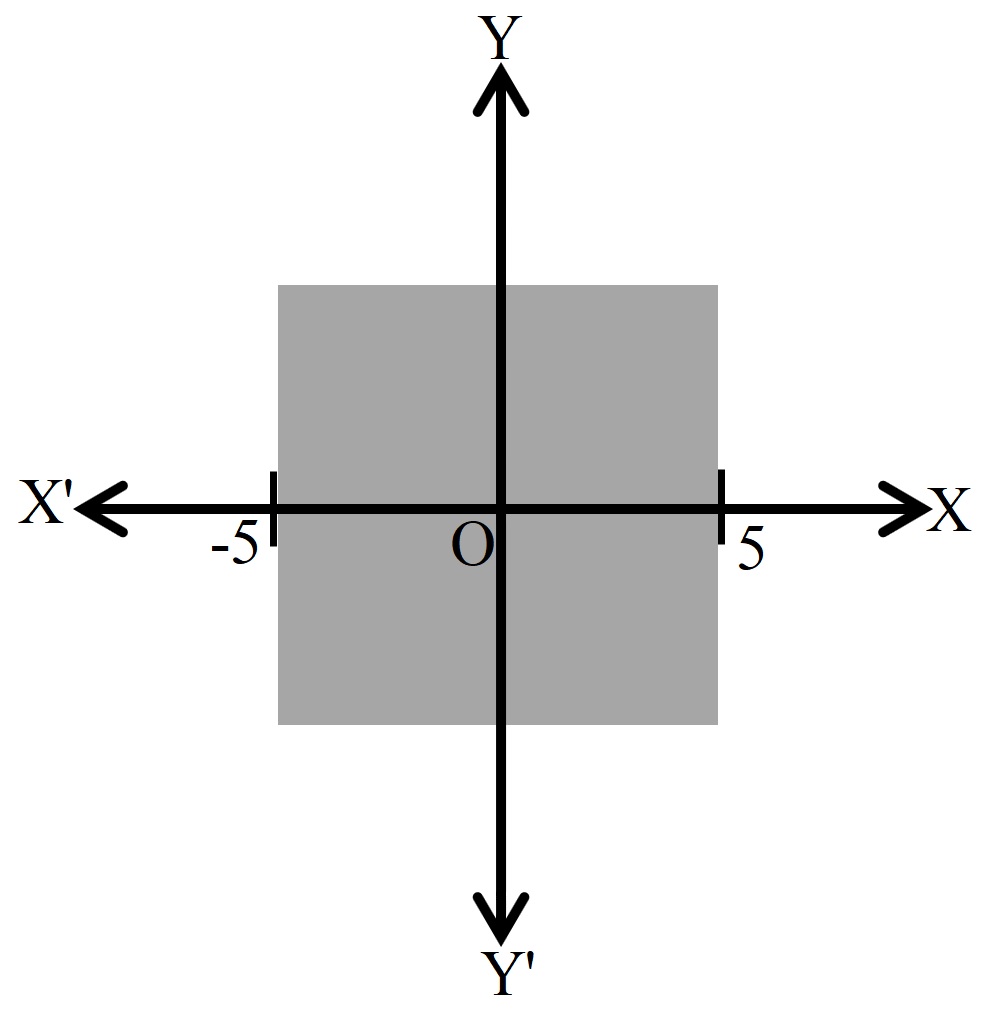
The inequality representing the following graph is:
- A
$|\text{x}|<5$
- B
$|\text{x}|\leq5$
- C
$|\text{x}|>5$
- D
$|\text{x}|\geq5$
View full question & answer→MCQ 321 Mark
Solve: $ 1\leq|\text{x} – 1|\leq3$
Answer - $\big[-2,0\big]\cup\big[2,4\big]$
Solution:
Given, $ 1\leq|\text{x} – 1|\leq3$
$\Rightarrow-3\leq(\text{x} – 1)\leq-1 $ or $1\leq(\text{x}-1)\leq3$
i.e. the distance covered is between 1 unit to 3 unit.
$\Rightarrow-2\leq \text{x}\leq0$ or $2\leq\text{x}\leq4$
Hence, the solution set of the given inequality is.
$\text{x}\in\big[-2, 0\big]\cup\big[2, 4\big]$
View full question & answer→MCQ 331 Mark
Given that x, y and b are real numbers and x < y, b < 0, then:
- A
$\frac{\text{x}}{\text{b}}<\frac{\text{y}}{\text{b}}$
- B
$\frac{\text{x}}{\text{b}}\leq\frac{\text{y}}{\text{b}}$
- C
$\frac{\text{x}}{\text{b}}>\frac{\text{y}}{\text{b}}$
- D
$\frac{\text{x}}{\text{b}}\geq\frac{\text{y}}{\text{b}}$
Answer - $\frac{\text{x}}{\text{b}}<\frac{\text{y}}{\text{b}}$
Solution:
Given that x, y and b are real numbers and x < y, b < 0.
Consider, x < y
Divide both sides of the inequality by “b”
$\frac{\text{x}}{\text{b}}<\frac{\text{y}}{\text{b}}(\text{since, b<0})$
View full question & answer→MCQ 341 Mark
Solution of $\frac{\text{x}-7}{\text{x}+3}>2$ is:
- A
$(– 3,\infty)$
- B
$\big(-\infty, –13\big)$
- C
$(-13, –3)$
- D
$(– 13, 3)$
View full question & answer→MCQ 351 Mark
Solution of 2x – 1 = |x + 7| is:
MCQ 361 Mark
Find all pairs of consecutive odd positive integers both of which are smaller than 8 such that their sum is more than 10.
Answer - (5, 7)
Solution:
Let two numbers be x and x + 2.
x + x + 2 > 10 ⇒ 2x > 8 ⇒ x > 4 and x < 8 and x + 2 < 8 ⇒ x < 6.
4 < x < 6 ⇒ x can be 5.
For x = 5, x + 2 = 7
So, Pairs of odd consecutive positive integers are (5, 7).
View full question & answer→MCQ 371 Mark
If both the roots of the quadratic equation $\text{x}^2 -2\text{kx}+\text{k}^2-5=0 $ are less than 5, than k lies in the interval:
- A
$\big[4,5\big]$
- B
$\big(-\infty,4\big)$
- C
$\big(6,\infty\big)$
- D
$\big(5,6\big]$
View full question & answer→MCQ 381 Mark
Given that x, y and b are real numbers and x < y, b > 0, then:
- A
$\frac{\text{x}}{\text{b}}<\frac{\text{y}}{\text{b}}$
- B
$\frac{\text{x}}{\text{b}}\leq\frac{\text{y}}{\text{b}}$
- C
$\frac{\text{x}}{\text{b}}>\frac{\text{y}}{\text{b}}$
- D
$\frac{\text{x}}{\text{b}}\geq\frac{\text{y}}{\text{b}}$
Answer - $\frac{\text{x}}{\text{b}}<\frac{\text{y}}{\text{b}}$
Solution:
Given that x, y and b are real numbers and x < y, b > 0.
Both sides of an inequality can be multiplied or divided by the same positive number.
$\therefore\frac{\text{x}}{\text{b}}<\frac{\text{y}}{\text{b}}$
View full question & answer→MCQ 391 Mark
If – 3x + 17 < – 13, then:
- A
$\text{x}\in(10,\infty)$
- B
$\text{x}\in\big[10,\infty)$
- C
$\text{x}\in(-\infty,10\big]$
- D
$\text{x}\in\big[-10,10)$
Answer - $\text{x}\in(10,\infty)$
Solution:
Given,
-3x + 17 < -13
Subtracting 17 from both sides,
-3x + 17 – 17 < -13 – 17
$\Rightarrow$ -3x < -30
$\Rightarrow$ x > 10 (since the division by negative number inverts the inequality sign)
$\Rightarrow\text{x}\in(10,\infty)$
View full question & answer→MCQ 401 Mark
A pack of coffee powder contains a mixture of x gms of coffee and y gms of choco. The amount of coffee powder is greater than that of chocolate and each pack weights at least 10g. Which of the followinginequalities describe the given condition?
Answer - $\text{x}+\text{y}\geq10$
Solution:
The coffee powder is greater than choco.
hence, $\text{x}>\text{y}$
each pack is at least 10gm.
View full question & answer→MCQ 411 Mark
Solution of $|3-\text{x}| = 3-\text{x} $ is:
- A
$\text{x}<3$
- B
$\text{x}>3$
- C
$\text{x}\geq3$
- D
$\text{x}\leq3$
View full question & answer→MCQ 421 Mark
If $–8\leq5\text{x} – 3<7,$ then $\text{x}\in$
- A
$\big(–1, 2\big)$
- B
$\big[–1, 2\big)$
- C
$\big[–2,\infty\big)$
- D
$\big[-2,0\big)$
View full question & answer→MCQ 431 Mark
If Ram has x rupees and he pay 40 rupees to shopkeeper then find range of x if amount of money left with Ram is at least 10 rupees is given by inequation, ___?
Answer - x ≥ 50
Solution:
Amount left is at least 10 rupees i.e.amount left ≥ 10.
x - 40 ≥ 10 ⇒ x ≥ 50.
View full question & answer→MCQ 441 Mark
Consider the linear inequations and solve them graphically:
$3\text{x−y}-2>0,\text{x+y}\leq4:\text{x}>0\text{y}\geq0$ Which of the following points belong to the feasible solution region?
- A
$\Big(\frac{1}{2},0\Big)$
- B
$\Big(\frac{1}{2},\frac{1}{2}\Big)$
- C
$\Big(\frac{3}{2},\frac{5}{2}\Big)$
- D
Answer - $\text{None of the above }$
View full question & answer→MCQ 451 Mark
Choose the correct answer.
If |x - 1| > 5, then:
- A
$\text{x}\in(-4, 6)$
- B
$\text{x}\in[-4,6]$
- C
$\text{x}\in[-\infty,-4)\cup(6,\infty) $
- D
$\text{x}\in[-\infty,-4)\cup[6,\infty) $
Answer - $\text{x}\in[-\infty,-4)\cup(6,\infty) $
Solution:
Given that |x - 1| > 5
⇒ (x - 1) < -5 or (x - 1) > 5
⇒ x < -5 + 1 or x > 5 + 1
⇒ x < -4 or x > 6
$\Rightarrow\text{x}\in[-\infty,-4)\cup(6,\infty) $
View full question & answer→MCQ 461 Mark
Solving $ – 8 \leq 5\text{x} – 3<7, $ we get:
Answer - $ –1\leq\text{x}<2$
Solution:
Given,
$-8\leq5\text{x}-3$ and $5\text{x}-3<7$
Let us solve these two inequalities simultaneously.
$-8\leq5\text{x}-3$ and $5\text{x}-3<7$ can be written as:
$– 8\leq5\text{x} –3 < 7$
Adding 3, we get
$– 8 + 3\leq5\text{x}-3+3<7+3$
$–5\leq5\text{x}<10$
Dividing by 5, we get
$–1\leq\text{x}<2$
View full question & answer→MCQ 471 Mark
If x is a positive integer and 20 x < 100 then find solution set of x.
Answer - (1, 2, 3, 4)
Solution:
$20\text{x}<100$
Dividing by 20 on both sides, $\text{x}<\Big(\frac{100}{20}\Big)\Rightarrow\text{x}<5$
Since x is a positive integer so x = 1, 2, 3, 4.
View full question & answer→MCQ 481 Mark
If x2 < 4 then the value of x is:
Answer - (-2, 2)
Solution:
Given, x2< 4
⇒ x2 – 4 < 0
⇒ (x – 2) × (x + 2) < 0
⇒ -2 < x < 2
⇒ x ∈ (-2, 2)
View full question & answer→MCQ 491 Mark
Solve: $\frac{-1}{(|\text{x}| – 2)}\geq1$ where $\text{x}\in\text{R}, \text{x}\neq\pm2$
- A
$(-2, -1)$
- B
$(-2, 2)$
- C
$(-2, -1)\cup(1, 2)$
- D
$\text{None of these}$
Answer - $(-2, -1)\cup(1, 2)$
Solution:
Given, $\frac{-1}{(|\text{x}| – 2)}\geq1$
$\Rightarrow\frac{-1}{(|\text{x}|-2) -1}\geq0$
$\Rightarrow\frac{-1 – (|\text{x}| – 2)}{(|\text{x}| – 2)}\geq0$
$\Rightarrow\frac{1 – |\text{x}|}{(|\text{x}| – 2)}\geq0$
$\Rightarrow\frac{-(|\text{x}| – 1)}{(|\text{x}| – 2)}\geq0$
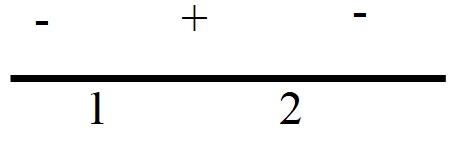
Using number line rule:
$1\leq |\text{x}|<2$
$\Rightarrow\text{x}\in(-2, -1)\cup(1, 2)$
View full question & answer→MCQ 501 Mark
Choose the correct answer. Solution of a linear inequality in variable x is represented on number line.

- A
$\text{x}\in\big(-\infty,-2\big)$
- B
$\text{x}\in\big[\infty,-2\big]$
- C
$\text{x}\in\big(-2,-\infty\big)$
- D
$\text{x}\in\big(-2,-\infty\big)$
Answer - $\text{x}\in\big[\infty,-2\big]$
Solution:
The given graph has all real values of x greater than and equal to -2.
So, $\text{x}\in\big[\infty,-2\big]$
View full question & answer→MCQ 511 Mark
Rahul obtained 20 and 25 marks in first two tests.Find the minimum marks he should get in the third test to have an average of at least 30 marks.
Answer - 45
Solution:
Average is at least 30 marks.
Let x be the marks in $3^\text{rd}$ test.
Average $=\frac{(20+25+\text{x})}{3}\geq30$
$\Rightarrow45+\text{x}\geq90\Rightarrow\text{x}\geq90-45\Rightarrow\text{x}\geq45.$
Minimum marks in $3^\text{rd}$ test should be 45.
View full question & answer→MCQ 521 Mark
If $|\text{x}| = -5$ then the value of x lies in the interval:
- A
$(-5,\infty)$
- B
$(5,\infty)$
- C
$(\infty,-5)$
- D
$\text{No Solution}$
Answer - $\text{No Solution}$
Solution:
Given, |x| = -5
Since |x| is always positive or zero.
So, it can not be negative.
Hence, given inequality has no solution.
View full question & answer→MCQ 531 Mark
If $7\text{x}+3<5\text{x}+9$ then $\text{x}\in$
View full question & answer→MCQ 541 Mark
If $-2<2\text{x}-1<2$ then the value of x lies in the interval:
- A
$\Big(\frac{1}{2},\frac{3}{2}\Big)$
- B
$\Big(\frac{-1}{2},\frac{3}{2}\Big)$
- C
$\Big(\frac{3}{2},\frac{1}{2}\Big)$
- D
$\Big(\frac{3}{2},\frac{-1}{2}\Big)$
Answer - $\Big(\frac{-1}{2},\frac{3}{2}\Big)$
Solution:
Given, $-2<2\text{x}-1<2$
$\Rightarrow2+1< 2\text{x}<2+1$
$\Rightarrow-1<2\text{x}<3$
$\Rightarrow\frac{-1}{2}<\text{x}<\frac{3}{2}$
$\Rightarrow\text{x}\in\Big(\frac{-1}{2},\frac{3}{2}\Big)$
View full question & answer→MCQ 551 Mark
All the values of m for which both roots of the equation x2 -2mx + m2 -1 = 0 are greater than -2
but less than 4 lie in the interval:
MCQ 561 Mark
The marks obtained by a student of Class XI in first and second terminal examination are 62 and 48, respectively.Find the minimum marks he should get in the annual examination to have an average of at least 60 marks.
MCQ 571 Mark
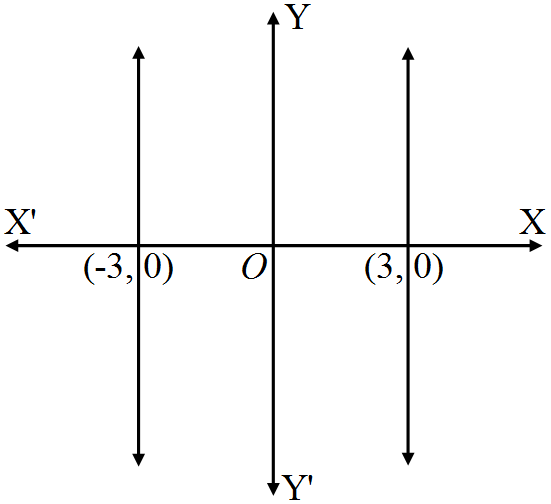
The inequality representing the following graph is:
- A
$\text{|x|}<3$
- B
$\text{|x|}\leq3$
- C
$\text{|x|}>3$
- D
$\text{|x|}\geq3$
Answer - $\text{|x|}\leq3$
Solution:
As according to the graph,
x lies between −3 and 3
$\Rightarrow-3\leq\text{x}\leq3$
$\Rightarrow|\text{x}|\leq3$
View full question & answer→MCQ 581 Mark
The quantity of A and B in one day for which profit will be maximum is:
MCQ 591 Mark
Choose the correct answer.
Given that x, y and b are real numbers and x < y, b < 0, then:
- A
$\frac{\text{x}}{\text{b}}<\frac{\text{y}}{\text{b}}$
- B
$\frac{\text{x}}{\text{b}}\leq\frac{\text{y}}{\text{b}}$
- C
$\frac{\text{x}}{\text{b}}>\frac{\text{y}}{\text{b}}$
- D
$\frac{\text{x}}{\text{b}}\geq\frac{\text{y}}{\text{b}}$
Answer - $\frac{\text{x}}{\text{b}}>\frac{\text{y}}{\text{b}}$
Solution:
Given that x < y, b < 0
$\Rightarrow\frac{\text{x}}{\text{b}}>\frac{\text{y}}{\text{b}},\text{b}<0$
View full question & answer→MCQ 601 Mark
If $\frac{\text{lx}-2\text{l}}{\text{x}-2}\geq0$ then, $\text{x}\in$
- A
$\big[2,\infty\big)$
- B
$\big(2,\infty\big)$
- C
$\big(\infty, 2\big)$
- D
$\big(-\infty, 2\big]$
View full question & answer→MCQ 611 Mark
The sum of four numbers in AP is 20.The numbers are such that the ratio of the product of first and fourth is to the product of second and third as 2 : 3.The greatest number is:
Answer - 8
Solution:
Let the four terms be a − 3d, a − d, a + d, and a + 3d with common difference 2d.sum = 4a = 20a = 5a = 5
$\frac{\text{(a-3d)}\text{(a+3d)}}{\text{(a-d)}\text{(a+d)}}=\frac{2}{3}$
$\frac{25-9\text{d}^2}{25-\text{d}^2}=\frac{2}{3}$
$\text{d}^2=1\Rightarrow\text{d}=1$
Largest term = a + 3d = 5 + 3(1) = 8
View full question & answer→MCQ 621 Mark
The set of values of x which satisfy the inequations $5\text{x}+2<3\text{x}+8$ and $\text{x}+\frac{\text{x}+2}{\text{x}-1}<4$ is:
- A
$(-\infty, 1)$
- B
$(2, 3)$
- C
$\big(-\infty, 3)$
- D
$(-\infty, 1)\cup(2, 3)$
View full question & answer→MCQ 631 Mark
If $\frac{\big[\text{x} – 7\big]}{(\text{x} – 7)\geq 0}$ then:
- A
$\text{x}\in\big[7,\infty)$
- B
$\text{x}\in(7,\infty)$
- C
$\text{x}\in(\infty, 7)$
- D
$\text{x}\in(-\infty, 7)$
Answer - $\text{x}\in(7,\infty)$
Solution:
Given,
$\frac{|\text{x}-7|}{(\text{x}-7)}\geq0$
This is possible when $\text{x}-7\geq0,$ and $\text{x}-7\neq0.$
Here, $\text{x}\geq7$ but $\text{x}\neq7$
Therefore, $\text{x}> 7, \text{i}.\text{e}. \text{x}\in(7,\infty).$
View full question & answer→MCQ 641 Mark
Choose the correct answer.
If – 3x + 17 < – 13, then:
- A
$\text{x}\in(10, \infty)$
- B
$\text{x}\in[10, \infty)$
- C
$\text{x}\in(-\infty\text{j},10]$
- D
$\text{x}\in[-10, 10)$
Answer - $\text{x}\in(10, \infty)$
Solution:
Given that - 3x + 17 < - 13
⇒ - 3x < - 17 - 13
⇒ -3x < - 30
⇒ 3x > 30
⇒ x > 10
$\Rightarrow\text{x}\in(10, \infty)$
View full question & answer→MCQ 651 Mark
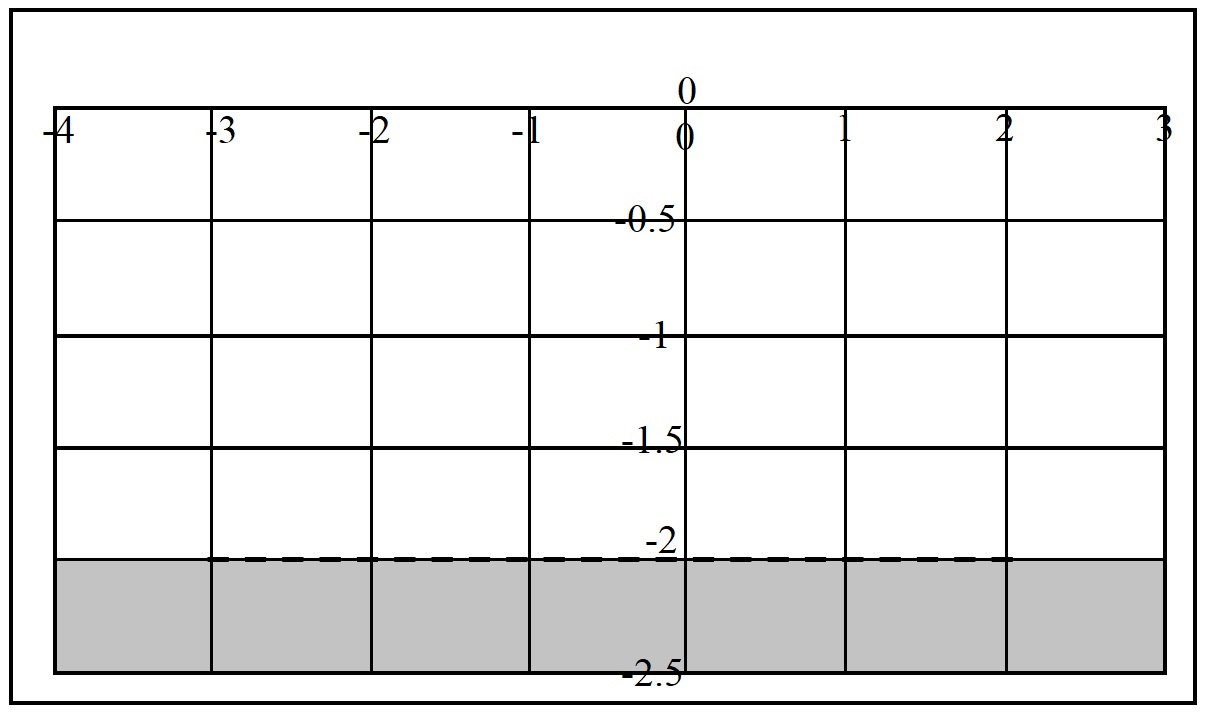
y < -2 involves region are, ____________?
- A
- B
- C
above complete line y = -2
- D
below complete line y = -2
Answer - below dotted line y = -2
Solution:
y < -2 does not satisfy (0, 0) so, region is below y = -2.
Since only inequality sign given, so dotted line y = -2.
View full question & answer→MCQ 661 Mark
Solve: $2\text{x}+1>3$
Answer - $\big(1,\infty\big)$
Solution:
Given, $2\text{x}+1>3$
$\Rightarrow2\text{x}>3-1$
$\Rightarrow2\text{x}>2$
$\Rightarrow\text{x}>1$
$\Rightarrow\text{x}\in\big(1,\infty\big)$
View full question & answer→MCQ 671 Mark
Value of i(iota) is, ____________?
- A
$-1$
- B
$1$
- C
$(-1)^\frac{1}{2}$
- D
$(-1)^\frac{1}{4}$
Answer - $(-1)^\frac{1}{2}$
Solution:
Explanation: Iota is used to denote complex number.
The value of i (iota) is $\sqrt{-1}\text{ i.e.}(-1)^\frac{1}{2}$
View full question & answer→MCQ 681 Mark
Find the number of real numbers in the solution set of following $\frac{2\text{x}}{5}+1<-3.$
Answer - Infinite
Solution:
$\frac{2\text{x}}{5}+1<-3.$
$\frac{2\text{x}}{5}<-3-1$
$2\text{x}<-4\times5$
$\text{x}<-\frac{20}{2}$
$\text{x}<-10$
As we know the number of rational numbers on either side of a number on the number line is infinite.
$\therefore$ set x = (infinite number of integers which are < - 10)
View full question & answer→MCQ 691 Mark
The graph of the inequalities x ≥ 0, y ≥ 0, 2x + y + 6 ≤ 0 is:
Answer - {}
Solution:
Given inequalities x ≥ 0, y ≥ 0, 2x + y + 6 ≤ 0
Now take x = 0, y = 0 and 2x + y + 6 = 0
when x = 0, y = -6
when y = 0, x = -3
So, the points are A(0, 0), B(0, -6) and C(-3, 0)
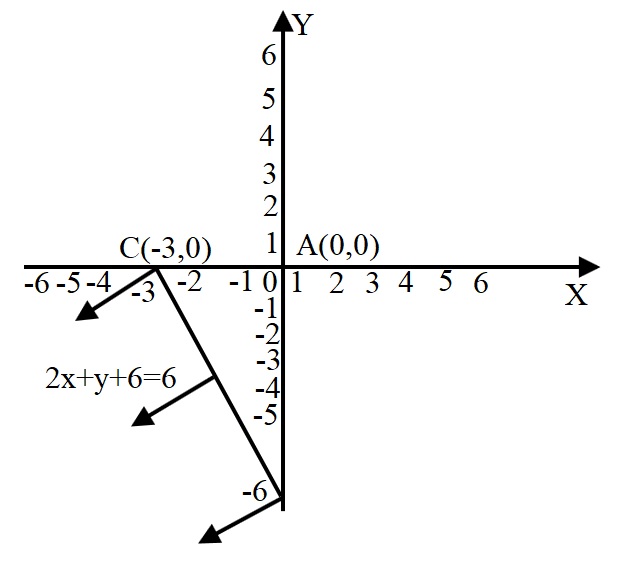
Since region is outside from the line 2x + y + 6 = 0
So, it does not represent any figure.
View full question & answer→MCQ 701 Mark
The solution of the inequality $\frac{3(\text{x}-2)}{5}\geq\frac{5(2-\text{x})}{3}$ is:
- A
$\text{x}\in(2,\infty)$
- B
$\text{x}\in\big[-2,\infty)$
- C
$\text{x}\in\big[\infty,2)$
- D
$\text{x}\in\big[2,\infty)$
Answer - $\text{x}\in\big[2,\infty)$
Solution:
Given, $\frac{3(\text{x}-2)}{5}\geq\frac{5(2-\text{x})}{3}$
$\Rightarrow3(\text{x} – 2)\times3\geq5(2 – \text{x})\times5$
$\Rightarrow9(\text{x} – 2)\geq25(2 – \text{x})$
$\Rightarrow9\text{x} – 18\geq50 – 25\text{x}$
$\Rightarrow9\text{x} – 18 + 25\text{x}\geq50$
$\Rightarrow34\text{x}-18\geq50$
$\Rightarrow34\text{x}\geq50+18$
$\Rightarrow34\geq68$
$\Rightarrow\text{x}\geq\frac{68}{34}$
$\Rightarrow\text{x}\geq2$
$\Rightarrow\text{x}\in\big[2,\infty)$
View full question & answer→MCQ 711 Mark
Solution of $\bigg|\text{x}+\frac{1}{\text{x}}\bigg|<4 $ is:
- A
$\big(2-3, 2+3\big)\cup\big(-2-3-2+3\big)$
- B
$\text{R}\big(2-3, 2+3\big)$
- C
$\text{R}-\big(-2-3-2 + 3\big)$
- D
$\text{None of these}$
Answer - $\big(2-3, 2+3\big)\cup\big(-2-3-2+3\big)$
View full question & answer→MCQ 721 Mark
If $\text{|x}+2|\leq9,$ then:
- A
$\text{x}\in(-7,11)$
- B
$\text{x}\in[-11,7]$
- C
$\text{x}\in(-\infty,-7)\cup(11,\infty)$
- D
$\text{x}\in(-\infty,-7)\cup[11,\infty)$
Answer - $\text{x}\in[-11,7]$
Solution:
$|\text{x}+2|\leq9$
$\Rightarrow-9\leq\text{x}+2\leq9$
$\Rightarrow-9-2\leq\text{x}+2-2\leq9-2$
$\Rightarrow-11\leq\text{x}\leq7$
$\Rightarrow\text{x}\in[-11,7]$
View full question & answer→MCQ 731 Mark
If $–3\text{x}+17<-13, $ then:
- A
$\text{x}\in\big(10,\infty\big)$
- B
$\text{x}\in\big[10,\infty\big)$
- C
$\text{x}\in\big(-\infty,10\big)$
- D
$\text{x}\in\big[-10,10\big)$
Answer - $\text{x}\in\big(10,\infty\big)$
View full question & answer→MCQ 741 Mark
If x > 7 then which is impossible?
Answer - x < 6
Solution:
x > 7 and 7 > 4 ⇒ x > 7 > 4 => x > 4.
If x > 7 then x cannot be less than 6.
If x = 11 then x > 7 and x > 9.
If x = 11 then x > 7 and x < 14.
View full question & answer→MCQ 751 Mark
Solution of $|\text{x} – 1|\geq|\text{x}-3| $ is:
- A
$\text{x}\leq2$
- B
$\text{x}\geq2$
- C
$\big[1, 3\big]$
- D
$\text{None of these}$
View full question & answer→MCQ 761 Mark
If the equations $\text{x}^2+2\text{x}+3=0 $ and $\text{ax}^2+\text{bx}+\text{c}=0,\text{abc}\in\text{R},$ I have a common root, then a : b : c is.
View full question & answer→MCQ 771 Mark
If the cube roots of unity are $1,\omega$ and $\omega^2$, then the roots of the equation $(\text{x} -1)3+8=0,$ are:
Answer - $-1,1+2\omega,1-2\omega^2$
View full question & answer→MCQ 781 Mark
Number of integral solutions satisfy inequality $|\text{x-3}|-|2\text{x}+5|\geq|\text{x}+8|$
View full question & answer→MCQ 791 Mark
Consider the linear inequations and solve them graphically:
$3\text{x−y}-2>0,\text{x+y}\leq4:\text{x}>0\text{y}\geq0$ Which of the following points belong to the feasible solution region?
- A
$\Big(\frac{1}{2},0\Big)$
- B
$\Big(\frac{1}{2},\frac{1}{2}\Big)$
- C
$\Big(\frac{3}{2},\frac{5}{2}\Big)$
- D
Answer - $\text{None of the above }$
View full question & answer→MCQ 801 Mark
The inequality $\frac{2}{\text{x}}<3$ is true, when x belongs to:
- A
$\big[\frac{2}{3},\infty\big) $
- B
$\big(-\infty,\frac{2}{3}\big)$
- C
$\big(-\infty ,0\big)\cup\big(\frac{2}{3},\infty\big) $
- D
$\text{None of these}$
Answer - $\big(-\infty ,0\big)\cup\big(\frac{2}{3},\infty\big) $
View full question & answer→MCQ 811 Mark
Choose the correct answer.
x and b are real numbers. If b > 0 and |x| > b, then:
- A
$\text{x}\in(-\text{b},\infty)$
- B
$\text{x}\in(\infty,-\text{b})$
- C
$\text{x}\in(-\text{b},\text{b})$
- D
$\text{x}\in(-\infty,-\text{b})\cup(\text{b},\infty)$
Answer - $\text{x}\in(-\infty,-\text{b})\cup(\text{b,}\infty)$
Solution:
Given that |x| > b, b > 0
⇒ x < -b or x > b
$\Rightarrow\text{x}\in(-\infty,-\text{b})\cup(\text{b,}\infty)$
View full question & answer→MCQ 821 Mark
Solution of $0<|3\text{x}+1\big|<\frac{1}{3} $ is:
Answer - $\bigg(\frac{-4}{9},\frac{2}{9}\bigg)-\bigg(\frac{-1}{3}\bigg)$
View full question & answer→MCQ 831 Mark
If the sum of the roots of the quadratic equation $ \text{ax}^2+\text{bx}+\text{c}=0$ is equal to the sum of the squares of their reciprocals, then $\frac{\text{a}}{\text{c}}, \frac{\text{b}}{\text{a}}$ and $\frac{\text{c}}{\text{b}}$ are in:
- A
- B
- C
- D
arithmetico-geometric progression
View full question & answer→MCQ 841 Mark
If |x−1| x - 1 > 5, then:
- A
$\text{x}\in(-4,6)$
- B
$\text{x}\in[-4,6]$
- C
$\text{x}\in(-\infty,-4)\cup(6,\infty)$
- D
$\text{x}\in(-\infty,-4)\cup[6,\infty)$
Answer - $\text{x}\in(-\infty,-4)\cup(6,\infty)$
Solution:
|x−1| > 5
⇒ x − 1 > 5 or x − 1 < −5
⇒ x > 5 + 1 or x < −5 + 1
⇒ x > 6 or x < −4
$\Rightarrow\text{x}\in(-\infty,-4)\cup(6,\infty)$
View full question & answer→MCQ 851 Mark
If the equstion $\text{a}_\text{n}\text{x}^\text{n}+\text{a}_\text{n-1}\text{x}^\text{n-1}+...+\text{a}_1\text{x}=0,$
$\text{a}_1\neq0,\text{n}\geq2,$ has positive root $\text{x}=\alpha$ then the eqestions
$\text{na}_\text{n}\text{x}^\text{n-1}+(\text{n-1})\text{a}_\text{n-1}\text{x}^\text{n-2}+...+\text{a}_1=0$ has a positive root, which is:
View full question & answer→MCQ 861 Mark
If $|\text{x}+3|\geq10,$ then:
- A
$\text{x}\in(-12,7]$
- B
$\text{x}\in(-13,7)$
- C
$\text{x}\in(\infty,-13)\cup(7,\infty)$
- D
$\text{x}\in(-\infty,-13]\cup[7,\infty)$
Answer - $\text{x}\in(-\infty,-13]\cup[7,\infty)$
Solution:
$|\text{x}+3|\geq10$
$\Rightarrow\text{x}+3\geq10\text{ or }\text{x}+3;\leq-10$
$\Rightarrow\text{x}\geq10-3\text{ or }\text{x}\leq-10-3$
$\Rightarrow\text{x}\geq7\ \text{or}\ \text{x}\leq-13$
$\Rightarrow\text{x}\in(-\infty,-13)\cup[7,\infty)$
View full question & answer→MCQ 871 Mark
If $|\text{x} – 1|>5,$ then
- A
$\text{x}\in\big(-4, 6\big)$
- B
$\text{x}\in\big[–4, 6\big]$
- C
$\text{x}\in\big(-\infty, –4\big)\cup\big(6,\infty\big)$
- D
$\text{x}\in\big(-\infty, –4\big)\cup\big[6,\infty\big)$
Answer - $\text{x}\in\big(-\infty, –4\big)\cup\big(6,\infty\big)$
View full question & answer→MCQ 881 Mark
If $|3 – 4\text{x}|\geq9, $ then$\text{x}\in$
- A
$\big(-\infty –3\big)\cup\big(3,\infty\big)$
- B
$\big(\infty,\frac{ -3}{2}\big]\cup\big(3 ,\infty\big)$
- C
$\big(−\infty ,\frac{-3}{2}\big]\cup\big(0,\infty\big)$
- D
$\big(-\infty,\frac{-3}{2}\big]\cup\big[3,\infty\big)$
Answer - $\big(-\infty,\frac{-3}{2}\big]\cup\big[3,\infty\big)$
View full question & answer→MCQ 891 Mark
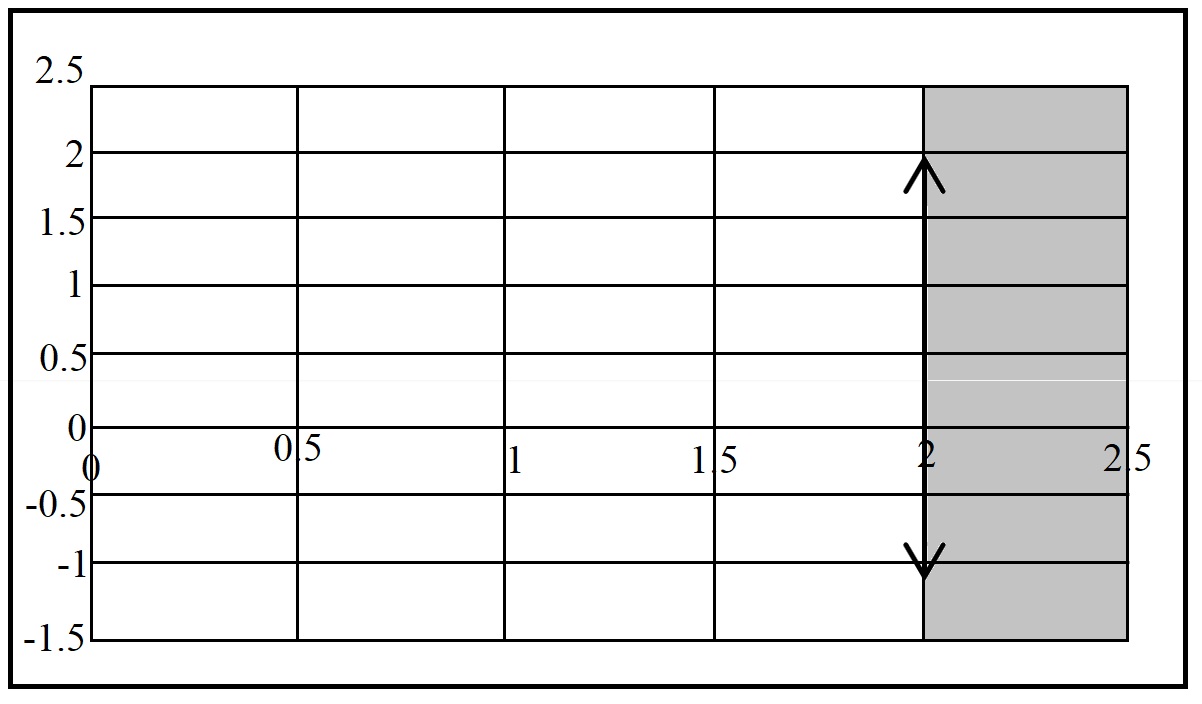
$3\text{x}-6\geq0$ are, ____________?
- A
right side with dotted x = 2
- B
left side with dotted x = 2
- C
right side with complete line x = 2
- D
left side with complete line x = 2
Answer - right side with complete line x = 2
Solution:
$3\text{x}-6\geq0\Rightarrow\text{x}\geq2.$
(0, 0) does not satisfy te equation so region is right side of x = 2 with complete line x = 2 due to presence of equality sign along with inequality sign.
View full question & answer→MCQ 901 Mark
If a is an irrational number which is divisible by b then the number b:
- A
- B
- C
May be rational or irrational
- D
Answer - Must be irrational
Solution:
If a is an irrational number which is divisible by b then the number b must be irrational.
Ex: Let the two irrational numbers are $\sqrt{2}$ and $\sqrt{3}$ Now, $\sqrt{2}\sqrt{3}=\sqrt{\Big(\frac{2}{3}}\Big)$
View full question & answer→MCQ 911 Mark
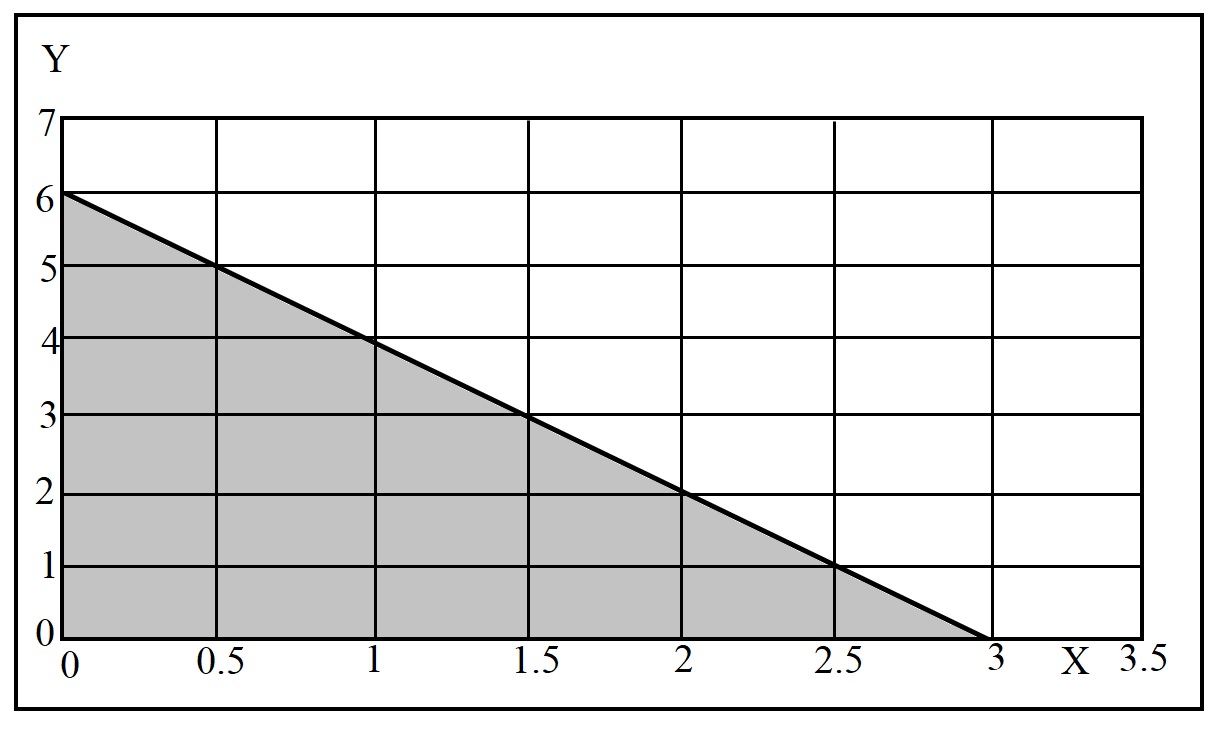
Inequations involved in the given region are____________?
- A
$2\text{x}+\text{y}\geq6,\text{x}\geq0,\text{y}\geq0$
- B
$2\text{x}+\text{y}>,\text{x}\geq0,\text{y}\geq0$
- C
$2\text{x}+\text{y}<6,\text{x}\geq0,\text{y}\geq0$
- D
$2\text{x}+\text{y}\leq6,\text{x}\geq0,\text{y}\geq0$
Answer - $2\text{x}+\text{y}\leq6,\text{x}\geq0,\text{y}\geq0$
Solution:
Since region involves 1st quadrant so $\text{x}\geq0,\text{y}\geq0.$
Two points on line are $(0,6)$ and$(3,0)$
$\frac{(\text{y}-6)}{(0-6)} =\frac{(\text{x}-0)}{(3-0)}$
$\Rightarrow\frac{(\text{y}-6)}{(-6)}=\frac{\text{x}}{3}$
$\Rightarrow\text{y}-6=2\text{x}\Rightarrow2\text{x}+\text{y}=6$
$2\text{x}+\text{y}\leq6$ since $(0,0) $ should also satisfy.
So, $ 2\text{x}+\text{y}\leq6, \text{x}\geq0, \text{y}\geq0.$
View full question & answer→MCQ 921 Mark
If x and a are real numbers such that a > 0 and |x| > a, then:
- A
$\text{x}\in(-\text{a},\infty)$
- B
$\text{x}\in[-\infty,\text{a}]$
- C
$\text{x}\in(-\text{a},\text{a})$
- D
$\text{x}\in(-\infty,-\text{a})\cup(\text{a},\infty)$
Answer - $\text{x}\in(-\infty,-\text{a})\cup(\text{a},\infty)$
Solution:
If x and a are real numbers such that a > 0.
|x| > a
⇒ x > a or x < −a
$\Rightarrow\text{x}\in(-\infty,-\text{a})\cup(\text{a},\infty)$
View full question & answer→MCQ 931 Mark
If $|\text{x} + 2|\leq9,$ then:
- A
$\text{x}\in\big(–7, 11\big)$
- B
$\text{x}\in\big[–11, 7\big]$
- C
$\text{x}\in\big(-\infty, –7\big)\cup\big(11,\infty\big)$
- D
$\text{x}\in\big(-\infty, -7\big)\cup\big[11,\infty\big)$
Answer - $\text{x}\in\big[–11, 7\big]$
View full question & answer→MCQ 941 Mark
x and b are real numbers.If $\text{b}>0$ and $|\text{x}|>\text{b},$ then:
- A
$\text{x}\in\big(–\text{b},\infty\big)$
- B
$\text{x}\in\big(-\infty,\text{b}\big)$
- C
$\text{x}\in\big(–\text{b}, \text{b}\big)$
- D
$\text{x}\in(-\infty, –\text{b}\big)\cup\big(\text{b},\infty\big)$
Answer - $\text{x}\in(-\infty, –\text{b}\big)\cup\big(\text{b},\infty\big)$
View full question & answer→MCQ 951 Mark
If $|\text{x} + 3|\geq10,$ then:
- A
$\text{x}\in(-13,7\big)$
- B
$\text{x}\in(-13,7\big]$
- C
$\text{x}\in(-\infty -13\big]\cup \big[7,\infty)$
- D
$\text{x}\in\big[-\infty -13\big]\cup \big[7,\infty)$
Answer - $\text{x}\in\big[-\infty -13\big]\cup \big[7,\infty)$
Solution:
$|\text{x} + 3|\geq10$
$\Rightarrow\text{x} + 3\leq-10$ or $\text{x}+3\geq10$
$\Rightarrow\text{x}\leq -13 $ or $\text{x}\geq7$
$\Rightarrow\text{x}\in\big[-\infty -13\big]\cup \big[7,\infty)$
View full question & answer→MCQ 961 Mark
x > 5 is, _____________________?
Answer - literal inequality
Solution:
Since a variable ‘x’ is compared with number ‘5’ with inequality sign so it is called literal inequality.
View full question & answer→MCQ 971 Mark
Formulate the equations for the above problem.(x and y are the number of units of A and B manufactured in a day respectively)
- A
$15\text{x}+5\text{y}\leq10:24\text{x}+14\text{y}\geq1000$
- B
$15\text{x}+5\text{y}\leq600:24\text{x}+14\text{y}\geq1000$
- C
$15\text{x}+15\text{y}\leq600:24\text{x}+14\text{y}\geq1000$
- D
$15\text{x}+15\text{y}\leq10:24\text{x}+14\text{y}\geq1000$
Answer - $15\text{x}+5\text{y}\leq600:24\text{x}+14\text{y}\geq1000$
View full question & answer→MCQ 981 Mark
Write the solution of inequality $\frac{1}{5}\bigg(\frac{3\text{x}}{5}+4\bigg)\geq\frac{1}{3}(\text{x}-6).$
Answer - $\text{x}\leq\frac{105}{8}$
Solution:
$\frac{1}{5}\big(\frac{3\text{x}}{5}+4\big)\geq\frac{1}{3}(\text{x}-6).$
$\Rightarrow3\big(\frac{3\text{x}}{5}+4\big)\geq5\big(\text{x}-6\big)$
$\Rightarrow\big(\frac{9\text{x}}{5}+12\big)\geq5\text{x}-6$
$\Rightarrow(30+12)\geq-\frac{9\text{x}}{5}+5\text{x}$
$\Rightarrow42\geq\frac{-9\text{x}+25\text{x}}{5}$
$\Rightarrow42\geq\frac{16\text{x}}{5}$
$\Rightarrow\frac{42\times5}{16}\geq\text{x}$
$\text{x}\leq\frac{105}{8}$
Therefore option (1) is the correct answere.
View full question & answer→MCQ 991 Mark
The quadratic equations x2 - 6x + a = 0 and x2- cx + 6 = 0 have one root in common. The other roots of the first and second equations are integers in the ratio 4 : 3.Then, the common root is:
MCQ 1001 Mark
The solution of the inequality $\frac{\text{x}}{4}>\frac{\text{x}}{2}+1$ will be:
- A
$\text{x}>4$
- B
$\text{x}>-4$
- C
$\text{x}<-4$
- D
$-4 <\text{ x} >4$
Answer - $\text{x}<-4$
Solution:
Given: $\frac{\text{x}}{4}>\frac{\text{x}}{2}+1$
$\Rightarrow\frac{\text{x}}{4}-\frac{\text{x}}{2}>1$
$\Rightarrow\frac{\text{x}-2\text{x}}{4}>1$
$\Rightarrow\frac{\text{-x}}{4}>1$
$\Rightarrow-\text{x}>4$
$\Rightarrow\text{x}<-4$
View full question & answer→MCQ 1011 Mark
What is the solution set for $0<−\frac{\text{x}}{2} < 3$
- A
$(−6, 6)$
- B
$(−6, 0)$
- C
$(0, 6)$
- D
$(-\infty, -6)$
Answer - $(−6, 0)$
Solution
Given: $0<−\frac{\text{x}}{2} < 3$
Multiply by 2 in above inequality (Here 2 is a positive number so the direction of the inequality does not change)
$\Rightarrow0 <-\text{x}<6$
$\Rightarrow−6 <\text{x}<0$
$\therefore\text{x}$ lies in $(−6, 0)$
View full question & answer→MCQ 1021 Mark
Solve the following in equations $\frac{2\text{x}+4}{\text{x}-1}\geq5$
- A
$\big(1,2\big]$
- B
$\big(1,3\big)$
- C
$\big(1,3\big]$
- D
$\big(1,4\big]$
Answer - $\big(1,3\big]$
Solution:
$\frac{2\text{x}+4}{\text{x}-1}\geq5$
$\Rightarrow\frac{2\text{x}+4}{\text{x}-1}-5\geq0$
$\Rightarrow\frac{2\text{x}+4-5(\text{x-1})}{\text{x-1}}\geq0$
$\Rightarrow\frac{2\text{x}+4-\text{5x+5}}{\text{x-1}}\geq0$
$\Rightarrow\frac{9-3\text{x}}{\text{x-1}}\geq0$
$\Rightarrow\frac{-3\text{(x-3)}}{\text{x}-1}\geq0$
Multiplying each side of an inequality by a negative number $\big(\frac{-1}{3}\big)$ reverses the direction of the inequality symbol.
$\Rightarrow\frac{(\text{x}-3)}{\text{x}-1}\leq0$ Here $\text{x}-1\neq0\Rightarrow\text{x}\neq1$
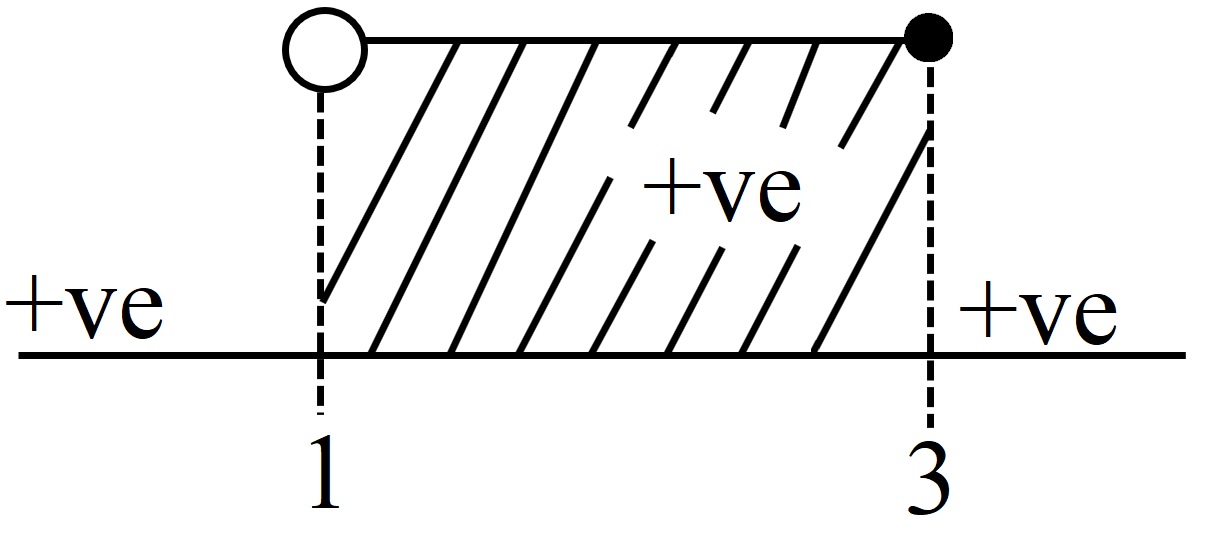
Hence the solution set of the given in equations is $\big(1, 3\big]$
View full question & answer→MCQ 1031 Mark
The length of a rectangle is three times the breadth. If the minimum perimeter of the rectangle is 160cm, then:
MCQ 1041 Mark
Which of the following points lie in the solution set?
MCQ 1051 Mark
If (1 – p) is a root of quadratic equation x2 + px + (1-p) = 0, then its roots are:
MCQ 1061 Mark
The solution of $\Big|\frac{2}{(\text{x} – 4)}\Big|>1$ where $\text{x}\neq4$ is:
- A
$(2, 6)$
- B
$(2, 4)\cup(4, 6)$
- C
$(2, 4)\cup(4,\infty)$
- D
$(-\infty, 4)\cup(4, 6)$
Answer - $(2, 4)\cup(4, 6)$
Solution:
Given,$\Big|\frac{2}{(\text{x} – 4)}\Big|>1$
$\Rightarrow2 > |\text{x} – 4|$
$\Rightarrow |\text{x} – 4|<2$
$\Rightarrow-2<\text{x}-4<2$
$\Rightarrow-2+4 < \text{x} < 2+4$
$\Rightarrow2<\text{x}<6$
$\Rightarrow\text{x}\in(2, 6), $ where $\text{x}\neq4$
$\Rightarrow\text{x}\in(2, 4)\cup(4, 6)$
View full question & answer→MCQ 1071 Mark
A solution is to be kept between $77^\circ$ F and $86^\circ$ F.What is the range in temperature in degree Celsius (C) if the $\frac{\text{Celsius}}{\text{Fahrenheit}}$(F) conversion formula is given by $\text{F}=\frac{9}{5\text{c}}+32^\circ$
- A
$\big[15^\circ, 20^\circ\big]$
- B
$\big[20^\circ, 25^\circ\big]$
- C
$\big[25^\circ, 30^\circ\big]$
- D
$\big[30^\circ, 35^\circ\big]$
Answer - $\big[25^\circ, 30^\circ\big]$
Solution:
$\text{F}=\frac{9}{5\text{c}}+32^\circ$
$\text{C}=\text{F}-32^\circ\times\frac{5}{9}$
$77^\circ\leq\text{F}\leq86^\circ$
$\Rightarrow77^\circ-32^\circ\leq\text{F}-32^\circ\leq86^\circ -32^\circ$
$\Rightarrow45^\circ\leq\text{F}-32^\circ\leq54^\circ$
$\Rightarrow45^\circ\times\frac{5}{9}\leq(\text{F}-32^\circ)\times\frac{5}{9}\leq54^\circ\times\frac{5}{9}$
$\Rightarrow25^\circ\leq\text{C}\leq30^\circ$
View full question & answer→MCQ 1081 Mark
The graph of the inequations x ≤ 0, y ≤ 0, and 2x + y + 6 ≥ 0 is:
- A
- B
a triangular region in the 3rd quadrant
- C
- D
Answer - a triangular region in the 3rd quadrant
Solution:
Given inequalities x ≥ 0, y ≥ 0, 2x + y + 6 ≥ 0
Now take x = 0, y = 0 and 2x + y + 6 = 0
when x = 0, y = -6
when y = 0, x = -3
So, the points are A(0, 0), B(0, -6) and C(-3, 0)
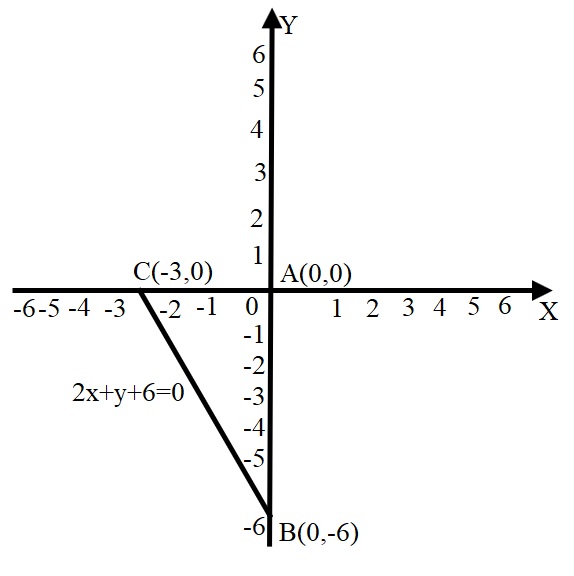
So, the graph of the inequations x ≤ 0, y ≤ 0, and 2x + y + 6 ≥ 0 is a triangular region in the 3rd quadrant.
View full question & answer→MCQ 1091 Mark
Find all pairs of consecutive odd natural numbers, both of which are larger than 10, such that their sum is less than 40.
- A
(11, 13), (13, 15), (15, 17), (17, 19)
- B
(11, 13), (13, 15), (15, 17)
- C
(21, 23), (23, 25), (25, 27), (27, 29)
- D
(15, 17), (17, 19), (19, 21), (21, 23)
Answer - (11, 13), (13, 15), (15, 17), (17, 19)
View full question & answer→MCQ 1101 Mark
If $4\text{x} + 3<6\text{x} + 7$, then$\text{ x}\in$
View full question & answer→MCQ 1111 Mark
If x is a natural number and $20\text{x}\leq100$ then find solution set of x.
Answer - {1, 2, 3, 4, 5}
Solution:
$20\text{x}\leq100$
Dividing by 20 on both sides, $\text{x}\leq\frac{100}{20}\Rightarrow\text{x}\leq5$
Since x is a natural number so x = 1, 2, 3, 4, 5.
View full question & answer→MCQ 1121 Mark
If $|\text{x} + 3|\geq10,$ then:
- A
$\text{x}\in\big(-13, 7\big] $
- B
$\text{x}\in\big(–13, 7\big)$
- C
$\text{x}\in\big(-\infty,-13\big]\cup\big[7,\infty\big)$
- D
$\text{x}\in\big(-\infty,-13\big)\cup\big[7,\infty\big)$
Answer - $\text{x}\in\big(-\infty,-13\big]\cup\big[7,\infty\big)$
View full question & answer→MCQ 1131 Mark
If $\frac{|\text{x}-2|}{\text{x}-2}\geq0,$ then:
- A
$\text{x}\in[2,\infty)$
- B
$\text{x}\in(2,\infty)$
- C
$\text{x}\in(-\infty,2)$
- D
$\text{x}\in(-\infty,2]$
Answer - [-7, 3]
Solution:
$|\text{x}+2|\leq5$
$\Rightarrow-5\leq\text{x}+2\leq5$
$\Rightarrow-5-2\leq\text{x}+2-2\leq5-2$
$\Rightarrow-7\leq\text{x}\leq3$
$\Rightarrow\text{x}\in[-7,3]$
View full question & answer→MCQ 1141 Mark
If x is a real number and |x| < 5, then:
- A
$\text{x}\geq5$
- B
$-5<\text{x}<5$
- C
$\text{x}\leq-5$
- D
$-5\leq\text{x}\leq5$
Answer - $-5<\text{x}<5$
Solution:
If x is a real number.
|x| < 5
⇒ -5 < x < 5
View full question & answer→MCQ 1151 Mark
Question: If one root of the equation $\text{x}^2+\text{px}+12=0$ is 4, while the equation $\text{x}^2+\text{px}+\text{q}=0$ has equal roots, then the value of q is:
- A
$\frac{49}{4}$
- B
$12$
- C
$3$
- D
$4$
View full question & answer→MCQ 1161 Mark
If the difference between the roots of the equation $\text{x}^2 +\text{ax}+1=0$ is less than $\sqrt{5},$ then the set of possible values of a is:
- A
$(-3,3)$
- B
$(-3,\infty)$
- C
$(3,\infty)$
- D
$(-\infty,-3)$
View full question & answer→MCQ 1171 Mark
All the values of m for which both roots of the equation x2 -2mx + m2 -1 = 0 are greater than -2
but less than 4 lie in the interval:
MCQ 1181 Mark
ax2 + bx + c > 0 is, _____________________?
Answer - quadratic inequality
Solution:
Since it has highest power of x ‘2’ and has inequality sign so, it is called quadratic inequality.
It is not numerical inequality as it does not have numbers on both sides of inequality.
It does not have two inequality signs so it is not double inequality.
View full question & answer→MCQ 1191 Mark
Choose the correct answer.
If x < 5, then.
- A
$-\text{x} < – 5 $
- B
$-\text{x}\leq-5$
- C
$-\text{x} > – 5 $
- D
$-\text{x}\leq-5$
Answer - $-\text{x} > – 5 $
Solution:
If x > 5 then - x > - 5.
View full question & answer→MCQ 1201 Mark
- A
$-\text{x}<-7$
- B
$-\text{x}\leq-7$
- C
$-\text{x}>-7$
- D
$-\text{x}\geq-7$
Answer - $-\text{x}>-7$
Solution:
x < 7
subtracting x on both sides, we get
⇒ x − x < 7 − x
⇒ 0 < 7 − x
subtracting 7 on both sides, we get
⇒ 0 − 7 < 7 − x − 7
⇒ −7 < − x
⇒ − x > −7
View full question & answer→MCQ 1211 Mark
If the roots of the equation bx2 + cx + a = 0 be imaginary, then for all real values of x, the expression 3b2 x2 + 6bcx + 2c2
MCQ 1221 Mark
IQ of a person is given by the formula.
$\text{IQ}=\Big(\frac{\text{MA}}{\text{CA}}\Big)\times100$ where MA is mental age and CA is chronological age.
If $40\leq\text{IQ}\leq120$ for a group of 10 years old children, find the range of their mental age.
- A
$\big(9,16\big)$
- B
$\big[9,16\big]$
- C
$\big(4,12\big)$
- D
$\big[4,12\big]$
Answer - $\big[4,12\big]$
Solution:
$\text{IQ}=\Big(\frac{\text{MA}}{\text{CA}}\Big)\times100$
$\Rightarrow\text{MA}=\text{IQ}\times\frac{\text{CA}}{100}$ Given, $\text{CA}=10$ years
$40\leq\text{IQ}\leq120$
$\Rightarrow40\times\text{CA}\leq\text{IQ}\times\text{CA}\leq120\times\text{CA}$
$\Rightarrow40\times10\leq\text{IQ}\times\text{CA}\leq120\times10$
$\Rightarrow40\times10100\leq\text{Q}\times\text{CA}100\leq120\times10100$
$\Rightarrow40\leq\text{MA}\leq120$
View full question & answer→MCQ 1231 Mark
The solution of the $15<\frac{3(\text{x} – 2)}{5}<0$ is:
- A
$27 <\times< 2$
- B
$27 <\times< -2$
- C
$-27 <\times< 2$
- D
$27 <\times< -2$
Answer - $27 <\times< 2$
Solution:
Given inequality is:
$15<\frac{3(\text{x} – 2)}{5}<0$
$\Rightarrow15\times5<3(\text{x} – 2)<0 × 5$
$\Rightarrow75<3(\text{x} – 2)<0$
$\Rightarrow\frac{75}{3}<\text{x} – 2<0$
$\Rightarrow25<\text{x}-2<0$
$\Rightarrow25 + 2 <\text{x}<0 + 2$
$\Rightarrow27 <\times< 2$
View full question & answer→MCQ 1241 Mark
The longest side of a triangle is 2 times the shortest side and the third side is 4cm shorter than the longest side.If the perimeter of the triangle is at least 61cm, find the minimum length of the shortest side.
Answer - 13
Solution:
Let shortest side be x.Then longest side $=2\text{x}.$
Third side $=2\text{x}-4.$
Given, perimeter of triangle is at least 61cm
$\Rightarrow\text{x}+2\text{x}+2\text{x} - 4\geq61\Rightarrow5\text{x}\geq65=\text{x}\geq13.$
Minimum length of the shortest side is 13cm.
View full question & answer→MCQ 1251 Mark
$\text{x} + 2\text{y}\leq8$ 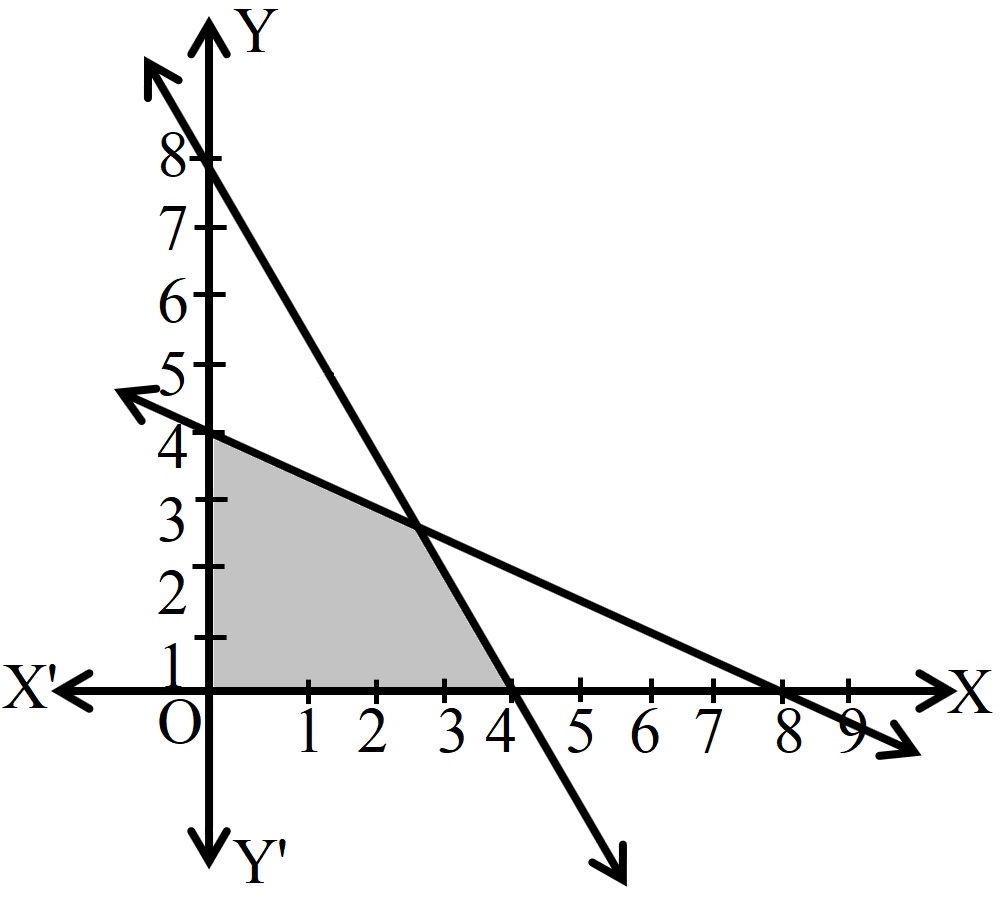
$\text{x}\geq0, \text{y}\geq0$
$\text{x}\leq0,\text{y}\leq0$
$ 2\text{x} + \text{y}\leq8$
$4\text{x}+5\text{y}\geq40$ View full question & answer→MCQ 1261 Mark
Choose the correct answer.
Solution of a linear inequality in variable x is represented on number line.

- A
$\text{x}\in\big(\frac{9}{2},\infty\big)$
- B
$\text{x}\in\big[\frac{9}{2},\infty\big]$
- C
$\text{x}\in\big(-\infty,\frac{9}{2}\big)$
- D
$\text{x}\in\big[\frac{9}{2},\infty\big)$
Answer - $\text{x}\in\big[\frac{9}{2},\infty\big]$
Solution:
The given graph has all real values of x greater than and equal to $\frac{9}{2}.$
So, $\text{x}\in\big[\frac{9}{2}\infty\big]$
View full question & answer→MCQ 1271 Mark
Choose the correct answer. Solution of a linear inequality in variable x is represented on number line.
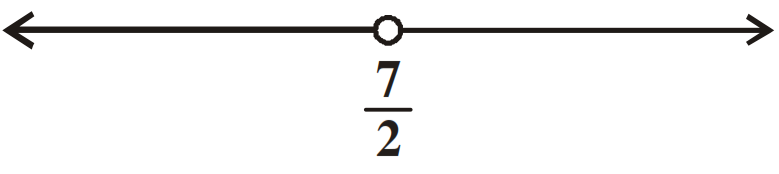
- A
$\text{x}\in\big(-\infty,\frac{7}{2}\big)$
- B
$\text{x}\in\big(-\infty,\frac{7}{2}\big]$
- C
$\text{x}\in\big(\frac{7}{2},-\infty\big)$
- D
$\text{x}\in\big(\frac{7}{2},\infty\big)$
Answer - $\text{x}\in\big(-\infty,\frac{7}{2}\big)$
Solution:
The given graph all real values of x greater than and equal $\frac{7}{2}$ on real number line.
So, $\text{x}\in\big(-\infty,\frac{7}{2}\big)$
View full question & answer→MCQ 1281 Mark
The value of a for which the sum of the squares of the roots of the equation x2 - (a - 2)x - a - 1 = 0 the least value is:
MCQ 1291 Mark
The value of x for which $|\text{x} + 1|+\sqrt{(\text{x} – 1)} = 0$
Answer - No value of x
Solution:
Given, $|\text{x} + 1| +\sqrt{(\text{x} – 1)}= 0, $where each term is non - negative.
So, $ |\text{x} + 1| = 0 $ and $\sqrt{\text{(x-1})}=0$ should be zero simultaneously.
$\text{i}.\text{e}. \text{x} = -1 $ and $\text{x}=1,$ which is not possible.
So, there is no value of x for which each term is zero simultaneously.
View full question & answer→MCQ 1301 Mark
Solution of $ |\text{x}^2 – 10|\leq6$ is:
- A
$\big(2, 4\big)$
- B
$\big(– 4, – 2\big)$
- C
$\big(– 4, – 2\big)\cup\big(2, 4\big)$
- D
$\big[– 4, – 2\big]\cup\big[2, 4\big]$
Answer - $\big[– 4, – 2\big]\cup\big[2, 4\big]$
View full question & answer→MCQ 1311 Mark
Choose correct option which suitably represents value of $\text{x.x}<5,\text{x}\in\text{N}$
Answer - {1, 2, 3, 4}
Solution:
Given, $\text{x}<5$ and $\text{x}\in\text{N}$ Natural numbers are counting numbers whose set is.
N = {1, 2, 3, ..} Therefore, {1, 2, 3, 4} represents $\text{x}<5$
View full question & answer→MCQ 1321 Mark
Solution of $2\text{x}-\frac{3}{3\text{x}}-5\geq3$ is:
- A
$\big[1,\frac{12}{7}\big]$
- B
$\big(\frac{5}{3},\frac{12}{7}\big]$
- C
$\big(-\infty,\frac{5}{3}\big)$
- D
$\big[\frac{2}{7},\infty\big)$
Answer - $\big(\frac{5}{3},\frac{12}{7}\big]$
View full question & answer→MCQ 1331 Mark
Solutions of the inequalities comprising a system in variable x are represented on number lines as given below, then 36
- A
$\text{x}\in\big(-\infty,-4\big]\cup\big[3,\infty\big)$
- B
$\text{x}\in\big[–3, 1\big]$
- C
$\text{x}\in\big(-\infty, -4\big)\cup\big[3,\infty\big)$
- D
$\text{x}\in\big[–4, 3\big]$
Answer - $\text{x}\in\big[–3, 1\big]$
View full question & answer→MCQ 1341 Mark
If $|2\text{x} – 3|<|\text{x} + 5|,$ then x belongs to:
- A
$\big(–3, 5\big)$
- B
$\big(5, 9\big)$
- C
$\big(\frac{-2}{3} ,8\big)$
- D
$\big(\frac{-8}{2} ,3\big)$
Answer - $\big(\frac{-2}{3} ,8\big)$
View full question & answer→MCQ 1351 Mark
If α and $\beta$ are the roots of the equation $\text{x}^2-\text{x}+1=0,$ then a $2009+\beta^{2009}$ is equal to:
View full question & answer→MCQ 1361 Mark
Solution of $\bigg|\text{x}+\frac{1}{\text{x}}\bigg|>2$ is:
View full question & answer→MCQ 1371 Mark
Solve: $|\text{x}-1|\leq 5, |\text{x}|\geq2$
- A
$[2, 6]$
- B
$[-4, -2]$
- C
$[-4, -2]\cup[2, 6]$
- D
$\text{None of these}$
Answer - $[-4, -2]\cup[2, 6]$
Solution:
Given, $|\text{x}-1|\leq 5, |\text{x}|\geq2$
$\Rightarrow-(5\leq(\text{x} – 1)\leq5), (\text{x}\leq -2 \text{or} \text{x} \geq 2)$
$\Rightarrow-(4\leq\text{x}\leq6), (\text{x}\leq-2 \text{or}\text{x}\geq 2)$
Now, required solution is.
$\text{x}\in[-4, -2]\cup[2, 6]$
View full question & answer→MCQ 1381 Mark
If $\text{x}\in\text{l},$ the solution set of the inequation $-2\leq\text{x}<3$ is:
Answer - −2, −1, 0, 1, 2
Solution:
$\text{x}\in\text{l},$ solution set $-2\leq\text{x}<3$
= −2, −1, 0, 1, 2
View full question & answer→MCQ 1391 Mark
Let two numbers have arithmetic mean 9 and geometric mean 4.Then, these numbers are the roots of the quadratic equation:
MCQ 1401 Mark
If x - 1 > -x + 7 then which is true?
Answer - x > 4
Solution:
x - 1 > -x + 7
⇒ 2x > 8 ⇒ x > 4.
View full question & answer→MCQ 1411 Mark
If x > 7 then -x > -7 is, ___________?
Answer - certainly false
Solution:
If we multiply by negative number on both sides of inequality then,
sign of inequality will change i.e. if x > 7 then (-1) x < (-1)7 ⇒ -x < -7.
View full question & answer→MCQ 1421 Mark
If $\frac{\text{lx}-2\text{l}}{\text{x}-2}\geq0$ then, $\text{x}\in$
- A
$\big[2,\infty\big)$
- B
$\big(2,\infty\big)$
- C
$\big(\infty, 2\big)$
- D
$\big(-\infty, 2\big]$
View full question & answer→MCQ 1431 Mark
If 2x + 1 > 5 then which is true?
Answer - x > 2
Solution:
2x + 1 > 5
⇒ 2x > 5 - 1
⇒ 2x > 4 ⇒ x > 2.
View full question & answer→MCQ 1441 Mark
If $1\leq|\text{x} -2|\leq3,$ then $\text{x}\in$
- A
$\big[–1, 5\big]$
- B
$\big[–1, 1\big]\cup\big[3, 5\big]$
- C
$\big(–1, 0\big)\cup\big(2, 5\big)$
- D
$\big(–1, 5\big)$
Answer - $\big[–1, 1\big]\cup\big[3, 5\big]$
View full question & answer→MCQ 1451 Mark
If $\text{x}^2<-4$ then the value of x is:
- A
$(-2,2)$
- B
$(2,\infty)$
- C
$(-2,\infty)$
- D
$\text{No solution}$
Answer - $\text{No solution}$
Solution:
Given, $\text{x}^2<-4$
$\Rightarrow\text{x}^2+4<0$
Which is not possible.
So, there is no solution.
View full question & answer→MCQ 1461 Mark
Solve: $2\text{x}+1>3$
- A
$\big[-1,\infty\big]$
- B
$(1,\infty)$
- C
$(\infty,\infty)$
- D
$(\infty,1)$
Answer - $(1,\infty)$
Solution:
Given, $2\text{x}+1>3$
$\Rightarrow2\text{x}>3-1$
$\Rightarrow2\text{x}>2$
$\Rightarrow\text{x}>1$
$\Rightarrow\text{x}\in(1,\infty)$
View full question & answer→MCQ 1471 Mark
If $3\text{x}-7<5+\text{x},11-5\text{x}\leq1,$, then $\text{x}\in$
- A
$\big[2, 6\big]$
- B
$\big[–2, 6\big]$
- C
$\big[2,6\big)$
- D
$\big(-2,6\big)$
View full question & answer→MCQ 1481 Mark
The cost and revenue functions of a product are given by C(x) = 20x + 4000 and R(x) = 60x + 2000, respectively, where x is the number of items produced and sold. How many items must be sold to realise some profit?
MCQ 1491 Mark
If $\frac{\text{x} – 2}{\text{x} + 5}> 2 ,$ then $\text{x}\in$
View full question & answer→MCQ 1501 Mark
Solution of $\text{l}1 +\frac{3}{\text{xl}}> 2 $ is:
Answer - $\big(-1, 0\big)\cup\big(0, 3\big)$
View full question & answer→