MCQ
Inside a hollow charged spherical conductor, the potential
  • Is constant
  • B
    Varies directly as the distance from the centre
  • C
    Varies inversely as the distance from the centre
  • D
    Varies inversely as the square of the distance from the centre

Answer

Correct option: A.
Is constant
a
(a) Inside the hollow sphere, at any point the potential is constant.

Need a full question paper?

Generate a complete, print-ready paper with questions like this in minutes — across 16+ boards, with answer keys.
Start Generating Free

Similar questions

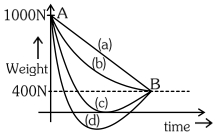
A person whose mass is $100\, {kg}$ travels from Earth to Mars in a spaceship. Neglect all other objects in sky and take acceleration due to gravity on the surface of the Earth and Mars as $10$ ${m} / {s}^{2}$ and $4 \,{m} / {s}^{2}$ respectively. Identify from the below figures, the curve that fits best for the weight of the passenger as a function of time.
Which of the following quantities has a unit but dimensionless?
A body of mass $10\, kg$ is moving with a constant velocity of $10 \,m/s$. When a constant force acts for $4 \,seconds$ on it, it moves with a velocity $2 \,m/sec$ in the opposite direction. The acceleration produced in it is...........$m/{\sec ^2}$
$5\,\,gm.$  of ice at $0\,^oC$  is dropped in a beaker containing $20\,\,gm.$ of water at $40\,^oC.$ The final temperature will be  ........ $^oC$
A short sighted person can see distinctly only those objects which lie between $10\, cm$ and $100\, cm$ from him. The power of the spectacle lens required to see a distant object is
A dry cell has an $e.m.f.$ of $1.5\, V$ and an internal resistance of $0.05\,\Omega $. The maximum current obtainable from this cell for a very short time interval is ................... $A$
Consider a point $P$ on the circumference of a disc rolling along a horizontal surface. If $R$ is the radius of the disc, the distance through which $P$ moves in one full rotation of the disc  is:
One mole of an ideal gas at an initial temperature of $T\, K$ does $6\, R\, joules$ of work adiabatically. If the ratio of specific heats of this gas at constant pressure and at constant volume is $\frac{5}{3}$ , the final temperature of gas will be
The limiting friction is
A particle executes $SHM$ with amplitude of $20 \,cm$ and time period is $12\, sec$.  What is the minimum time required for it to move between two points $10\, cm$ on  either side of the mean position ..... $\sec$ ?