MCQ
Inside a hollow charged spherical conductor, the potential
  • Is constant
  • B
    Varies directly as the distance from the centre
  • C
    Varies inversely as the distance from the centre
  • D
    Varies inversely as the square of the distance from the centre

Answer

Correct option: A.
Is constant
a
(a) Inside the hollow sphere, at any point the potential is constant.

Need a full question paper?

Generate a complete, print-ready paper with questions like this in minutes — across 16+ boards, with answer keys.
Start Generating Free

Similar questions

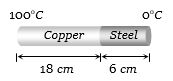
The coefficient of thermal conductivity of copper is nine times that of steel. In the composite cylindrical bar shown in the figure. What will be the temperature at the junction of copper and steel ....... $^oC$
A source of sound of frequency $450$ cycles/sec is moving towards a stationary observer with $34\, m/sec$ speed. If the speed of sound is $340\, m/sec,$ then the apparent frequency will be ..... $cycles/sec$
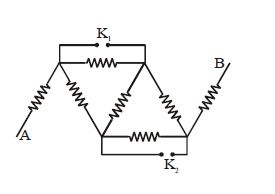
All wires have same resistance and equivalent resistance between $A$ and $B$ is $R$. Now keys are closed, then the equivalent resistance will become
A person standing on a rotating platform has his hands lowered. He suddenly outstretch his arms. The angular momentum
The temperature of the sun is measured with
A pendulum of length $2 \; m$ consists of a wooden bob of mass $50 \; g$. A bullet of mass $75 \; g$ is fired towards the stationary bob with a speed $v$. The bullet emerges out of the bob with a speed $\frac{v}{3}$ and the bob just completes the vertical circle. The value of $v$ is $\dots \; ms ^{-1}$. (if $g =10 \; m / s ^{2}$ )
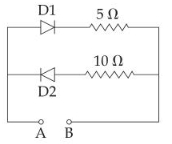
A $2\,V$ battery is connected across $AB$ as shown in the figure. The value of the current supplied by the battery when in one case battery's positive terminal is connected to $A$ and in other case when positive terminal of battery is connected to $B$ will respectively be
According to Gauss’ Theorem, electric field of an infinitely long straight wire is proportional to
Column $I$ gives some devices and Column $II$ gives some process on which the functioning of these devices depend. Match the devices in Column $I$ with the processes in Column $II$ and indicate your answer by darkening appropriate bubbles in the $4 \times 4$ matrix given in the $ORS$.
Column $I$ Column $II$
$(A)$ Bimetallic strip $(p)$ Radiation from a hot body
$(B)$ Steam engine $(q)$ Energy conversion
$(C)$ Incandescent lamp $(r)$ Melting
$(D)$ Electric fuse $(s)$ Thermal expansion of solids
A thin circular frame of radius $'a'$ is made of insulating material. A square loop is constructed with in it. If loop carrying current $I$ ,  then magnetic induction at geometrical centre $'O'$ will be