MCQ
Inside a hollow charged spherical conductor, the potential
  • Is constant
  • B
    Varies directly as the distance from the centre
  • C
    Varies inversely as the distance from the centre
  • D
    Varies inversely as the square of the distance from the centre

Answer

Correct option: A.
Is constant
a
(a) Inside the hollow sphere, at any point the potential is constant.

Need a full question paper?

Generate a complete, print-ready paper with questions like this in minutes — across 16+ boards, with answer keys.
Start Generating Free

Similar questions

When a nucleus in an atom undergoes a radioactive decay, the electronic energy levels of the atom:
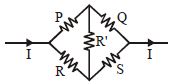
Wheat stone bridge is balanced. Find ratio of electric power dissipated in $(P + Q)$ to $(R + S)$
$12$ cells each having the same emf are connected in series and are kept in a closed box. Some of the cells are wrongly connected. This battery is connected in series with an ammeter and two cells identical with each other and also identical with the previous cells. The current is $3\, A$ when the external cells aid this battery and is $2\,A$ when the cells oppose the battery. How many cells in the battery are wrongly connected :-
The e.m.f. of a cell is E volts and internal resistance is r ohm. The resistance in external circuit is also r ohm. The p.d. across the cell will be
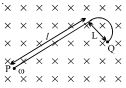
When a $‘J’$ shaped conducting rod is rotating in its own plane with constant angular velocity $w$, about one of its end $P$, in a uniform magnetic field $\vec B\,$ directed normally into the plane of paper) then magnitude of emf induced across it will be
The graph which represents the correct variation of logarithm of activity (log A) versus time, in figure is
Hard $X-$ rays for the study of fractures in bones should have a minimum wavelength of $10^{11}\, m$. The accelerating voltage for electrons in $X-$ ray machine should be
Which of the following is conserved when light waves interfere
Which one of the following is the primary effect of $UV$ radiation caused due to depletion of ozone layer?
Find out the $e.m.f$. produced when the current changes from $0$ to $1 \,A$ in $10 \,second$, given $L = 10$ $\mu H$