MCQ
Inside a uniform spherical shell

$(a)$ the gravitational field is zero

$(b)$ the gravitational potential is zero

$(c)$ the gravitational field is same everywhere

$(d)$ the gravitation potential is same everywhere

$(e)$ all of the above

Choose the most appropriate answer from the options given below

  • $(a), (c)$ and $(d)$ only
  • B
    $(e)$ only
  • C
    $(a), (b)$ and $(c)$ only
  • D
    $({b}),({c})$ and $({d})$ only

Answer

Correct option: A.
$(a), (c)$ and $(d)$ only
a
Inside a spherical shell, gravitational field is zero and hence potential remains same everywhere

Need a full question paper?

Generate a complete, print-ready paper with questions like this in minutes — across 16+ boards, with answer keys.

Start Generating Free

Similar questions

A body is projected horizontally from a height with speed $20$ metres/sec. ........ $metres/sec$ will be its speed after $5$ seconds ($g = 10\,\,metres/{\sec ^2})$
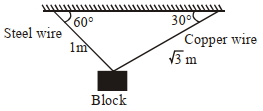
A block of weight $100 N$ is suspended by copper and steel wires of same cross sectional area $0.5 cm ^2$ and, length $\sqrt{3} m$ and $1 m$, respectively. Their other ends are fixed on a ceiling as shown in figure. The angles subtended by copper and steel wires with ceiling are $30^{\circ}$ and $60^{\circ}$, respectively. If elongation in copper wire is $\left(\Delta \ell_{ C }\right)$ and elongation in steel wire is $\left(\Delta \ell_{ s }\right)$, then the ratio $\frac{\Delta \ell_{ C }}{\Delta \ell_{ S }}$ is. . . . . .

[Young's modulus for copper and steel are $1 \times 10^{11} N / m ^2$ and $2 \times 10^{11} N / m ^2$ respectively]

A simple pendulum of mass $m$ executes $S.H.M.$ with total energy $E$. If at an instant it is at one of extreme positions, then its linear momentum after a phase shift of $\frac{\pi}{3} \,rad$ will be
 In a standing wave on a string rigidly fixed at both ends
In which of the following graphs, the total change in momentum is zero?
In an isothermal reversible expansion, if the volume of $96\, gm$ of oxygen at $27°C$ is increased from $70$ litres to $140$ litres, then the work done by the gas will be
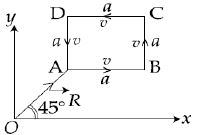
A particle of mass $m$ is moving along the side of a square of side '$a$', with a uniform speed $v$ in the $x-y$ plane as shown in the figure

Which of the following statement is false for the angular momentum $\vec L$ about the origin ?

Excess pressure of one soap bubble is four times more than the other. Then the ratio of volume of first bubble to another one is
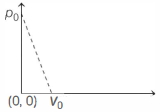
One mole of ideal gas undergoes a linear process as shown in the figure below. Its temperature expressed as a function of volume $V$ is
A block of weight $1 \,N$ rests on an inclined plane of inclination $\theta$ with the horizontal. The coefficient of friction is $\mu$ The minimum force that has to be applied parallel to the inclined plane to make the body just move up the plane is