MCQ
$\int_{}^{} {\frac{{dx}}{{\sqrt {2x - {x^2}} }} = } $
  • A
    ${\cos ^{ - 1}}(x - 1) + c$
  • ${\sin ^{ - 1}}(x - 1) + c$
  • C
    ${\cos ^{ - 1}}(1 + x) + c$
  • D
    ${\sin ^{ - 1}}(1 - x) + c$

Answer

Correct option: B.
${\sin ^{ - 1}}(x - 1) + c$
b
(b)$\int_{}^{} {\frac{{dx}}{{\sqrt {2x - {x^2}} }}} = \int_{}^{} {\frac{{dx}}{{\sqrt {1 - {{(x - 1)}^2}} }}} = {\sin ^{ - 1}}(x - 1) + c.$

Need a full question paper?

Generate a complete, print-ready paper with questions like this in minutes — across 16+ boards, with answer keys.
Start Generating Free

Similar questions

The distance between two parallel lines $3x + 4y - 8 = 0$ and $3x + 4y - 3 = 0$, is given by
$\int_{ - 1}^1 {x{{\tan }^{ - 1}}x\,dx} $ equals
Let a function $f\left( x \right) = \left\{ \begin{gathered}
   - \ln \left( {3x - \left[ {3x} \right]} \right)\,;\,\,3x \ne n;n \in N \hfill \\
  \ln \left( {\operatorname{sgn} \left( {3x} \right)} \right)\,\,\,\,\,\,\,;\,\,3x = n;n \in N \hfill \\ 
\end{gathered}  \right.,$ (where [.] and sgn $(x)$ denotes greatest integer function and signum function respectively) then number of point $(s)$ , where $f(x)$ is minimum in $x  \in  (0, 5)$ , is 
Let $'C'$ be the locus of centre of circles which touch the lines $x + 2y -5 = 0$ and $2x -4y + 7 = 0$ and area enclosed by curve $'C'$ with the line $x -y -5 = 0$ is $\frac{{{P^2}}}{{2{Q^2}}}$ ; where $P$ and $Q$ are relative primes, then $P + Q$ is
Let $f(x)$ be a polynomial of degree $3$ such that $f(-1)=10, f(1)=-6, f(\mathrm{x})$ has a critical point at $\mathrm{x}=-1$ and $f^{\prime}(\mathrm{x})$ has a critical point at $\mathrm{x}=1$ Then $f(x)$ has a local minima at $x=$
A bag contains $5$ distinct Red, $4$ distinct Green and $3$ distinct Black balls. Balls are drawn one by one without replacement,then the probability of getting a particular red ball in fourth draw is-
The coefficient of $x^{7}$ in the expression $(1+x)^{10}+x(1+x)^{9}+x^{2}(1+x)^{8}+\ldots+x^{10}$ is
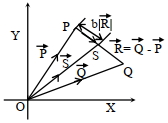
Three vectors $\vec{P}, \vec{Q}$ and $\vec{R}$ are shown in the figure. Let $S$ be any point on the vector $\vec{R}$. The distance between the point $P$ ad $S$ is $b|\vec{R}|$. The general relation among vectors $\vec{P}, \vec{Q}$ and $\vec{S}$ is
The general solution of the trigonometric equation $tan\, x + tan \,2x + tan\, 3x = tan \,x · tan\, 2x · tan \,3x$ is
For positive integers ${n_1},{n_2}$the value of the expression ${(1 + i)^{{n_1}}} + {(1 + {i^3})^{{n_1}}} + {(1 + {i^5})^{{n_2}}} + {(1 + {i^7})^{{n_2}}}$where $i = \sqrt { - 1} $ is a real number if and only if