MCQ
$\int_{\,0}^{\,1} {\,{{\tan }^{ - 1}}\left( {\frac{1}{{{x^2} - x + 1}}} \right)\,dx} $ is
  • A
    $ln\ 2$
  • B
    $ - \ln 2$
  • C
    $\frac{\pi }{2} + \ln 2$
  • $\frac{\pi }{2} - \ln 2$

Answer

Correct option: D.
$\frac{\pi }{2} - \ln 2$
d
(d) $\int_0^1 {{{\tan }^{ - 1}}\left( {\frac{1}{{{x^2} - x + 1}}} \right)\,dx} $

$= \int_0^1 {{{\tan }^{ - 1}}x\,dx - } \int_0^1 {{{\tan }^{ - 1}}(x - 1)} \,dx$

$ = 2\int_{\,0}^{\,1} {{{\tan }^{ - 1}}x\,dx} $

$= 2\,[{\tan ^{ - 1}}x - \frac{1}{2}\log (1 + {x^2})]_0^1 $

$= \frac{\pi }{2} - \log 2.$

Need a full question paper?

Generate a complete, print-ready paper with questions like this in minutes — across 16+ boards, with answer keys.

Start Generating Free

Similar questions

The integral $\int {x\,{{\cos }^{ - 1}}\,\left( {\frac{{1 - {x^2}}}{{1 + {x^2}}}} \right)dx} \,\left( {x > 0} \right)$ is equal to
For any square matrix $A, A A^T$ is a
Evaluate : $\sin \left[\frac{\pi}{3}+\sin ^{-1}\left(\frac{1}{2}\right)\right]$
Let $f:(0, \infty) \rightarrow R$ be given by $f(x)=\int_{\frac{1}{x}}^x e^{-\left(t+\frac{1}{t}\right)} \frac{d t}{t}$. Then

$(A)$ $f(x)$ is monotonically increasing on $[1, \infty)$

$(B)$ $f(x)$ is monotonically decreasing on $(0,1)$

$(C)$ $f(x)+f\left(\frac{1}{x}\right)=0$, for all $x \in(0, \infty)$

$(D)$ $f\left(2^x\right)$ is an odd function of $x$ on $R$
Domain of function $f(x) = {\sin ^{ - 1}}5x$ is
Given the system of equation $a(x + y + z)=x,b(x + y + z) = y, c(x + y + z) = z$ where $a,b,c$  are non-zero real numbers. If the real numbers $x,y,z$ are such that $xyz \neq 0,$ then  $(a + b + c)$ is equal to-
For non-zero vectors $\vec{\text{a}},\vec{\text{b}}$ and $\vec{\text{c}}$ the relation $\big|\big(\vec{\text{a}}\times\vec{\text{b}}\big).\vec{\text{c}}\big|=\big|\vec{\text{a}}\big|\big|\vec{\text{b}}\big|\big|\vec{\text{c}}\big|$ holds good, if:
  1. $\vec{\text{a}}.\vec{\text{b}}=\vec{\text{b}}.\vec{\text{c}}=0$
  2. $\vec{\text{a}}.\vec{\text{b}}=0=\vec{\text{c}}.\vec{\text{a}}$
  3. $\vec{\text{a}}.\vec{\text{b}}=\vec{\text{b}}.\vec{\text{c}}=\vec{\text{c}}.\vec{\text{a}}=0$
  4. $\vec{\text{b}}.\vec{\text{c}}=\vec{\text{c}}.\vec{\text{a}}=0$
If $\int \frac{1}{a^2 \sin ^2 x+b^2 \cos ^2 x} d x=\frac{1}{12} \tan ^{-1}(3 \tan x)+$ constant, then the maximum value of $\operatorname{asin} \mathrm{x}+\mathrm{b} \cos \mathrm{x}$, is :
Let $f: \rightarrow R \rightarrow(0, \infty)$ be strictly increasing function such that $\lim _{x \rightarrow \infty} \frac{f(7 x)}{f(x)}=1$. Then, the value of $\lim _{x \rightarrow \infty}\left[\frac{f(5 x)}{f(x)}-1\right]$ is equal to
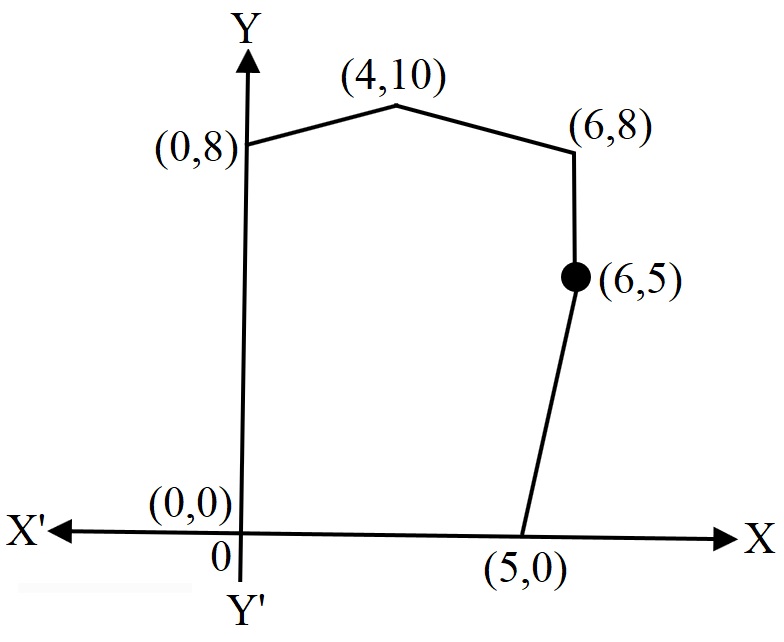
The feasible solution for a LPP is shown in the following figure. Let Z = 3x - 4y be the objective function.

Minimum of Z occurs at: