MCQ
$\int_0^{\pi /4} {\frac{{4\sin 2\theta \,d\theta }}{{{{\sin }^4}\theta + {{\cos }^4}\theta }}} = $
  • A
    $\pi /4$
  • B
    $\pi /2$
  • $\pi $
  • D
    એકપણ નહીં.

Answer

Correct option: C.
$\pi $
c
(c) $4\int_0^{\pi /4} {\frac{{\sin 2\theta \,d\theta }}{{{{\sin }^4}\theta + {{\cos }^4}\theta }} = 4\int_0^{\pi /4} {\frac{{2\sin \theta \cos \theta \,d\theta }}{{{{\sin }^4}\theta + {{\cos }^4}\theta }}} } $

$ = 4\int_0^{\pi /4} {\frac{{2\tan \theta \,{{\sec }^2}\theta \,d\theta }}{{{{\tan }^4}\theta + 1}}} $

{Dividing numerator and denominator by ${\cos ^4}\theta $ }

Now put ${\tan ^2}\theta = t $

$\Rightarrow 2\tan \theta\, {\sec ^2}\theta \,d\theta = dt$,  then the reduced form is 

$4\int_0^1 {\frac{{dt}}{{{t^2} + 1}}} = 4[{\tan ^{ - 1}}t]_0^1 = 4\left[ {\frac{1}{4}\pi - 0} \right] = \pi $.

Need a full question paper?

Generate a complete, print-ready paper with questions like this in minutes — across 16+ boards, with answer keys.
Start Generating Free

Similar questions

$\left( { - \infty ,\infty } \right)$ મા એવા કેટલા બિંદુઓ મળે કે જેથી $x^2 -x\, sin\,x -cos\,x = 0$ થાય 
જો $\mathrm{A}=\left[\begin{array}{ll}2 & 3 \\ 1 & 4\end{array}\right]$ હોય, તો $\mathrm{a d j}$ $\mathrm{A}$ શોધો.
$\int_{\,0}^{\,\pi /2} {{{\left( {\sqrt {\sin \theta } \cos \theta } \right)}^3}d\theta }  = . . . ..$
$\tan \left[ {\frac{1}{2}{{\cos }^{ - 1}}\left( {\frac{{\sqrt 5 }}{3}} \right)} \right] = $
અહી $\mathrm{f}(\mathrm{x})=\cos \left(2 \tan ^{-1} \sin \left(\cot ^{-1} \sqrt{\frac{1-\mathrm{x}}{\mathrm{x}}}\right)\right)$ $0<\mathrm{x}<1$ તો  . . . . 
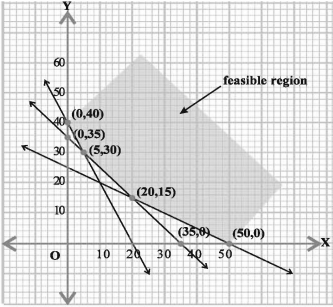
નીચે દર્શાવેલ આલેખ શક્ય ઉકેલનો પ્રદેશ દર્શાવે છે. હેતુલક્ષી વિધેય $z=5 x+4 y$ ની ન્યૂનતમ કિંમત .... છે. 
$\int_0^\pi {\frac{{x\,\tan x}}{{\sec x + \cos x}}} \,dx = $
વાસ્તવિક સંખ્યા $x$  માટે, ધારો કે $f\left( x \right) = {x^3} + 5x + 1$,તો $f $ એ . . . . . . . છે.
જો $f\left( x \right) = \frac{x}{{\sqrt {{a^2} + {x^2}} }} - \frac{{d - x}}{{\sqrt {{b^2} + {{\left( {d - x} \right)}^2}} }},x \in R\,$, કે જ્યાં $a, b$ અને $d$ એ શૂન્યતર વાસ્તવિક સંખ્યા છે તો . . . . 
નીચેની સમીકરણ સંહતિનો ઉકેલ અનન્ય હોય, તો $k$ ની કિંમતનો ગણ ........... છે. $x - ky + z = 0,kx + 3y - kz = 0,3x + y - z = 0$