Question
Interference is based on the superposition principle. According to this principle, at a particular point in the medium, the resultant displacement produced by a number of waves is the vector sum of the displacements produced by each of the waves.
If two sodium lamps illuminate two pinholes $S_1$ and $S_2,$ the intensities will add up and no interference fringes will be observed on the screen.
Here the source undergoes abrupt phase change in times of the order of $10^{-10}$ seconds.
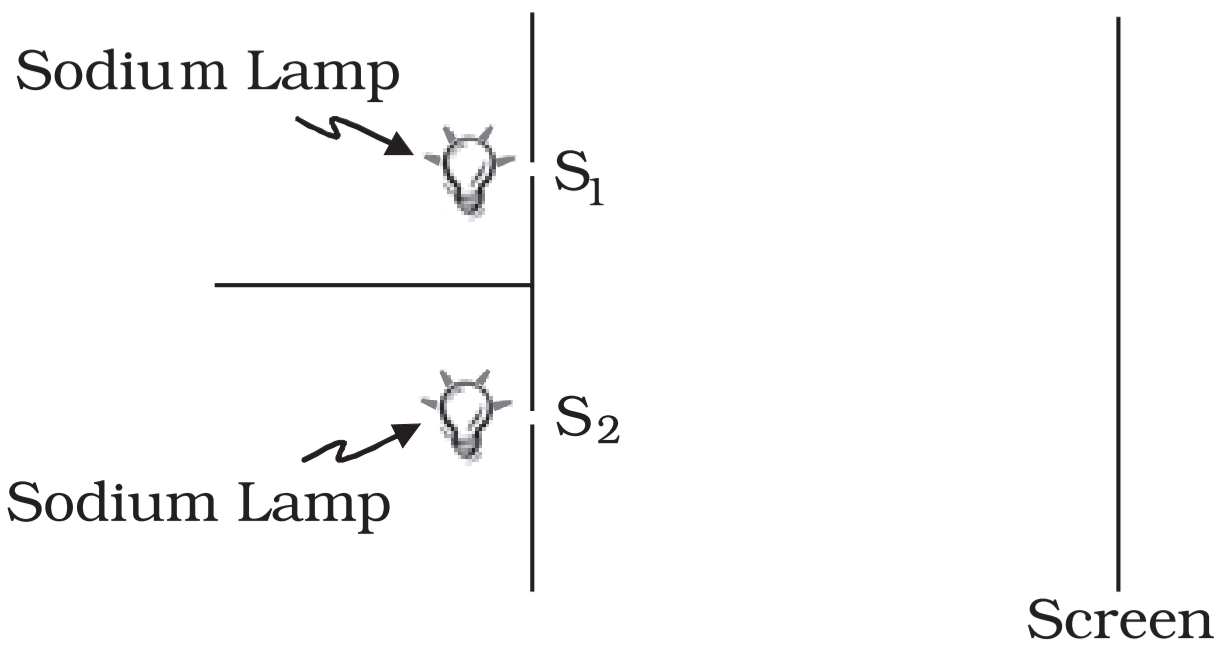
If two sodium lamps illuminate two pinholes $S_1$ and $S_2,$ the intensities will add up and no interference fringes will be observed on the screen.
Here the source undergoes abrupt phase change in times of the order of $10^{-10}$ seconds.
- Two coherent sources of intensity $\text{10 }\frac{\text{W}}{\text{m}^2}$ and $\text{25 }\frac{\text{W}}{\text{m}^2}$ interfere to form fringes. Find the ratio of maximum intensity to minimum intensity.
- $\text{y}_1=\text{a}\sin\Big[\omega\text{t}+\frac{\pi}{3}\Big]$ and $\text{y}_2=\text{a}\sin\omega\text{t}$ is:
- $\text{a}$
- $\sqrt2\text{a}$
- $\text{2a}$
- $\sqrt3\text{a}$
- The resultant amplitude of a vibrating particle by the superposition of the two waves.
- Infinite
- Five
- Three
- Zero
- The maximum number of possible interference maxima for slit separation equal to twice the wavelength in Young's double $-$ slit experiment, is:
- $2D$
- $4D$
- $\frac{\text{D}}{2}$
- $\frac{\text{D}}{4}$
- ln a Young's double $-$ slit experiment, the slit separation is doubled. To maintain the same fringe spacing on the screen, the screen $-$ to $-$ slit distance $D$ must be changed to:
- Soap bubble.
- Excessively thin film.
- A thick film.
- Wedge shaped film.
- Which of the following does not show interference?
- $15.54$
- $16.78$
- $19.72$
- $18.39$