Question
✓
Answer
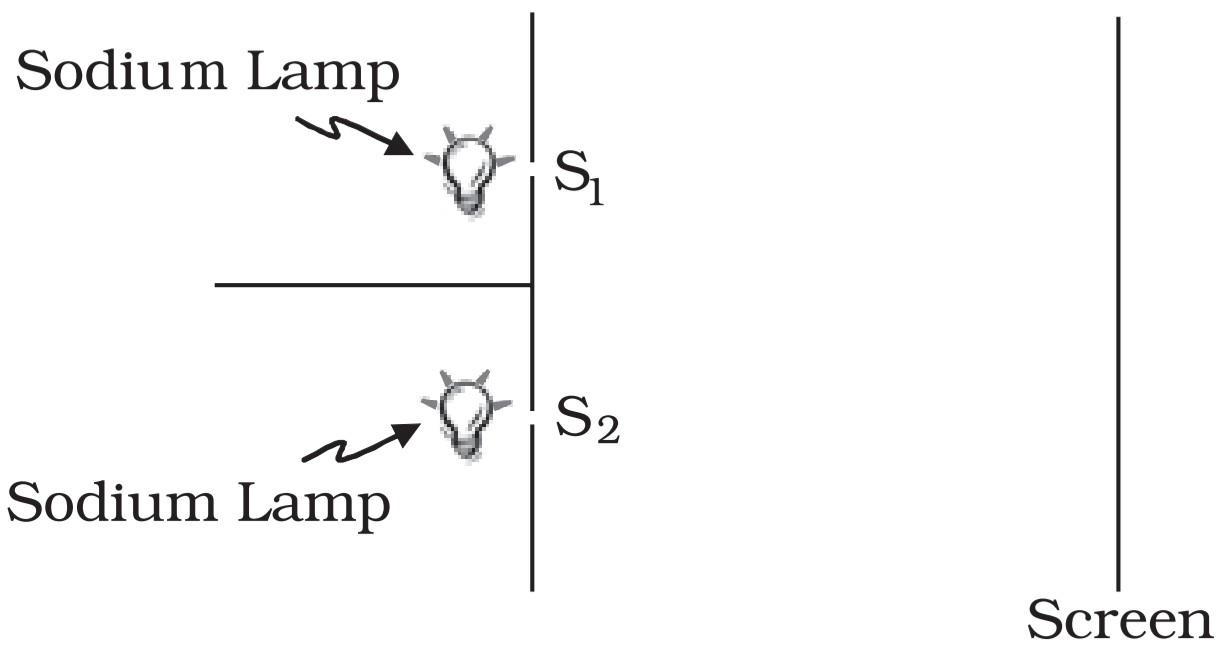
- (c) 19.72
Explanation:
Given $\text{I}_1=\text{10 }\frac{\text{W}}{\text{m}^2}$ and $\text{I}_2=\text{25 }\frac{\text{W}}{\text{m}^2}$
$\frac{\text{I}_1}{\text{I}_2}=\frac{\text{a}^2_1}{\text{a}^2_2}=\frac{10}{25}\Rightarrow\frac{\text{a}_1}{\text{a}_2}=\frac{3.16}{5}$ or
$\text{a}_1=\frac{3.16}{5}\text{a}_2=0.6324\text{a}_2$
$\frac{\text{I}_\text{max}}{\text{I}_\text{min}}=\frac{(\text{a}_1+\text{a}_2)^2}{(\text{a}_1-\text{a}_2)^2}=\frac{[0.6324\text{a}_2+\text{a}_2]^2}{[0.6324\text{a}_2-\text{a}_2]^2}=19.724$
- (b) Excessively thin film.
Explanation:
In an excessively thin film, the thickness of the film is negligible. Thus the path difference between the reflected rays becomes $\frac{\lambda}{2}$ which produces a minima.
- (a) 2D
Explanation:
Since, $\beta=\frac{\lambda\text{D}}{\text{d}}$ for d = 2d,
$\beta'=\frac{\lambda\text{D}'}{2\text{d}}=\beta$ (Gives)
$\therefore$ D1 = 2D
- (b) Five
Explanation:
The condition for possible interference maxima on the screen is, $\text{d}\sin\theta=\text{n}\lambda$
where d is slit separation and $\lambda$ is the wavelength.
As $\text{d}=2\lambda$ (given) $\therefore2\lambda\sin\theta=\text{n}\lambda$ or $2\sin\theta=\text{n}$
For number of interference maxima to be maximum,
$\sin\theta=1\ \ \ \therefore\ \ \ \text{n}=2$
The interference maxima will be formed when
$\text{n}=0,\pm1,\pm2$
Hence the maximum number of possible maxima is 5.
-
(d) $\sqrt3\text{a}$
Explanation:
$\text{y}_1=\text{a}\sin\Big(\omega\text{t}\frac{\pi}{3}\Big)$ and $\text{y}_2=\text{a}\sin\omega\text{t}$
$\text{A}=\sqrt{\text{a}_1^2+\text{a}^2_2+2\text{a}_1\text{a}_2\cos\phi}$, where $\phi=\frac{\pi}{3}$
$=\sqrt{\text{a}^2+\text{a}^2+2\text{aa}\cos\frac{\pi}{3}}=\sqrt3\text{a}$
Need a full question paper?
Generate a complete, print-ready paper with questions like this in minutes — across 16+ boards, with answer keys.
Explore more
Similar questions
To keep valuable instruments away from the earth's magnetic field, they are enclosed in iron boxes. Explain.
Plot a graph showing variation of de-Broglie wavelength $ \lambda $ versus $ 1/\sqrt{V} $ where V is accelerating potential for two particles A and B carrying same charge but of masses $ m_{1} $ and $ m_{2} $, where $ m_{1}>m_{2} $
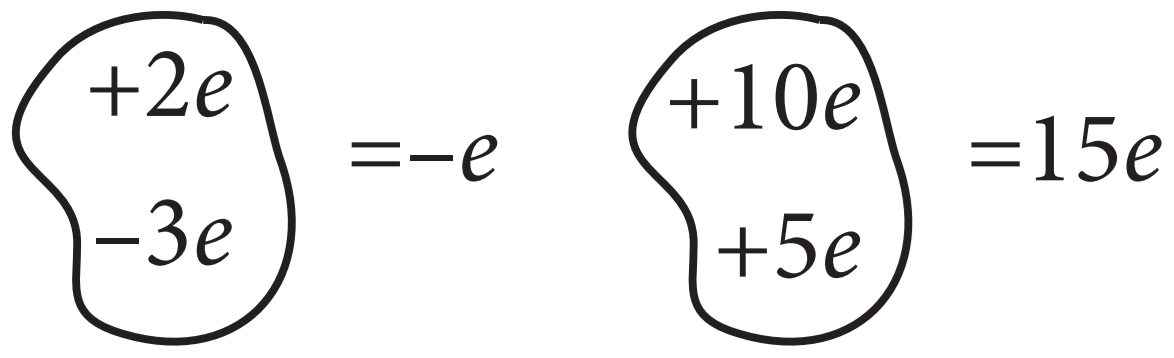
→Smallest charge that can exist in nature is the charge of an electron. During friction, it is only the transfer of electrons which makes the body charged. Hence, net charge on any body is an integral multiple of charge of an electron [1.6 x 10⁻¹⁹C] i.e. q = ± ne Where n = 1, 2, 3, 4,....
→
- Which of the following properties is not satisfied by an electric charge?
- Total charge conservation.
- Quantization of charge.
- Two types of charge.
- Circular line of force.
- Which one of the following charges is possible?
- 5.8 × 10⁻¹⁸C
- 3.2 × 10⁻¹⁸C
- 4.5 × 10⁻¹⁹C
- 8.6 × 10⁻¹⁸C
- If a charge on a body is 1nC, then how many electrons are present on the body?
- 6.25 × 1027
- 1.16 × 10¹⁹
- 6.25 × 1028
- 6.25 × 10⁹
- If a body gives out 109 electrons every second, how much time is required to get a total charge of 1C from it?
- 190.19 years
- 150.12 years
- 198.19 years
- 188.21 years
- A polythene piece rubbed with wool is found to have a negative charge of 3.2 × 10⁻⁷ C. Calculate the number of electrons transferred.
- 2 × 10¹²
- 3 × 10¹²
- 2 × 10¹⁴
- 3 × 10¹⁴
According to wave theory, the tight of any frequency can emit electrons from metallic surface provided the intensity of light be sufficient to provided necessary energy for emission of electrons, but according to experimental observations, the light of frequency less than threshold frequency can not emit electrons; whatever be the intensity of incident light. Einstein also proposed that electromagnetic radiation is quantised. If photoelectrons are ejected from a surface when light of wavelength $\lambda_1=550\text{nm}$ is incident on it. The stopping potential for such electrons is Vs = 0.19V. Suppose the radiation of wavelength $\lambda_2=190\text{nm}$ is incident on the surface.
→- Photoelectric effect supports quantum nature oflight because.
- There is a minimum frequency of light below which no photoelectrons are emitted.
- The maximum K.E. of photoelectric depends only on the frequency oflight and not on its intensity.
- Even when the metal surface is faintly illuminated, the photo electrons leave the surface immediately.
- Electric charge of the photoelectrons is quantized.
- A, B, C
- B, C
- C, D
- A, D, C
- ln photoelectric effect, electrons are ejected from metals, if the incident light has a certain minimum.
- Wavelength.
- Frequency.
- Amplitude.
- Angle of incidence.
- Calculate the stopping potential $\text{V}_{\text{s}_2}$ of surface.
- 4.47
- 3.16
- 2.76
- 5.28
- Calculate the work function of the surface.
- 3.75
- 2.07
- 4.20
- 3.60
- Calculate the threshold frequency for the surface.
- 500 × 1012Hz
- 480 × 1013Hz
- 520 × 1011Hz
- 460 × 1013Hz
How is Lenz's law based on conservation of energy ?
In a TV picture tube electrons are ejected from the cathode with negligible speed and reach a velocity of 5 × 10⁶m/s in travelling one centimeter. Assuming straight line motion, find the constant force exerted on the electron. The mass of the electron is 9.1 × 10⁻³¹kg.
Wavefront is a locus of points which vibratic in same phase. A ray of light is perpendicular to the wavefront. According to Huygens principle, each point of the wavefront is the source of a secondary disturbance and the wavelets connecting from these points spread out in all directions with the speed of wave.
The figure shows a surface XY separating two transparent media, medium-I and medium-2. The lines ab and cd represent wavefronts of a light wave travelling in medium- 1 and incident on XY. The lines ef and gh represent wavefronts of the light wave in medium-2 after refraction.
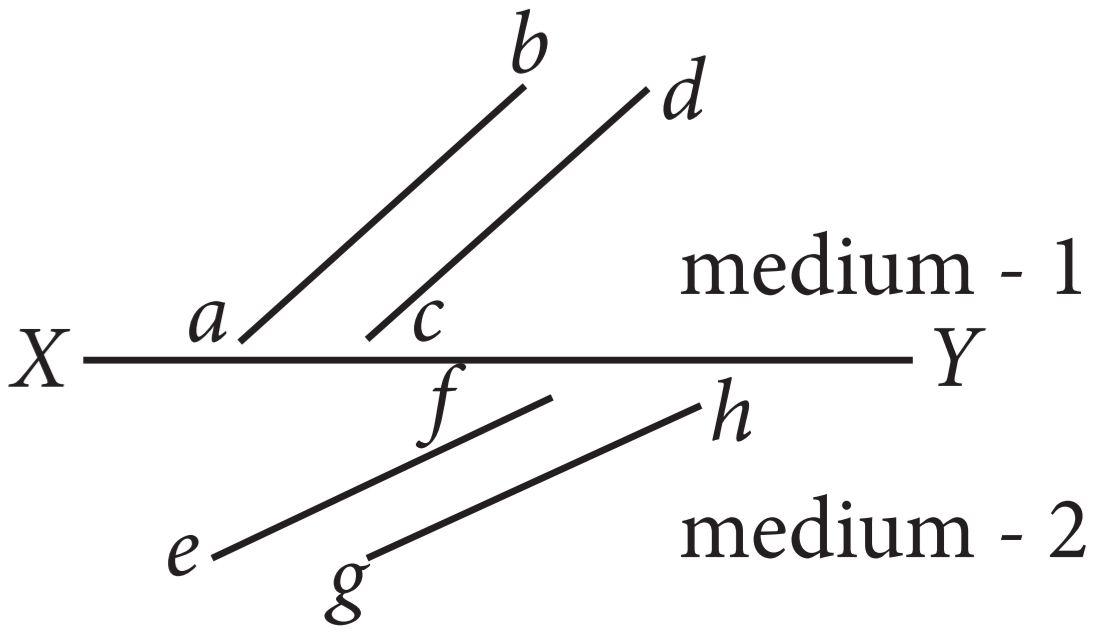
→The figure shows a surface XY separating two transparent media, medium-I and medium-2. The lines ab and cd represent wavefronts of a light wave travelling in medium- 1 and incident on XY. The lines ef and gh represent wavefronts of the light wave in medium-2 after refraction.
- Light travels as a:
- Parallel beam in each medium.
- Convergent beam in each medium.
- Divergent beam in each medium.
- Divergent beam in one medium and convergent beam in the other medium.
- The phases of the light wave at c, d, e and f are $\phi_\text{c},\phi_\text{d},\phi_\text{e}$ and $\phi_\text{f}$ respectively. It is given that $\phi_\text{c}\not=\phi_\text{f}$
- $\phi_\text{c}$ cannot be equal $\phi_\text{d}$
- $\phi_\text{d}$ cannot be equal $\phi_\text{e}$
- $(\phi_\text{d}-\phi_\text{f})$ is equal to $(\phi_\text{c}-\phi_\text{e})$
- $(\phi_\text{d}-\phi_\text{c})$ is not equal to $(\phi_\text{f}-\phi_\text{e})$
- Wavefront is the locus of all points, where the particles of the medium vibrate with the same.
- Phase
- Amplitude
- Frequency
- Period
- A point source that emits waves uniformly in all directions, produces wavefronts that are:
- Spherical
- Elliptical
- Cylindrical
- Planar
- What are the types of wavefronts?
- Spherical
- Cylindrical
- Plane
- All of these.
ln Young's double slit experiment, the width of the central bright fringe is equal to the distance between the first dark fringes on the two sides of the central bright fringe.
ln given figure below a screen is placed normal to the tine joining the two point coherent source S1 and S2. The interference pattern consists of concentric circles.
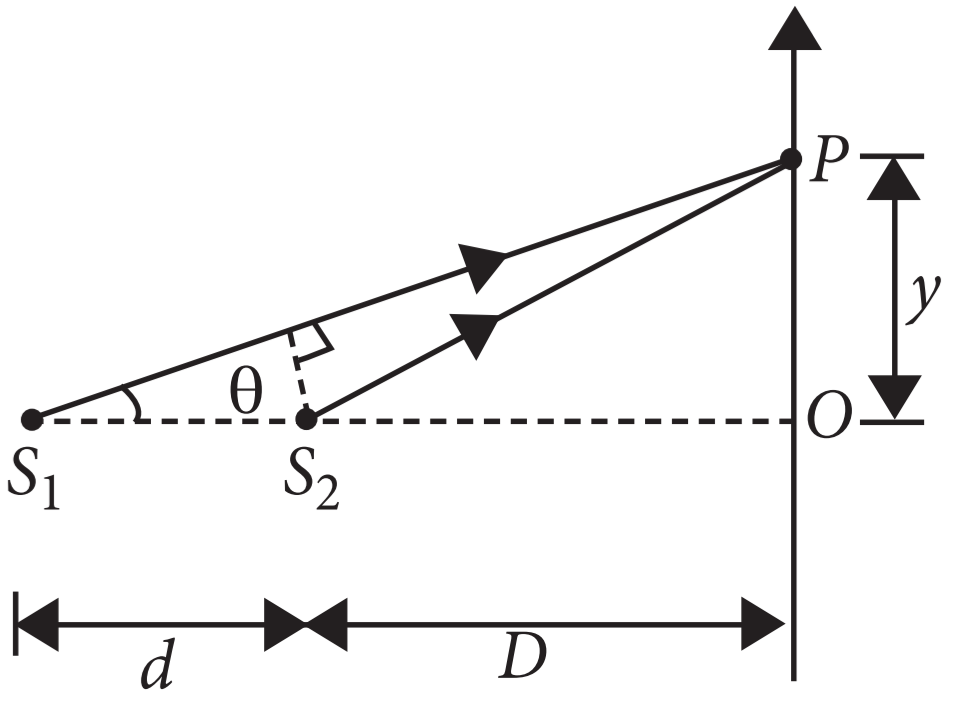
→ln given figure below a screen is placed normal to the tine joining the two point coherent source S1 and S2. The interference pattern consists of concentric circles.
- The optical path difference at P is:
- $\text{d}\Big[1+\frac{\text{y}^2}{2\text{D}}\Big]$
- $\text{d}\Big[1+\frac{2\text{D}}{\text{y}^2}\Big]$
- $\text{d}\Big[1-\frac{\text{y}^2}{2\text{D}^2}\Big]$
- $\text{d}\Big[2\text{D}-\frac{1}{\text{y}^2}\Big]$
- Find the radius of the nth bright fringe.
- $\text{D}\sqrt{1\Big(1-\frac{\text{n}\lambda}{\text{d}}\Big)}$
- $\text{D}\sqrt{2\Big(1-\frac{\text{n}\lambda}{\text{d}}\Big)}$
- $2\text{D}\sqrt{2\Big(1-\frac{\text{n}\lambda}{\text{d}}\Big)}$
- $\text{D}\sqrt{2\Big(1-\frac{\text{n}\lambda}{2\text{d}}\Big)}$
- If $\text{d}=0.5\text{mm}.\lambda=5000\mathring{\text{A}}$ and D = 100cm, find the value of n for the closest second bright fringe.
- 888
- 830
- 914
- 998
- The coherence of two light sources means that the light waves emitted have.
- Same frequency.
- Same intensity.
- Constant phase difference.
- Same velocity.
- The phenomenon of interference is shown by:
- Longitudinal mechanical waves only.
- Transverse mechanical waves only.
- Electromagnetic waves only.
- All of these.
When tall buildings are constructed on earth, the duration of day-night slightly increases. Is it true?
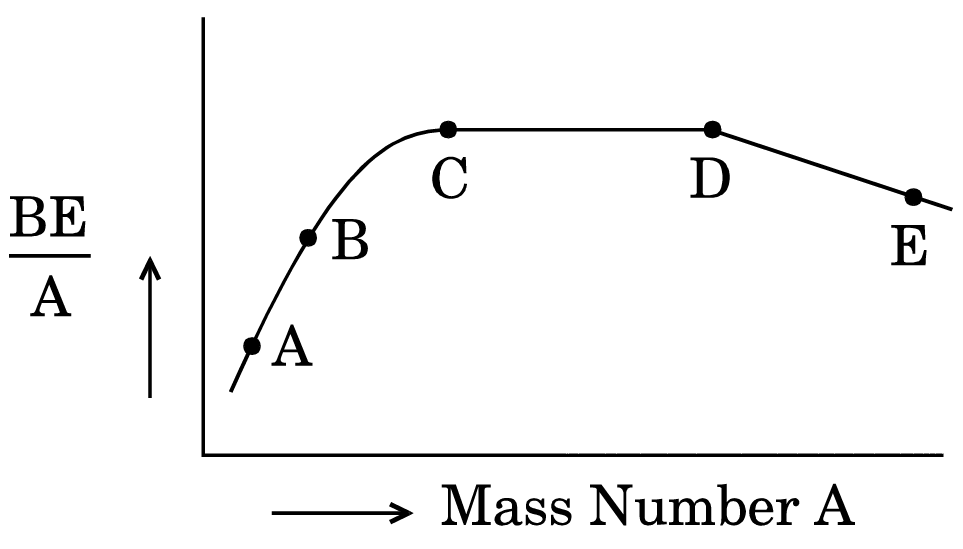
- The figure shows the plot of binding energy (BE) per nucleon as a function of mass number A. The letters A, B, C, D and E represent the positions of typical nuclei on the curve. Point out, giving reasons, the two processes (in terms of A, B, C, D and E), one of which can occur due to nuclear fission and the other due to nuclear fusion.
- Identify the nature of the radioactive radiations emitted in each step of the decay process given below.
$^{A}_{Z}\text{X}\rightarrow ^{A-4}_{Z-2}\text{Y}\rightarrow ^{A-4}_{Z-1}\text{W}$.