Question
Wavefront is a locus of points which vibratic in same phase. A ray of light is perpendicular to the wavefront. According to Huygens principle, each point of the wavefront is the source of a secondary disturbance and the wavelets connecting from these points spread out in all directions with the speed of wave.
The figure shows a surface XY separating two transparent media, medium-I and medium-2. The lines ab and cd represent wavefronts of a light wave travelling in medium- 1 and incident on XY. The lines ef and gh represent wavefronts of the light wave in medium-2 after refraction.
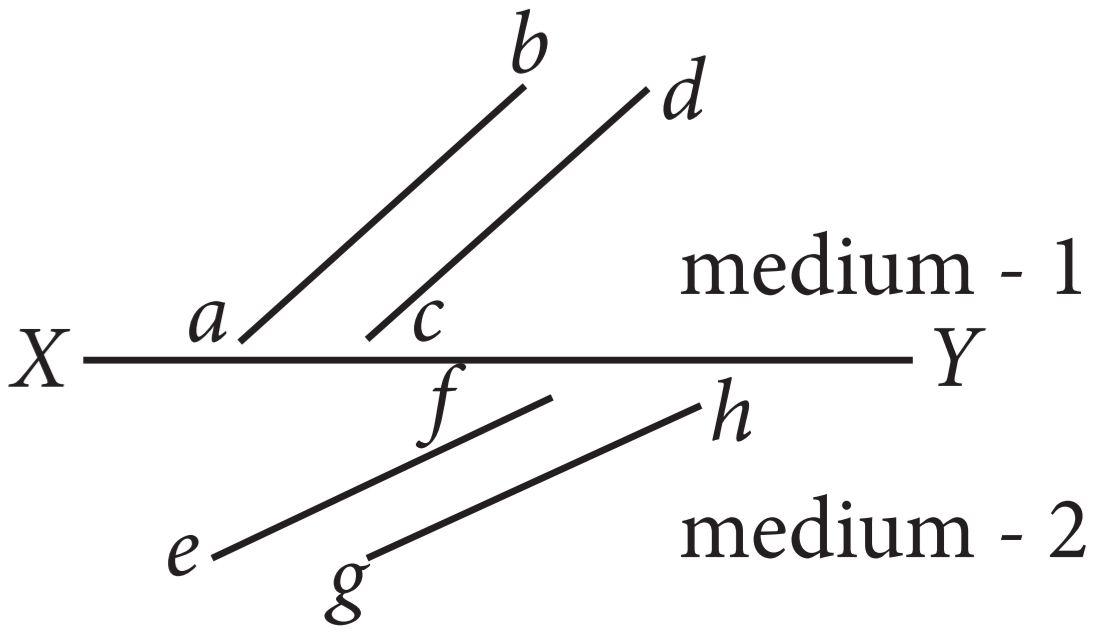
  1. Light travels as a:
  1. Parallel beam in each medium.
  2. Convergent beam in each medium.
  3. Divergent beam in each medium.
  4. Divergent beam in one medium and convergent beam in the other medium.
  1. The phases of the light wave at c, d, e and f are $\phi_\text{c},\phi_\text{d},\phi_\text{e}$ and $\phi_\text{f}$ respectively. It is given that $\phi_\text{c}\not=\phi_\text{f}$
  1. $\phi_\text{c}$ cannot be equal $\phi_\text{d}$
  2. $\phi_\text{d}$ cannot be equal $\phi_\text{e}$
  3. $(\phi_\text{d}-\phi_\text{f})$ is equal to $(\phi_\text{c}-\phi_\text{e})$
  4. $(\phi_\text{d}-\phi_\text{c})$ is not equal to $(\phi_\text{f}-\phi_\text{e})$
  1. Wavefront is the locus of all points, where the particles of the medium vibrate with the same.
  1. Phase
  2. Amplitude
  3. Frequency
  4. Period
  1. A point source that emits waves uniformly in all directions, produces wavefronts that are:
  1. Spherical
  2. Elliptical
  3. Cylindrical
  4. Planar
  1. What are the types of wavefronts?
  1. Spherical
  2. Cylindrical
  3. Plane
  4. All of these.

Answer

  1. (a) Parallel beam in each medium.

Explanation:

Since the path difference between two waveform is equal, light traves as parallel beam in each medium.

  1. (c) $(\phi_\text{d}-\phi_\text{f})$ is equal to $(\phi_\text{c}-\phi_\text{e})$

Explanation:

Since all points on the wavefront are in the same phase,

$\phi_\text{d}=\phi_\text{c}$ and $\phi_\text{f}=\phi_\text{e}$

$\therefore\phi_\text{d}-\phi_\text{f}=\phi_\text{c}-\phi_\text{e}$

  1. (a) Phase

Explanation:

Wavefront is the locus of all points, where the particles of the medium vibrate with the same phase.

  1. (a) Spherical
  1. (d) All of these.

Need a full question paper?

Generate a complete, print-ready paper with questions like this in minutes — across 16+ boards, with answer keys.

Start Generating Free

Similar questions

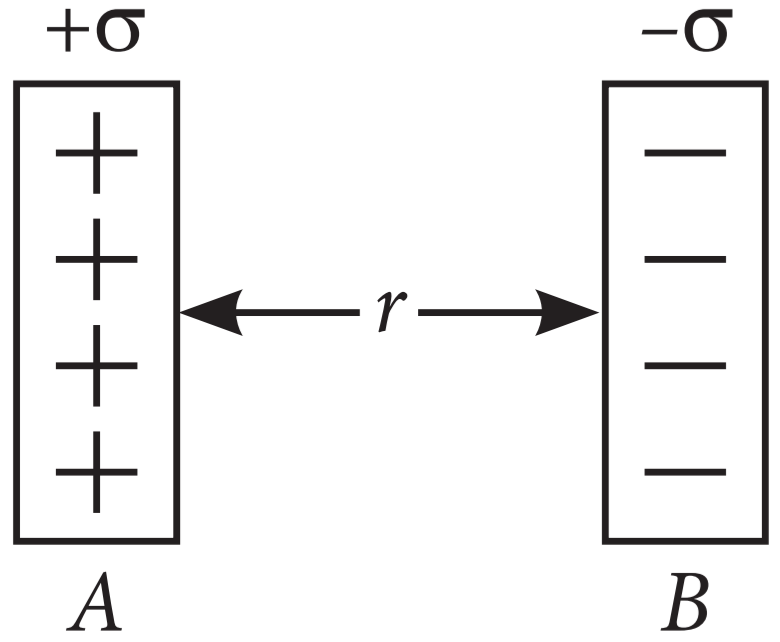
Surface charge density is defined as charge per unit surface area of surface charge distribution. i.e., $\sigma=\frac{\text{dq}}{\text{dS}}.$ Two large, thin metal plates are parallel and close to each other. On their inner faces, the plates have surface charge densities of opposite signs having magnitude of 17.0 × 10-22Cm-2 as shown. The intensity of electric field at a point is $\text{E}=\frac{\sigma}{\in_0},$ where$\in_0=$ permittivity of free space.

  1. E in the outer region of the first plate is:
  1. 17 × 10-22 N/C
  2. 1.5 × 10-25 N/C
  3. 1.9 × 10-10 N/C
  4. Zero.
  1. E in the outer region of the second plate is:
  1. 17 × 10-22 N/C
  2. 1.5 × 10-15 N/C
  3. 1.9 × 10-10 N/C
  4. Zero.
  1. E between the plates is:
  1. 17 × 10-22 N/C
  2. 1.5 × 10-15 N/C
  3. 1.9 × 10-10 N/C
  4. Zero.
  1. The ratio of E from right side of B at distances 2cm and 4cm, respectively is:
  1. 1 : 2
  2. 2 : 1
  3. 1 : 1
  4. $1:\sqrt{2}$
  1. ln order to estimate the electric field due to a thin finite plane metal plate, the Gaussian surface considered is:
  1. Spherical.
  2. Spherical.
  3. Straight line.
  4. None of these.
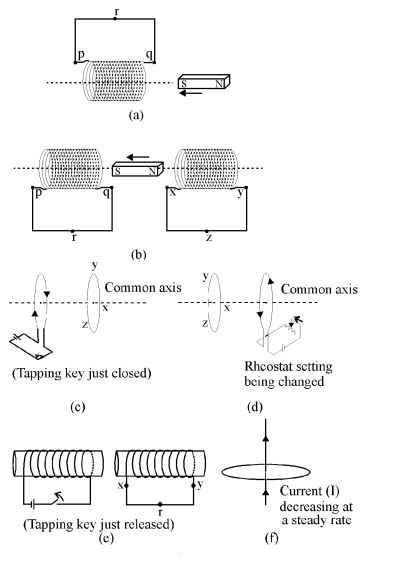
Predict the direction of induced current in the situations described by the following figures (a) to (f).
Image
Write Ampere's circuital law. Obtained and expression for magnetic field on the axis of a current carrying long solenoid with the help of ampere circuital law. Draw necessary diagram.
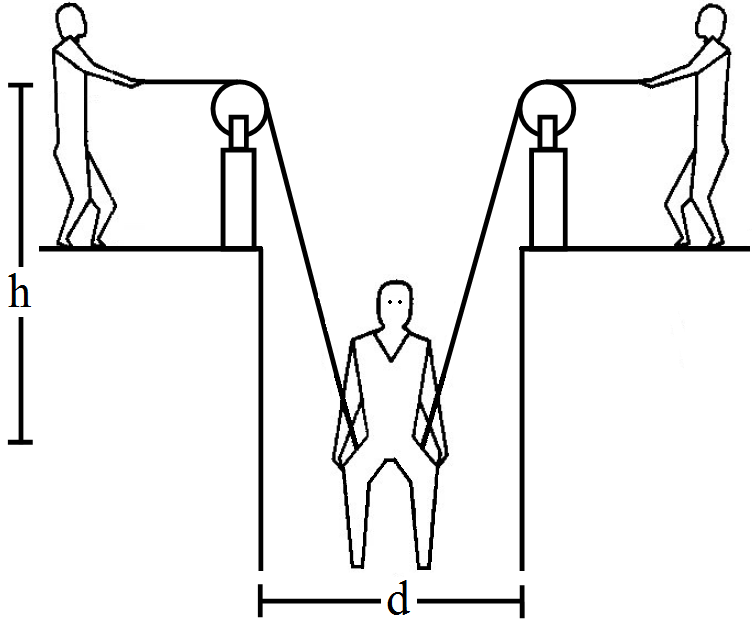
A man has fallen into a ditch of width d and two of his friends are slowly pulling him out using a light rope and two fixed pulleys as shown in figure. Show that the force (assumed equal for both the friends) exerted by each friend on the road increases as the man moves up. Find the force when the man is at a depth h.

A metal rod is placed along the axis of a solenoid carrying a high-freqμency alternating current. It is found that the rod gets heated. Explain why the rod gets heated.
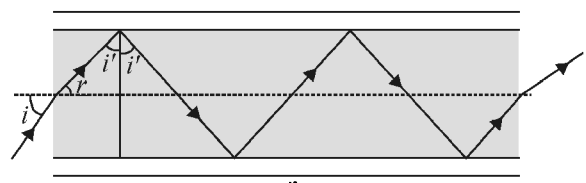
(a) Figure shows a cross-section of a 'light pipe' made of a glass fibre of refractive index 1.68. The outer covering of the pipe is made of a material of refractive index 1.44. What is the range of the angle of the incident rays with the axis of the pipe for which total reflections inside the pipe take place, as shown in the figure. Image
(b) What is the answer if there is no outer covering of the pipe?
An electric dipole of length 2 cm is placed in an electric field of intensity $10^5$ Newton/Coulomb in such a way that its axis makes an angle of $30^{\circ}$ with the direction of the field. A torque of $10 \sqrt{3}$ Newton meter acts on it. Find the magnitude of charge on the electric diple.
Power (P) of a lens is given by reciprocal of focal length (f) of the lens i.e. $\text{p}=\frac{1}{\text{f}},$ where f is in metre and P is in dioptre. For a convex lens, power is positive and for a concave lens, power is negative. When a number of thin lenses of powers P1, P2, P3, ...... are held in contact with one another, the power of the combination is given by algebraic sum of the powers of all the lenses i.e., P = P1 + P2 + P3 +......
  1. A convex and a concave lens separated by distance d are then put in contact. The focal length of the combination.
  1. Becomes 0.
  2. Remains the same.
  3. Decreases.
  4. Increases.
  1. If two lenses of power +1.5D and +1.0D are placed in contact, then the effective power of combination will be.
  1. 2.5D
  2. 1.5D
  3. 0.5D
  4. 3.25D
  1. If the power of a lens is +5 dioptre, what is the focal length of the lens?
  1. 10cm
  2. 20cm
  3. 15cm
  4. 5cm
  1. Two thin lenses of focal lengths +10cm and -5cm are kept in contact. The power of the combination is:
  1. -10D
  2. -20D
  3. 10D
  4. 15D
  1. A convex lens of focal length 25cm is placed coaxially in contact with a concave lens of focal length 20cm. The system will be.
  1. Converging in nature.
  2. Diverging in nature.
  3. Can be converging or divergin.
  4. None of the above.

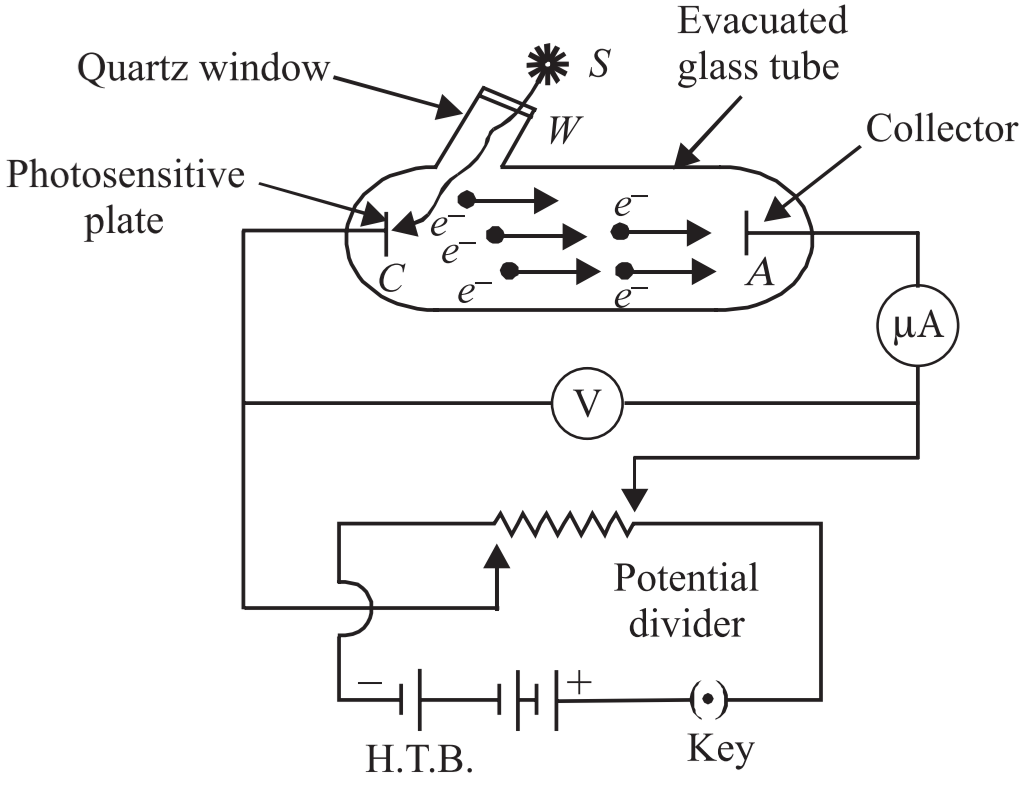
To study photoelectric effect, an emitting electrode C of a photosensitive material is kept at negative potential and collecting electrode A is kept at positive potential in an evacuated tube. When light of sufficiently high frequency falls on emitting electrode, photoelectrons are emitted which travel directly to collecting electrode and hence an electric current called photoelectric current starts flowing in the circuit, which is directly proportional to the number of photoelectrons emitted by emitting electrode C.

While demonstrating the existence of electromagnetic waves, Hertz found that high voltage sparks passed across the metal electrodes of the detector loop more easily when the cathode was illuminated by ultraviolet light from an arc lamp. The ultraviolet light falling on the metal surface caused the emission of negatively charged particles, which are now known to be electrons, into the surrounding space and hence enhanced the high voltage sparks.

  1. Cathode rays were discovered by:
  1. Maxwell Clerk James.
  2. Heinrich Hertz.
  3. William Crookes.
  4. J. J. Thomson.
  1. Cathode rays consists of:
  1. Photons
  2. Electrons
  3. Pistons
  4. $\alpha$-particles

  1. Who discovered the charge on an electron for the frist time?
  1. Millikan
  2. Thomson
  3. Kelvin
  4. Coulomb
  1. The dual nature oflight is exhibited by:
  1. Diffraction and photoelectric effect.
  2. Photoelectric effect.
  3. Refraction and interference.
  4. Diffraction and reflection.
  1. ln the phenomenon of electric discharge through gases at low pressure, the coloured glow in the tube appears as a result of:
  1. Collisions between the charged particles emitted from the cathode and the atoms of the gas.
  2. Collision between different electrons of the atoms of the gas.
  3. Excitation of electrons in the atoms.
  4. Collision between the atoms of the gas.