MCQ
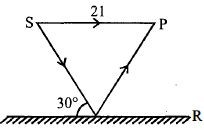
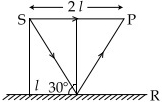
Interference pattern is observed at $'P'$ due to superimposition of two rays coming out from a source $'S'$ as shown in the figure. The value of $'I'$ for which maxima is obtained at $'P'$ is: ( $R$ is perfect reflecting surface)
  • A
    $I\, = \,\frac{{2n\lambda }}{{\sqrt 3  - 1}}$
  • B
    $I\, = \,\frac{{(2n - 1)\lambda }}{{2(\sqrt 3  - 1)}}$
  • $I\, = \,\frac{{(2n - 1\,\lambda )\sqrt 3 }}{{4(2 - \sqrt 3 )}}$
  • D
    $I\, = \,\frac{{(2n - 1)\lambda }}{{\sqrt 3  - 1}}$
Answer

Correct option: C.
$I\, = \,\frac{{(2n - 1\,\lambda )\sqrt 3 }}{{4(2 - \sqrt 3 )}}$
c
From the figure straight path $\mathrm{SP}=2 l$

Reflected path $\mathrm{SP}=2 l$ sec $30^{\circ}$

So path difference is $2 l\left(\sec 30^{\circ}-1\right)$

Also the ray, when reflected by the mirror, suffers a phase change of $\pi$

So the total difference in phase is $2 l\left(\sec 30^{\circ}-1\right) \times \frac{2 \pi}{\lambda}+\pi$

For constructive interference

$2 l\left(\sec 30^{\circ}-1\right) \times \frac{2 \pi}{\lambda}+\pi=2 n \pi$

Solving this, we get $l=\frac{(2 n-1) \lambda \sqrt{3}}{4(2-\sqrt{3})}$

Need a full question paper?

Generate a complete, print-ready paper with questions like this in minutes — across 16+ boards, with answer keys.

Start Generating Free

Similar questions

Two identical charged spheres are suspended by strings of equal lengths. The strings make an angle of $30^o$ with each other. When suspended in a liquid of density $1\, g\, cm^{-3}$, the angle remains the same. If density of the material of the sphere is $4/3\, g\, cm^{-3}$, the dielectric constant of the liquid is
The work function of tungsten is $4.50\,eV$. The wavelength of fastest electron emitted when light whose photon energy is $5.50 \,eV$ falls on tungsten surface, is ......... $\mathring A$
A simple pendulum doing small oscillations at a place $\mathrm{R}$ height above earth surface has time period of $T_1=4 \mathrm{~s}$. $T_2$ would be it's time period if it is brought to a point which is at a height $2 R$ from earth surface. Choose the correct relation $[R=$ radius of Earth]:
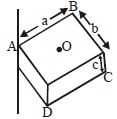
Figure shows a uniform solid block of mass $M$ and edge lengths $a, b$ and $c$. Its $M.I.$ about an axis through one edge and perpendicular (as shown) to the large face of the block is
If force $\vec{F}=3 \hat{i}+4 \hat{j}-2 \hat{k}$ acts on a particle having position vector $2 \hat{i}+\hat{j}+2 \hat{k}$ then, the torque about the origin will be
A marble block of mass $2\, kg$ lying on ice when given a velocity of $6\, m/s$ is stopped by friction in $10s$. Then the coefficient of friction is-
Air in a cylinder is suddenly compressed by a piston, which is then maintained at the same position. With the passage of time
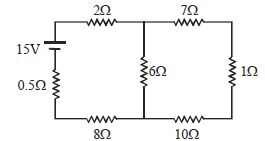
The current from the battery in the given circuit is ................ $A$
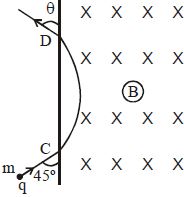
A particle of mass $m = 1.67 \times 10^{-27}\, kg$ and charge $q = 1.6 \times 10^{-19} \, C$ enters a region of uniform magnetic field of strength $1$ $tesla$ along the direction shown in the figure. The speed of the particle is $10^7\, m/s.$ The magnetic field is directed along the inward normal to the plane of the paper. The particle enters the field at $C$ and leaves at $D.$ Then the angle $\theta$ must be :-.........$^o$
The aperture of the objective is $24.4\,cm$. The resolving power of this telescope. If a light of wavelength $2440 \mathring A$ is used to see the object will be