MCQ
Two identical charged spheres are suspended by strings of equal lengths. The strings make an angle of $30^o$ with each other. When suspended in a liquid of density $1\, g\, cm^{-3}$, the angle remains the same. If density of the material of the sphere is $4/3\, g\, cm^{-3}$, the dielectric constant of the liquid is
  • $4$
  • B
    $3$
  • C
    $2$
  • D
    $1$

Answer

Correct option: A.
$4$
a
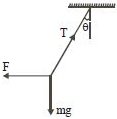
From $\mathrm{FBD}$ of sphere, using theorem,

$\frac{\mathrm{F}}{\mathrm{mg}}=\tan \theta$           ..........$(i)$

when suspended in liquid, as $\theta$ remains same,

$\frac{\mathrm{F}^{\prime}}{\operatorname{mg}\left(1-\frac{\rho}{\mathrm{d}}\right)}=\tan \theta$           .........$(ii)$

Using eqns. $(i)$ and $(ii),$

$\frac{\mathrm{F}}{\mathrm{mg}}=\frac{\mathrm{F}^{\prime}}{\mathrm{mg}\left(1-\frac{\rho}{\mathrm{d}}\right)}$

where, $\quad \mathrm{F}^{\prime}=\frac{\mathrm{F}}{\mathrm{K}}$

$\therefore \frac{\mathrm{F}}{\mathrm{mg}}=\frac{\mathrm{F}^{\prime}}{\operatorname{mg} \mathrm{K}\left(1-\frac{\rho}{\mathrm{d}}\right)}$

or $\quad \mathrm{K}=\frac{1}{1-\frac{\rho}{\mathrm{d}}}=2$

Need a full question paper?

Generate a complete, print-ready paper with questions like this in minutes — across 16+ boards, with answer keys.

Start Generating Free

Similar questions

A monochromatic light is incident at a certain angle on an equilateral triangular prism and suffers minimum deviation. If the refractive index of the material of the prism is $\sqrt 3$ , then the angle of incidence....$^o$
A unit positive point charge of mass $m$ is projected with a velocity $V$ inside the tunnel as shown. The tunnel has been made inside a uniformly charged non conducting sphere. The minimum velocity with which the point charge should be projected such it can it reach the opposite end of the tunnel, is equal to
The photodiode is used to detect the optiocal signals. These diodes are preferably operated in reverse biased mode because.
If $3$ charges are placed at the vertices of equilateral triangle of charge ‘$q$’ each. What is the net potential energy, if the side of equilateral triangle is $l\, cm$
A particle moves in the $x-y$ plane under the action of a force $\,\vec F$ such that the value of its linear momentum $(\,\vec P)$ at anytime $t$ is $P_x = 2cost$ , $P_y = 2sint$ . The angle between $\,\vec F$ and $\,\vec P$ at a given time $t$ , will be 
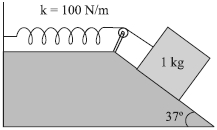
A $1\; kg$ block situated on a rough incline is connected to a spring of spring constant $100\;N m ^{-1}$ as shown in Figure. The block is released from rest with the spring in the unstretched position. The block moves $10 \;cm$ down the incline before coming to rest. Find the coefficient of friction between the block and the incline. Assume that the spring has a negligible mass and the pulley is frictionless.
The $(x, y)$ coordinates of the corners of a square plate are $(0, 0), (L, 0), (L, L)$ and $(0, L).$ The edges of the plate are clamped and transverse standing waves are set up in it. If $u(x, y)$ denotes the displacement of the plate at the point $(x, y)$ at some instant of time, the possible expression(s) for $u$ is(are) ($a =$ positive constant)
A galvanometer has resistance of $7\,\Omega $ and gives a full scale deflection for a current of $1.0\, A$. How will you convert it into a voltmeter of range $10\, V$
With what minimum acceleration can a fireman slides down a rope while breaking strength of the rope is $\frac{2}{3}$ of his weight
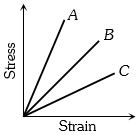
The stress-strain curves for brass, steel and rubber are shown in the figure. The lines $A, B$ and $C$ are for