MCQ
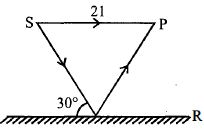
Interference pattern is observed at $'P'$ due to superimposition of two rays coming out from a source $'S'$ as shown in the figure. The value of $'I'$ for which maxima is obtained at $'P'$ is: ( $R$ is perfect reflecting surface)
  • A
    $I\, = \,\frac{{2n\lambda }}{{\sqrt 3  - 1}}$
  • B
    $I\, = \,\frac{{(2n - 1)\lambda }}{{2(\sqrt 3  - 1)}}$
  • $I\, = \,\frac{{(2n - 1\,\lambda )\sqrt 3 }}{{4(2 - \sqrt 3 )}}$
  • D
    $I\, = \,\frac{{(2n - 1)\lambda }}{{\sqrt 3  - 1}}$
Answer

Correct option: C.
$I\, = \,\frac{{(2n - 1\,\lambda )\sqrt 3 }}{{4(2 - \sqrt 3 )}}$
c
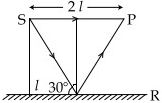
From the figure straight path $\mathrm{SP}=2 l$

Reflected path $\mathrm{SP}=2 l$ sec $30^{\circ}$

So path difference is $2 l\left(\sec 30^{\circ}-1\right)$

Also the ray, when reflected by the mirror, suffers a phase change of $\pi$

So the total difference in phase is $2 l\left(\sec 30^{\circ}-1\right) \times \frac{2 \pi}{\lambda}+\pi$

For constructive interference

$2 l\left(\sec 30^{\circ}-1\right) \times \frac{2 \pi}{\lambda}+\pi=2 n \pi$

Solving this, we get $l=\frac{(2 n-1) \lambda \sqrt{3}}{4(2-\sqrt{3})}$

Need a full question paper?

Generate a complete, print-ready paper with questions like this in minutes — across 16+ boards, with answer keys.

Start Generating Free

Similar questions

The power (in diopters) of an equiconvex lens with radii of curvature of $10\, cm$ and refractive index of $1.6$ is
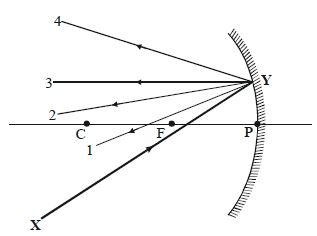
Figure shows a small concave mirror with $CP$ as its principal axis. A ray $XY$ is incident on the mirror. Which of the four rays can be the reflected ray.
Pauli suggested the emission of nutrino during $\beta^{+}$decay to explain
The Boolean equation of NOR gate is
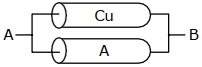
A Copper $(Cu)$ rod of length $25\, {cm}$ and cross- sectional area $3\, {mm}^{2}$ is joined with a similar Aluminium $(Al)$ rod as shown in figure. Find the resistance of the combination between the ends $A$ and $B$ (in ${m} \Omega$)

(Take Resistivity of Copper $=1.7 \times 10^{-8}\, \Omega \,{m}$, Resistivity of Aluminium $=2.6 \times 10^{-8}\, \Omega \,{m}$ )

The emitter-base junction of a transistor is …… biased while the collector-base junction is ……. biased
An object placed in front of a concave mirror of focal length $0.15 \,m$ produces a virtual image, which is twice the size of the object. The position of the object with respect to the mirror is ........... $cm$
Two charges are placed at certain distance apart. A metallic sheet is placed between them. What will happen to the force between the charges?
$A$ thin wire of length $2m$ is perpendicular to the $xy$ plane. It is moved with velocity $\vec v = (2\hat i + 3\hat j + \hat k)\,m/s$ through $a$ region of magnetic induction $\vec B = (\hat i + 2\hat j)\,\,Wb/{m^2}$. Then potential difference induced between the ends of the wire :........$volts$
Choose the wrong statement: