Question
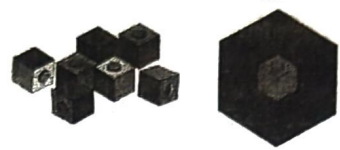
Interlocking cubes come in different colours. Different shapes can be created by joining them.
Image
Sasha is making large cube using small interlocking cubes. She starts with a yellow cube and then fits one layer of red cubes around it to make the large cube.
On the basis of above given information, answer the following questions.

(i) What is the number of red cubes used?
(a) 9 $~~\quad$ (b) 18
(c) 26 $\quad$ (d) 27

(ii) Sasha considers the red layer as the first layer on the yellow cube. Which equation can be used to find the number of red cubes?
(a) $6 x^2$ $~\qquad$ (b) $x^3$
(c) $x^3+1$ $\quad$ (d) $2(x+2)^2+4 x^2$
(iii) The red cube is surrounded by a layer of green cubes. The resulting figure is also a cube. What is the number of green cubes used?
(iv) Shubham puts $\text x$ layers around the yellow cube. How many small cubes did he use on the top-most face of the large cube so formed?

Answer

(i) (c) To make first cube,
Number of required cube $=1$
To make second cube,
Number of required cube $=3^3=27$
Since, large cube is made by interlocking red cubes around the yellow cube placed at centre.
$\therefore$ Number of red cubes used $=27-1=26$
(ii) (d) By hit and trial method, if we put $x=1$ in given equations,
$2(x+2)^2+4 x^2+4 x=2(1+2)^2+4(1)^2+4(1)=26$ which is the number of red cubes used.
Therefore, $2(x+2)^2+4 x^2+4 x$ can be used to find the number of red cubes.
(iii) Now, the red cube is surrounded by green cubes.
Since, we know the number of cubes required to make first cube $=1$
The number of cubes required to make second cube $=3^3=27$
$\therefore$ Number of cubes required to make third cube
$=5^3=125$
$\therefore$ Number of green cubes used $=125-27=98$
(iv) When Shubham puts red cubes around the yellow cube.
The number of small cubes on the top-most face of cube $=9$
When green cubes are put around the yellow cube.
The number of small cubes on the top-most face of cube $=25$
If we keep on repeating the process, the numbers we will get on the top are
$1,9,25,49,81, \ldots \ldots \ldots$
Since, Shubham puts x layers
$\therefore$ The equation to find small cube on the top-most face can be given by $(2 x+1)^2$, where $x$ is whole number.
(v) 2 cubes and 3 cubes.s

Need a full question paper?

Generate a complete, print-ready paper with questions like this in minutes — across 16+ boards, with answer keys.

Start Generating Free

Similar questions

Write five rational numbers which are smaller than $2.$
Fill in the blanks to make the given statement true. The coordinates of the origin are ______.
Tanya had some sweets which she distributed among her five friends $A, B, C, D$ and $E$. She gave $x$ sweets to $A$. To $B$, she gave 10 sweets less than twice of those she gave to $A$. To $C$, she gave 4 sweets more than 4 times of those she gave to $A$. To $D$, she gave $(x+12)$ sweets more than those she gave to $B$. To $E$, she gave $(11-x)$ sweets less than those she gave to $C$. Tanya still had 16 sweets left.
(1) If $C$ got 28 sweets, how many sweets did Tanya have in all, in the beginning?
(a) 79$\quad$(b) 85$\quad$(c) 91$\quad$(d) 95
(2) How many more sweets does $E$ have than $D$ ?
(a) $(-2 x+9)$$\quad$(b) $(2 x-9)$$\quad$(c) $(2 x-5)$$\quad$(d) $(-2 x+5)$
(3) $B$ and $C$ mixed their sweets together and then distributed them equally between themselves. Which of the following algebraic expressions denotes the number of sweets that each of them got?
(a) $3(x-1)$$\quad$(b) $3(x-2)$$\quad$(c) $3(x+1)$$\quad$(d) $3(x+2)$
(4) Had Tanya distributed all the sweets equally amongst her five friends then how many toffees would each friends get?
(a) $\left(5 x-\frac{11}{3}\right)$$\quad$(b) $(3 x+1)$$\quad$(c) $\left(3 x-\frac{11}{3}\right)$$\quad$(d) $(3 x-1)$
A playground has the shape of a rectangle, with two semi-circles on its smaller sides as diameters, added to its outside. If the sides of the rectangle are $36\ m$ and $24.5m$, find the area of the playground. $\Big(\text{Take }\pi=\frac{22}{7}\Big )$
In a certain laboratory, scientists grow bacteria for research purposes. During a certain experiment, they rear bacteria in culture in a Petri dish. A particular strain of bacteria doubles in every 30 minutes. The scientists start with a single cell.
(1) How many bacteria will be there in the Petri dish after 12 hours?
(a) $2^{12}$$\quad$(b) $2^{18}$$\quad$(c) $2^{20}$$\quad$(d) $2^{24}$
(2) How many bacteria will be there in the Petri dish after 24 hours?
(a) $2^{24}$$\quad$(b) $2^{36}$$\quad$(c) $2^{40}$$\quad$(d) $2^{48}$
(3) If the Petri dish was full with bacteria after 24 hours, when was it half full?
(a) After 12 hours$\quad$(b) After 18 hours$\quad$(c) After 23 hours$\quad$(d) After 23 hours 30 minutes
(4) Had the scientists started with 1 cell each in two similar Petri dishes, how many bacteria would have been there in all after 12 hours?
(a) $2^{24}$$\quad$(b) $2^{25}$$\quad$(c) $2^{36}$$\quad$(d) $2^{48}$
(5) Had the scientists started with 2 cells in a Petri dish, how much time would they have saved in having a Petri dish full of bacteria?
(a) 30 minutes$\quad$(b) 1 hour$\quad$(c) 6 hours$\quad$(d) 12 hours
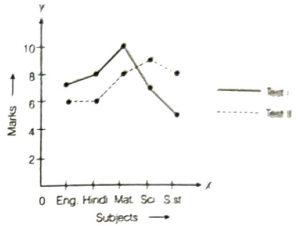
The graph given below, shows the marks obtained out of 10 by Sonia in two different tests. Study the graph and answer the questions that follow.
Image
(i) What information is represented by the axes?
(ii) In which subject did she score the highest in test I?
(iii) In which subject did she score the least in test II?
(iv) In which subjects did she score the same marks in both the tests?
Find the number of digits in the square root of each of the following numbers (without any calculation).$4489$
Draw the front, side and top view of the given shapes.
For each of the following numbers, find the smallest whole number by which it should be divided so as to get a perfect square. Also find the square root of the square number so obtained.$1620$
Kunal owns an electrical goods shop wherein he trades in home appliances and also undertakes repair of appliances. On a certain day, he bought an electric iron for ₹ 415 but it turned out fauity and he had to spend ₹ 35 on its repairs. Thereafter he sold the iron for $₹ 486$. He then bought an electric kettle for ₹ 702 including VAT at $8 \%$. He paid $₹ 48$ for its transportation and sold it, gaining $12 \%$. Next, he bought a heater for ₹ 3600 . He marked it at a price $15 \%$ above its cost and then sold it at a discount of $15 \%$ on it.
(1) What percentage of profit did Kunal earn on the electric iron?
(a) $5 \%$$\quad$(b) $8 \%$$\quad$(c) $9 \%$$\quad$(d) $14.6 \%$
(2) The original or basic cost price (excluding VAT) of the electric kettle is
(a) ₹ 646$\quad$(b) ₹ 650$\quad$(c) ₹ 654$\quad$(d) ₹ 670
(3) The price at which Kunal sold the kettle was
(a) ₹ 786$\quad$(b) ₹ 825$\quad$(c) ₹ 840$\quad$(d) ₹ 850
(4) How much profit or loss did Kunal earn by selling the heater?
(a) No profit no loss$\quad$(b) Profit of ₹ 71$\quad$(c) Loss of ₹ 71$\quad$(d) Loss of ₹ 81