Question
$\int\text{e}^{\text{x}}\Big(\frac{1-\sin\text{x}}{1-\cos\text{x}}\Big)\text{dx}=$
  1. $-\text{e}^{\text{x}}\tan\frac{\text{x}}{2}+\text{C}$
  2. $-\text{e}^{\text{x}}\cot\frac{\text{x}}{2}+\text{C}$
  3. $-\frac{1}{2}\text{e}^{\text{x}}\tan\frac{\text{x}}{2}+\text{C}$
  4. $-\frac{1}{2}\text{e}^{\text{x}}\cot\frac{\text{x}}{2}+\text{C}$
Answer

  1. $-\text{e}^{\text{x}}\cot\frac{\text{x}}{2}+\text{C}$
Solution:
Let $\text{I}=\int\text{e}^{\text{x}}\Big(\frac{1-\sin\text{x}}{1-\cos\text{x}}\Big)\text{dx}$
$\int\text{e}^{\text{x}}\Big(\frac{1}{1-\cos\text{x}}-\frac{\sin\text{x}}{1-\cos\text{x}}\Big)\text{dx}$
$\int\text{e}^{\text{x}}\bigg(\frac{1}{2\sin^2\frac{\text{x}}{2}}-\frac{2\sin\frac{\pi}{2}\cos\frac{\pi}{2}}{2\sin^2\frac{\pi}{2}}\bigg)\text{dx}$
$\int\text{e}^\text{x}\Big(\frac{1}{2}\text{cosec}^2\frac{\text{x}}{2}-\cot\frac{\text{x}}{2}\Big)\text{dx}$
As, we know that $\int\text{e}^{\text{x}}\{\text{f(x)}+\text{f}'(\text{x})\}\text{dx}=\text{e}^{\text{x}}\text{f(x)}+\text{C}$
$\therefore\ \text{I}=-\text{e}^{\text{x}}\cot\Big(\frac{\text{x}}{2}\Big)+\text{C}$

Need a full question paper?

Generate a complete, print-ready paper with questions like this in minutes — across 16+ boards, with answer keys.

Start Generating Free

Similar questions

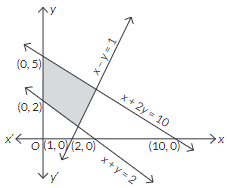
The feasible region corresponding to the linear constraints of a Linear Programming Problem is given belowImage

Which of the following is not a constraint to the given Linear Programming Problem?
Speed equation of a particle is $S =t^2-4 t+5$, Find the time having zero speed.
If the system of equations $x+k y-z=0, 3 x-k y-z=0$ and $x-3 y+z=0$ has non $-$ zero solution, then $k$ is equal to
The area enclosed between the curve $y^2=4 x$ and the line $y=x$ is
The scalar product of 5i + j - 3k and 3i - 4j + 7k is:
  1. 15
  2. -15
  3. 10
  4. -10
If the points $(p, 0), (0, q)$ and $(1, 1)$ are collinear, then $\frac{1}{\text{p}}+\frac{1}{\text{q}}$​ is equal to:
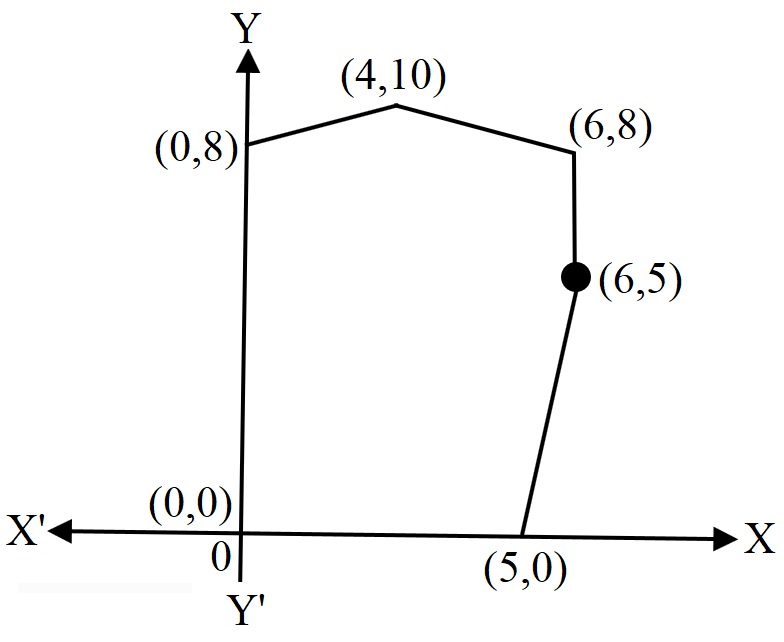
The feasible solution for a LPP is shown in the following figure. Let Z = 3x - 4y be the objective function.
Minimum of Z occurs at:
  1. (0, 0)
  2. (0, 8)
  3. (5, 0)
  4. (4, 10)
$\int\frac{1}{1-\cos\text{x}-\sin\text{x}}\text{ dx}=$
  1. $\log\big|1+\cot\frac{\pi}{2}\big|+\text{C}$
  2. $\log\big|1-\tan\frac{\pi}{2}\big|+\text{C}$
  3. $\log\big|1-\cot\frac{\pi}{2}\big|+\text{C}$
  4. $\log\big|1+\tan\frac{\pi}{2}\big|+\text{C}$
Three faces of aj ordinary dice are yellow, two faces are red and one face is blue. The dice is rolled 3 times. The probability that yellow red and blue face appear in the first second and third throws respectively, is
  1. $\frac{1}{36}$
  2. $\frac{1}{6}$
  3. $\frac{1}{30}$
  4. None of these.
Let $\begin{vmatrix}\text{x}&2&\text{x}\\\text{x}^2&\text{x}&6\\\text{x}&\text{x}&6\end{vmatrix}=\text{ax}^4+\text{bx}^3+\text{cx}^2+\text{dx}+\text{e}.$ Then, the value of $5a + 4b + 3c + 2d + e$ is equal to: