Question
The feasible region corresponding to the linear constraints of a Linear Programming Problem is given belowImage
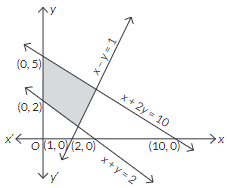
Which of the following is not a constraint to the given Linear Programming Problem?

Answer

We observe, $(0,0)$ does not satisfy the inequality
$x-y \geq 1$
So, the half plane represented by the above inequality will not contain origin therefore, it will not contain the shaded feasible region.

Need a full question paper?

Generate a complete, print-ready paper with questions like this in minutes — across 16+ boards, with answer keys.

Start Generating Free

Similar questions

Apply linear programming to this problem. A firm wants to determine how many units of each of two products (products D and E) they should produce to make the most money. The profit in the manufacture of a unit of product D is 100 and the profit in the manufacture of a unit of product E is100 and the profit in the manufacture of aunit of product E is 87. The firm is limited by its total available labor hours and total available machine hours. The total labor hours per week are 4,000. Product D takes 5 hours per unit of labor and product E takes 7 hours per unit. The total machine hours are 5,000 per week. Product D takes 9 hours per unit of machine time and product E takes 3 hours per unit. Which of the following is one of the constraints for this linear program?
The optimal value of the objective function is attained at the points
If one of the roots of $\left |\begin{matrix} 3 &\text{amp; 5} &\text{amp; x}\\ 7 &\text{amp; x} &\text{amp; 7}\\ \text{x} &\text{amp; 5} &\text{amp; 3}\end{matrix}\right |=0$ is $-10,$ the other roots are:
  1. 3, 7
  2. 4, 7
  3. 3, 9
  4. 3, 4
If $\begin{bmatrix}\cos\frac{2\pi}{7}&-\sin\frac{2\pi}{7}\\\sin\frac{2\pi}{7}&\cos\frac{2\pi}{7}\end{bmatrix}^\text{k}=\begin{bmatrix}1&0\\0&1\end{bmatrix},$ then the least positive integral value of k is:
  1. 3
  2. 4
  3. 6
  4. 7
Given that $\left[\begin{array}{ll}1 & x\end{array}\right]\left[\begin{array}{cc}4 & 0 \\ -2 & 0\end{array}\right]=0$, the value of $x$ is :
A fair die is tossed eight times. The probability that a third six is observed in the eight throw is:
  1. $\frac{\text{ }^7\text{C}_2\times5^5}{6^7}$
  2. $\frac{\text{ }^7\text{C}_2\times5^5}{6^8}$
  3. $\frac{\text{ }^7\text{C}_2\times5^5}{6^6}$
  4. $\text{None of these}$
The general solution of a differential equation of the type $\frac{d x}{d y}+ P _1 x= Q _1$ is
If $\text{f}(\text{x})=\frac{\sin^{-1}\text{x}}{\sqrt{1-\text{x}}^2},$ then $(1-\text{x})^2\text{f}''(\text{x})-\text{xf}(\text{x})=$
  1. 1
  2. -1
  3. 0
  4. None of these
Given that $A$ is a square matrix of order 3 and $|A|=-2$, then $|\operatorname{adj}(2 A)|$ is equal to
If $\text{A}=\begin{vmatrix} 10 & 2 \\ 30 & 6 \end{vmatrix}$ then $|\text{A}|$
  1. 0
  2. 10
  3. 12
  4. 60