Question
$\int\limits_{0}^{\pi}\text{x}\log\sin\text{x dx}$

Answer

Let $\text{I}=\int\limits_{0}^{\pi}\text{x}\log\sin\text{x dx}\ \ \dots(\text{i})$
$\Rightarrow\ \text{I}=\int\limits^{\pi}_{0}(\pi-\text{x})\log\sin(\pi-\text{x})\text{dx}$ $\bigg[\because\ \int\limits^{\text{b}}_{\text{a}}\text{f(x)dx}=\int\limits^{\text{b}}_{\text{a}}\text{f}(\text{a}+\text{b}-\text{x})\text{dx}\bigg]$
$\Rightarrow\ \text{I}=\int\limits^{\pi}_{0}(\pi-\text{x})\log\sin\text{x}\text{ dx}\ \ \dots(\text{ii})$
Adding (i) and (ii), we get
$2\text{I}=\pi\int^{\pi}_{0}\log\sin\text{x}\text{ dx} \ \ \dots(\text{iii})$
$2\text{I}=2\pi\int\limits^{\frac{\pi}{2}}_{0}\log\sin\text{x}\text{ dx} $
$ \bigg[\because\ \int\limits^{2\text{a}}_{0}\text{f}(\text{x})\text{dx}=2\int\limits^{\text{a}}_{0}\text{f}(\text{x})\text{dx if f}(2\text{a}-\text{x})=\text{f(x)}\bigg] $
$\Rightarrow\ \text{I}=\pi\int\limits^{\frac{\pi}{2}}_{0}\log\sin\text{x dx} \ \ \dots(\text{iv})$
$\Rightarrow\ \text{I}=\pi\int\limits^{\frac{\pi}{2}}_{0}\log\sin\Big(\frac{\pi}{2}-\text{x}\Big)\text{ dx} \ \ \dots(\text{v})$
Adding (iv) and (v), we get
$2\text{I}=\pi\int\limits^{\frac{\pi}{2}}_{0}(\log\sin\text{x}+\log\cos\text{x})\text{ dx} $
$=\pi\int\limits^{\frac{\pi}{2}}_{0}\log\sin\text{x}\cos\text{x}\text{ dx}$
$=\pi\int\limits^{\frac{\pi}{2}}_{0}\log\frac{2\sin\text{x}\cos\text{x}}{2}\text{ dx} $
$=\pi\int\limits^{\frac{\pi}{2}}_{0}(\log\sin2\text{x}-\log2)\text{ dx} $
$=\pi\int\limits^{\frac{\pi}{2}}_{0}\log\sin2\text{x dx}-\pi\int\limits^{\frac{\pi}{2}}_{0}\log2\text{ dx} $
Put $2\text{x}=\text{t}\Rightarrow\ \text{dx}=\frac{1}{2}\text{dt}$
$\therefore\ 2\text{I}=\frac{\pi}{2}\int\limits^{\pi}_{2}\log\sin\text{t dt}-\frac{\pi^2}{2}\log2$
$\Rightarrow\ \ 2\text{I}=\frac{\pi}{2}\int\limits^{\pi}_{2}\log\sin\text{x dx}-\frac{\pi^2}{2}\log2$
$\Rightarrow\ 2\text{I}=\text{I}-\frac{\pi^2}{2}\log2 $ [from Eq. (iii)]
$\therefore\ \text{I}=-\frac{\pi^2}{2}\log2 $

Need a full question paper?

Generate a complete, print-ready paper with questions like this in minutes — across 16+ boards, with answer keys.
Start Generating Free

Similar questions

Find the vector and Cartesian equations of the plane that passes through the point (5, 2, -4) and is perpendicular to the line with direction ratios 2, 3, -1.
Solve the system of linear equation, using matrix method 2x + 3y + 3z = 5; x - 2y + z = - 4; 3x - y - 2z = 3
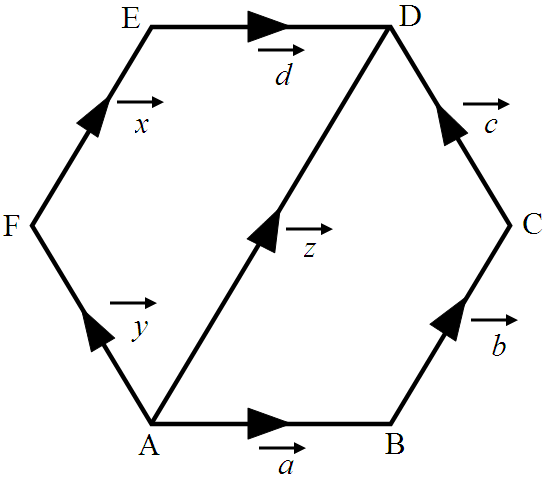
In Figure ABCD is a regular hexagon, which vectors are:
  1. Collinear.
  2. Equal.
  3. Co-initial.
  4. Collinear but not equal.
If lines $\frac{x - 1}{2} = \frac{y + 1}{3} = \frac{z - 1}{4} \text{and} \frac{x - 3}{1} = \frac{y - k}{2} = \frac{z}{1}$ intersect, then find the value of k and hence find the equation of the plane containing these lines.
A card is drawn and replaced in an ordinary pack of 52 cards. How many times must a card be drawn so that.
  1. there is at least an even chance of drawing a heart.
  2. the probability of drawing a heart is greater than $\frac{3}{4}$?
Write the minors and cofactors of element of the first column of the following matrices and hence evaluate the determinant in case:
$\text{A}=\begin{vmatrix}2&-1&0&1\\-3&0&1&-2\\1&1&-1&1\\2&-1&5&0 \end{vmatrix}$
Show that the differential equation $x^{2} d y+\left(x y+y^{2}\right) d x=0$ is homogenous and find the particular solution, given that $y = 1$ when $x = 1$.
Find the vector and cartesian forms of the plane passing through the point (1, 2, -4) and parallel to the lines $\vec{\text{r}}=(\hat{\text{i}}+2\hat{\text{j}}-4\hat{\text{k}})+\lambda(2\hat{\text{i}}+3\hat{\text{j}}+6\hat{\text{k}})$ and $\vec{\text{r}}=(\hat{\text{i}}-3\hat{\text{j}}+5\hat{\text{k}})+\mu(\hat{\text{i}}+\hat{\text{j}}-\hat{\text{k}}).$ Also, find the distance of the point (9, -8, -10) from the plane thus obtained.
Show that the family of curves for which the slope of the tangent at any point (x, y) on it is $ \frac { x ^ { 2 } + y ^ { 2 } } { 2 x y }$, is given by $x^2 - y^2 = cx$.
Prove using vector: the quadrilateral obtained by joining mid-points of adjacent sides of a rectangle is a rhombus.