MCQ
Ionisation energy for hydrogen atom in the ground state is $E$. What is the ionisation energy of $Li^{++}$ atom in the $2\ nd$ excited state:
  • $E$
  • B
    $3E$
  • C
    $6E$
  • D
    $9E$

Answer

Correct option: A.
$E$

Need a full question paper?

Generate a complete, print-ready paper with questions like this in minutes — across 16+ boards, with answer keys.
Start Generating Free

Similar questions

An $X-$ ray tube is operating at $50 kV$ and $20 mA$. The target material of the tube has a mass of $1.0 kg$ and specific heat $495 J kg-1 ^o{C^{ - 1}}$. One percent of the supplied electric power is converted into $X-$ rays and the entire remaining energy goes into heating the target. Then
The value of electric permittivity of free space is:
Light takes $8$ min $ 20\, sec$ to reach from sun on the earth. If the whole atmosphere is filled with water, the light will take the time ($_a{\mu _w} = 4/3$)
The maximum number of possible interference maxima for slit separation equal to $1.8\,\lambda $, where $\lambda $ is the wavelength of light used, in a Young's double slit experiment is
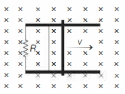
A conducting bar of mass $m$ and length $l$ moves on two frictionless parallel rails in the presence of a constant uniform magnetic field of magnitude $B$ directed into the page as shown in the figure. The bar is given an initial velocity $v_{0}$ towards the right at $t=0$. then, the
How much water should be filled in a container $21 cm$ in height, so that it appears half filled when viewed from the top of the container......$cm$ (given that $_a{\mu _\omega } = 4/3$)
An elementary particle of mass $m$ and charge $+e$ is projected with velocity $v$ at a much more massive particle of charge $Ze$, where $Z > 0$. What is the closest possible approach of the incident particle
Which one of the following is known as Saptarishi
A telescope of diameter $2m$ uses light of wavelength $5000 Å$ for viewing stars. The minimum angular separation between two stars whose image is just resolved by this telescope is
Two amplifier are connected one after the other in series (cascade). The first amplifier has a voltage gain $10$ and the second has a voltage gain of $20$. If the input signal is $0.01\, V$, the out $ac$ signal will be........$V$