MCQ
The maximum number of possible interference maxima for slit separation equal to $1.8\,\lambda $, where $\lambda $ is the wavelength of light used, in a Young's double slit experiment is
  • A
    zero
  • $3$
  • C
    infinite
  • D
    $5$

Answer

Correct option: B.
$3$
b
As $\sin \theta=\frac{n \lambda}{d}$ and $\sin \theta$ cannot be $ \ne \,1$

$\therefore 1=\frac{n \lambda}{1.8 \lambda}$

or $n=1.8$

Hence maximum number of possible interference maximas, $0, \pm 1$ i.e. $3$

Need a full question paper?

Generate a complete, print-ready paper with questions like this in minutes — across 16+ boards, with answer keys.
Start Generating Free

Similar questions

A constant voltage is applied between two ends of a metallic wire. If the length is halved and the radius of the wire is doubled, the rate of heat developed in the wire will be
If a coil made of conducting wires is rotated between poles pieces of the permanent magnet. The motion will generate a current and this device is called
A beam of monochromatic light is used to excite the electron in $Li ^{++}$from the first orbit to the third orbit. The wavelength of monochromatic light is found to be $x \times 10^{-10} \; m$. The value of $x$ is $\dots.$ [Given hc $=1242 \; eV nm ]$
If one face of a prism of prism angle $30^o$ and $\mu  = \sqrt 2 $ is silvered, the incident ray retraces its initial path. The angle of incidence is.......$^o$
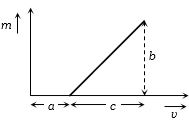
The graph shows how the magnification $m$ produced by a convex thin lens varies with image distance $v$. What was the focal length of the used
A cathode emits $1.8 \times {10^{14}}$ electrons per second, when heated. When $ 400\;V$  is applied to anode all the emitted electrons reach the anode. The charge on electron is $1.6 \times {10^{ - 19}}\;C$. The maximum anode current is ............ $\mu A$
The path of a refracted ray of light in a prism is parallel to the base of the prism only when the
A FM Broad cast transmitter, using modulating signal of frequency $20\,kHz$ has a deviation ratio of $10$. The Bandwidth required for transmission is $.......kHz$
In an $X-$ ray tube electrons bombarding the target produce $X-$ rays of minimum wavelength $1\; \mathring A$. What must be the energy of bombarding electrons.......$eV$
Which of the following is true for a sample of isotope containing ${U^{235}}$ and ${U^{238}}$