Question
Is $\text{p}=\frac{\text{E}}{\text{c}}$ valid for electrons?

Answer

From Einstein's mass- energy equation,$\text{E}=\text{mc}^2$
$\Rightarrow\text{E}=\frac{\text{m}_0\text{c}^2}{\sqrt{1\frac{\text{v}^2}{\text{c}^2}}}$
Relativistic momentum,
$\text{p}=\text{mv}$
$\Rightarrow\text{p}=\frac{\text{m}_0\text{c}^2}{\sqrt{1\frac{\text{v}^2}{\text{c}^2}}}$
Combining the above equations, we get:
$\text{E}^2=\text{m}_0^2\text{c}^ 4+\text{p}^2\text{c}^2$
From the above equation, it is clear that for $\text{p}=\frac{\text{E}}{\text{c}}$ to be valid, the rest mass of the body should be zero. As electrons do not have zero rest mass, this equation is not valid for electrons.

Need a full question paper?

Generate a complete, print-ready paper with questions like this in minutes — across 16+ boards, with answer keys.
Start Generating Free

Similar questions

Briefly explain the cause of special cylindrical shape of bullets.
There are energy bands in a solid. Do we have really continuous energy variation in a band or do we have very closely spaced but still discrete energy levels?
The length, breadth and thickness of a block of metal were measured with the help of a Vernier Callipers. The measurements are: $\text{l}=(5.250\pm0.001)\text{cm}$ $\text{b}=(3.450\pm0.001)\text{cm}$ $\text{t}=(1.740\pm0.001)\text{cm}$ Find the percentage error in volume of the block.
When you lift a box from the floor and put it on an almirah the potential energy of the box increases, but there is no change in its kinetic energy. Is it a violation of conservation of energy?
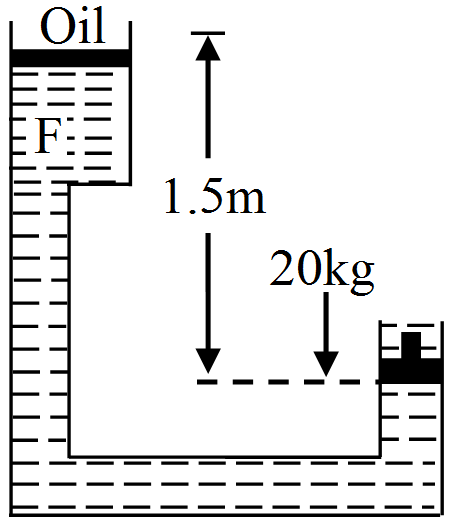
The figure adjoining shows a hydraulic press with the larger piston of diameter $35cm$ at a height of $1.5m$ relative to the smaller piston of diameter $10cm$. The mass on the smaller piston is $20kg$. What is the force exerted on the load by the larger piston? The density of oil in the press is $750kg m^{-3}$.
State work energy theorem for rotational motion.
Three moles of an ideal diatomic gas is taken at a temperature of $300K$. Its volume is doubled keeping its pressure constant. Find the change in internal energy of gas.
Carbon $(Z = 6)$ with mass number $11$ decays to boron $(Z = 5)$.
  1. Is it a $\beta^+-\text{decay}$ or a $\beta^--\text{decay}?$
  2. The half$-$life of the decay scheme is $20.3$ minutes. How much time will elapse before a mixture of $90\%$ carbon$-11$ and $10\%$ boron$-11 ($by the number of atoms$)$ converts itself into a mixture of $10\%$ carbon$-11$ and $90\%$ boron$-11?$
An electric bulb is designed to operate at 12 volts DC. If this bulb is connected to an AC source and gives normal brightness, what would be the peak voltage of the source?
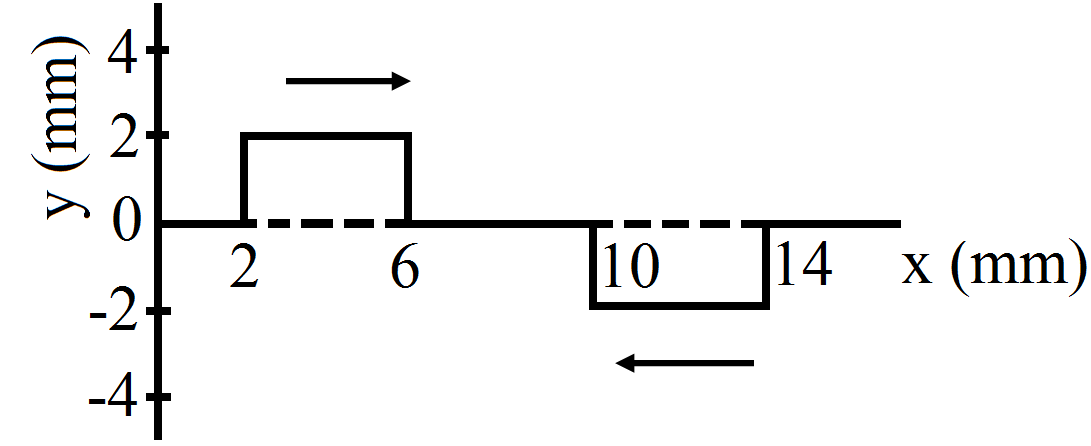
Figure shows two wave pulses at t = 0 travelling on a string in opposite directions with the same

wave speed 50cm/s. Sketch the shape of the string at t = 4ms, 6ms, 8ms, and 12ms.