Question
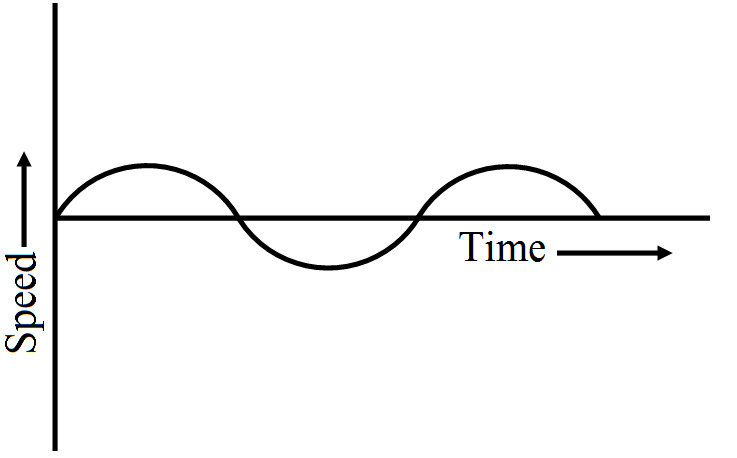
Is the speed-time graph shown in Fig possible?

Answer

No. Speed cannot be negative.

Need a full question paper?

Generate a complete, print-ready paper with questions like this in minutes — across 16+ boards, with answer keys.
Start Generating Free

Similar questions

A Carnot engine works between temperatures $T_1 K$ and $T_2 K$. Prove that to increase its efficiency it will be more effective to reduce the sink temperature to the same value than increasing the source temperature.
A body hanging from a spring can oscillate in a horizontal plane with angular velocity $\omega$ without friction or damping when it is stretched to a distance and then released. It passes through the equilibrium center with a velocity at time $t=0$. Find the amplitude of the resultant oscillation in terms of parameter $\omega_0, x_0$ and $v_0$.
[Hint : The equation $x=a \cos (\omega t+\theta)$ is negative keep in mind that the initial]
Without any torque, the angular velocity of an object change from 1 revolution per 25 second to 1 revolution per second. Find the ratio of the radii of rotation of the object in these two situations
Which of the following functions of time represent (a) simple harmonic, (b) periodic but not simple harmonic, and (c) non-periodic motion? Give period for each case of periodic motion ($\omega$ is any positive constant):
$3\cos\Big(\frac{\pi}{4}-2\omega\text{t}\Big)$
A plate of thickness t made of a material of refractive index $\mu$ is placed in front of one of the slits in a double slit experiment.
  1. Find the change in the optical path due to introduction of the plate.
  2. What should be the minimum thickness t which will make the intensity at the centre of the fringe pattern zero? Wavelength of the light used is $\lambda$. Neglect any absorption of light in the plate.
If a constant potential difference is applied across a bulb, the current slightly decreases as time passes and then becomes constant. Explain.
Rule out or accept the following formulae for kinetic energy on the basis of dimensional arguments:
  1. $\frac{3}{16}\text{mv}^2$
  2. $\frac{1}{2}\text{mv}^2+\text{ma}$
The heart rate (number of heart beats per minute) scales as $\frac{1}{\text{L}}$ where L is the characteristic length of the mammal. Can you explain this?
If the scale factor of a human relative to a rhesus monkey is about 2.5, what is the monkey's heart rate?
A steel ring of radius r and cross-section area A is fitted onto a wooden disc of radius R(R > r). If Young's modulus be E, find the force with which the steel ring is expanded.
Explain why (or how):
in a sound wave, a displacement node is a pressure antinode and vice versa,