Question
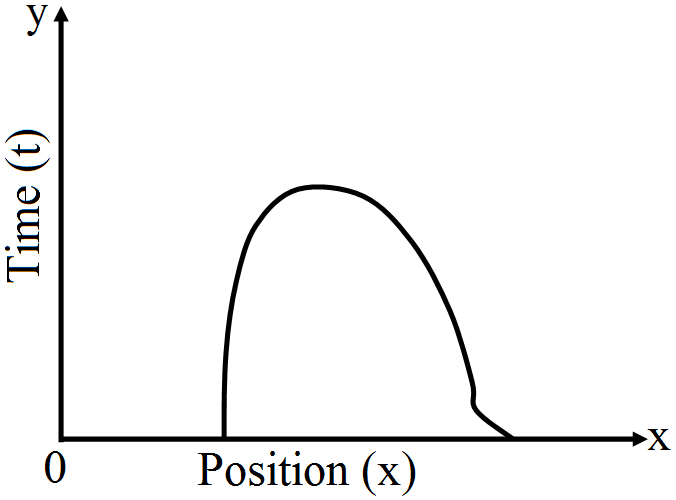
Is the time variation of position shown in figure observed in nature possible?

Answer

No, when x increases, the time first increases and then decreases. It is not possible. It implies that at a given time, the body in motion is simultaneously at two different positions which is not possible.

Need a full question paper?

Generate a complete, print-ready paper with questions like this in minutes — across 16+ boards, with answer keys.
Start Generating Free

Similar questions

The density of mercury is $13.6 g cm ^{-3}$ in CGS system. Find its value in SI units.
Make a graphical representation of the average kinetic or potential energy per oscillation.
Explain why: The climate of a harbour town is more temperate than that of a town in a desert at the same latitude.
Derive an expression for the excess pressure inside a liquid drop.
Show graphically how g varies as you move from the centre of earth to great heights above the surface.
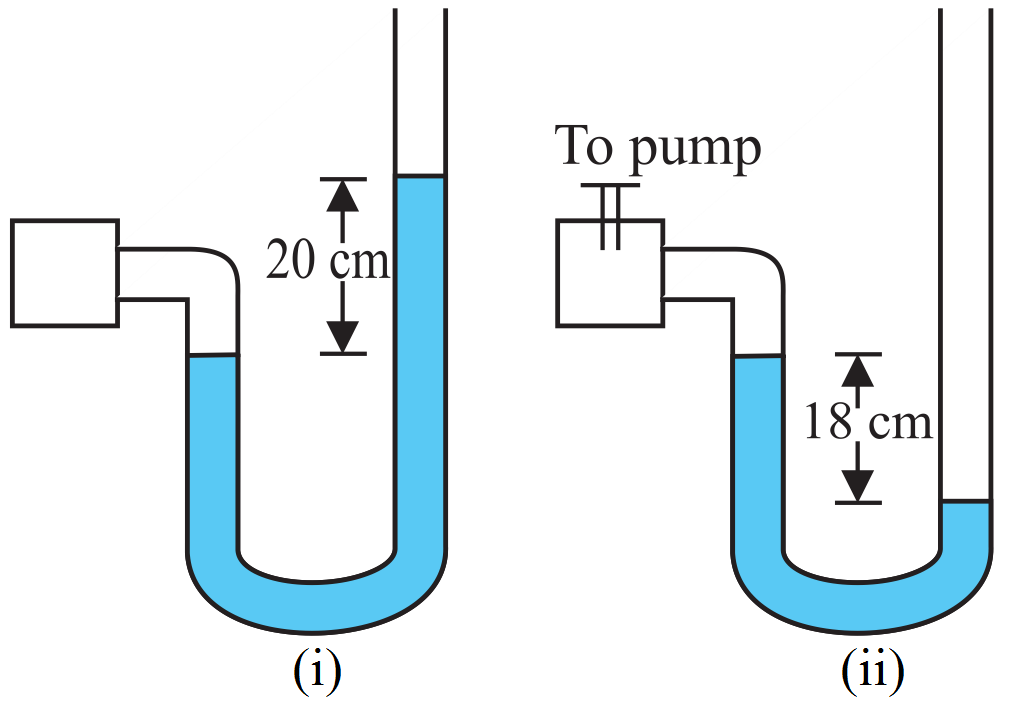
A manometer reads the pressure of a gas in an enclosure as shown in Fig.(a) When a pump removes some of the gas, the manometer reads as in Fig. (b) The liquid used in the manometers is mercury and the atmospheric pressure is $76cm$ of mercury. Give the absolute and gauge pressure of the gas in the enclosure for cases (i) and (ii) in units of cm of mercury. How would the levels change in case (i) if $13.6cm$ of water (immiscible with mercury) are poured into the right limb of the manometer? (Ignore the small change in volume of the gas.)
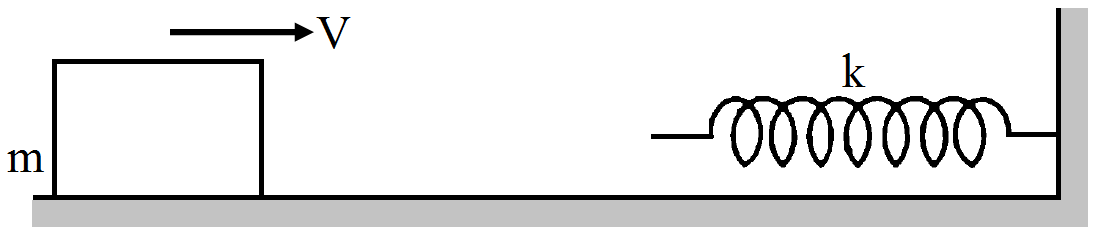
A block of massip, sliding on a smooth horizontal surface with a velocity $\vec{\text{v}}$ meets a long horizontal spring fixed at one end and having spring constant k as shown in figure. Find the maximum compression of tin spring. Will the velocity of the block be the same $\vec{\text{v}}$ when it comes back to the original position shown?
A book is lifted from the floor and is kept in an almirah. One person says that the potential energy of the book is increased by 20J and the other says it is increased by 30J. Is one of them necessarily wrong?
A voltmeter consists of a $25\Omega$ coil connected in series with a $575\Omega$ resistor. The coil takes 10mA for full scale deflection. What maximum potential difference can be measured by this voltmeter?
Is a slow process always isothermal? ls a quick process always adiabatic?