Question
Is there any lower limit to the electric force between two particles placed at a separation of 1cm ?

Answer

Yes, there's a lower limit to the electric force between two particles placed at a separation of 1cm, which is equal to the magnitude of force of repulsion between two electrons placed at a separation of 1cm.

Need a full question paper?

Generate a complete, print-ready paper with questions like this in minutes — across 16+ boards, with answer keys.
Start Generating Free

Similar questions

What does the red shift in the spectrum of a galaxy indicate?
Answer the following question:
Ray optics is based on the assumption that light travels in a straight line. Diffraction effects (observed when light propagates through small apertures/slits or around small obstacles) disprove this assumption. Yet the ray optics assumption is so commonly used in understanding location and several other properties of images in optical instruments. What is the justification?
Write the equation of electric potential for electric dipole and discuss its special cases.
Calculate the dimensions of:
  1. $\int\vec{\text{E}}.\vec{\text{dl}}.$
  2. $\text{vBl}$
  3. $\frac{\text{d}\psi_{\text{B}}}{\text{dt}}$
The symbols have their usual meanings.
Answer the following question:
Does the apparent depth of a tank of water change if viewed obliquely? If so, does the apparent depth increase or decrease?
A long narrow horizontal slit is placed 1mm above a horizontal plane mirror. The interference between the light coming directly from the slit and that after reflection is seen on a screen 1.0m away from the slit. Find the fringe-width if the light used has a wavelength of 700nm.
Net capacitance of three identical capacitors in series is $1\mu\text{F}.$ What will be their net capacitance if connected in parallel?
Find the ratio of energy stored in the two configurations if they are both connected to the same source.
When n capacitors of capacitance C are connected in series, the equivalence is $C _s$ and when connected in parallel, the equivalence is $C _p$. Prove that $C _{ P }- C _{ S }=\frac{\left(n^2-1\right) C }{n}$
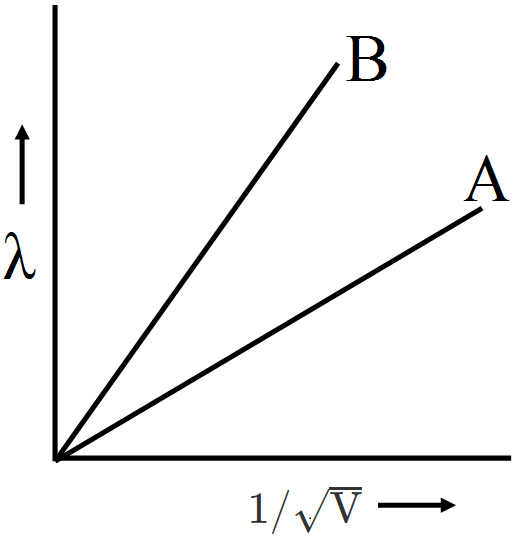
Two lines A and B shown in the graph represent the de Broglie wavelength $(\lambda)$ as a function of $\frac{1}{\sqrt{\text{V}}}$ (V is the accelerating potential) for two particles having the same charge. Which of the two represents the particle of smaller mass?
The internal resistance of an accumulator battery of emf 6V is $10\Omega$ when it is fully discharged. As the battery gets charged up, its internal resistance decreases to $1\Omega.$
The battery in its completely discharged state is connected to a charger that maintains a constant potential difference of 9V. Find the current through the battery (a) just after the connections are made and (b) after a long time when it is completely charged.