Question
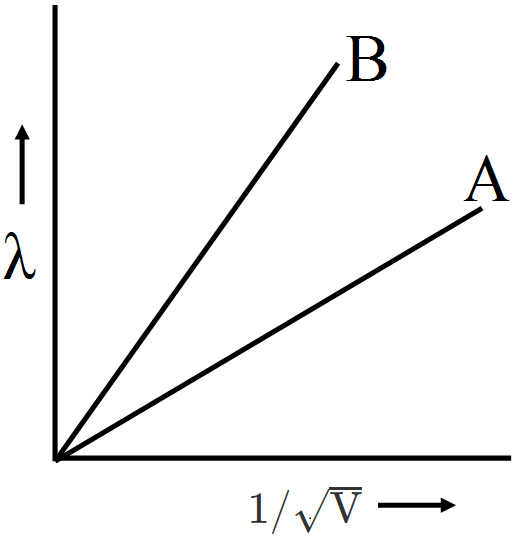
Two lines A and B shown in the graph represent the de Broglie wavelength $(\lambda)$ as a function of $\frac{1}{\sqrt{\text{V}}}$ (V is the accelerating potential) for two particles having the same charge. Which of the two represents the particle of smaller mass?
Answer

de Broglie wavelength $\lambda=\frac{\text{h}}{\sqrt{2\text{mqV}}}$ or $\lambda=\frac{\text{h}}{\sqrt{2\text{mq}}}.\frac{1}{\sqrt{\text{V}}}$
The graph of $\lambda$ versus $\frac{1}{\sqrt{\text{V}}}$ is a straight line of slope $\frac{\text{h}}{\sqrt{2\text{mq}}}\propto\frac{1}{\sqrt{\text{m}}}.$ The slope of line B is large, so particle B has smaller mass.

Need a full question paper?

Generate a complete, print-ready paper with questions like this in minutes — across 16+ boards, with answer keys.

Start Generating Free

Similar questions

Consider the situation shown in figure. The switch is closed at t = 0 when the capacitors are uncharged. Find the charge on the capacitor $C_1$ as a function of time t.
A barometer tube is 80cm long (above the mercury reservoir). It reads 76cm on a particular day. A small amount of water is introduced in the tube and the reading drops to 75.4cm. Find the relative humidity in the space above the mercury column if the saturation vapour pressure at the room temperature is 1.0cm.
A spherical surface of radius 30cm separates two transparent media A and B with refractive indices 1.33 and 1.48 respectively. The medium A is on the convex side of the surface. Where should a point object be placed in medium A so that the paraxial rays become parallel after refraction at the surface?
Assume that the magnetic field is uniform in a cubical region and is zero outside. Can you project a charged particle from outside into the field so that the particle describes a complete circle in the field?
Answer the following:
The discharging current in the atmosphere due to the small conductivity of air is known to be 1800A on an average over the globe. Why then does the atmosphere not discharge itself completely in due course and become electrically neutral? In other words, what keeps the atmosphere charged?
What is the rms value of alternating current shown in figure?
By evaluating $\int\text{i}^2\text{Rdt},$ show that when a capacitor is charged by connecting it to a battery through a resistor, the energy dissipated as heat equals the energy stored in the capacitor.
A high jumper successfully clears the bar. Is it possible that his centre of mass crossed the bar from below it? Try it with appropriate figures.
A beam of light consisting of two wavelengths, $4000 \mathring A$ and $6000 \mathring A ,$ is used to obtain interference fringes in a Young’s double$-$slit experiment. What is the least distance from the central maximum where the dark fringe is obtained?
Which of the following electromagnetic waves has (a) minimum wavelength, and (b) minimum frequency? Write one use of each of these two waves.
Infrared waves, Microwaves, $\gamma$-rays and X-rays