Question
Isogonic lines on magnetic map will have(a) Zero angle of dip(b) Zero angle of declination(c) Same angle of declination(d) Same angle of dip


Answer

(c) Same angle of declination

Need a full question paper?

Generate a complete, print-ready paper with questions like this in minutes — across 16+ boards, with answer keys.
Start Generating Free

Similar questions

For a fast chain reaction, the size of $U^{235 }$ block, as compared to its critical size, must be:
Assertion :  If an electron is not deflected while passing through a certain region of space, then only possibility is that there is no magnetic region.
Reason    : Force is directly proportional to the magnetic field applied.(a) If both assertion and reason are true and the reason is the correct explanation of the assertion.(b) If both assertion and reason are true but reason is not the correct explanation of the assertion.(c) If assertion is true but reason is false.(d) If assertion is false but reason is true.


Two metal spheres of capacitances $C_1$ and $C_2$ carry some charges. They are put in contact and then separated. The final charges $Q_1$ and $Q_2$ on them will satisfy:
The unit of electric field intensity is:
Which error is removed when the known and unknown resistances are interchanged in a Meter Bridge?
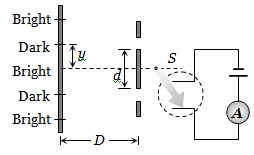
In the following arrangement $y = 1.0\ mm, d = 0.24\ mm$ and $D = 1.2 m.$ The work function of the material of the emitter is $2.2\ eV.$ The stopping potential $V$ needed to stop the photo current will be
When a proton moves in a uniform magnetic field, the momentum change but its kinetic energy does not change because:
In a certain double slit experimental arrangement interference fringes of width 1.0 mm each are observed when light of wavelength 5000 Å is used. Keeping the set up unaltered, if the source is replaced by another source of wavelength 6000 Å, the fringe width will be(a) 0.5 mm(b) 1.0 mm(c) 1.2 mm(d) 1.5 mm
       
Ray diverging from a point source from a wave front that is(a) Cylindrical(b) Spherical(c) Plane  (d) Cubical
       
The temperature of the cold junction of thermo$-$couple is $0^{\circ} \mathrm{C}$ and the temperature of hot junction is $\mathrm{T}^{\circ} \mathrm{C}$. The $e.m.f.$ is $\mathrm{E}=16 \mathrm{~T}-0.04$ $\mathrm{T}^2 \mu$ volts. The temperature of inversion is