MCQ
Isotonic solutions are those which have the:
  • A
    same density
  • B
    same normality
  • C
    same molarity
  • D
    same osmotic pressure

Answer

D. same osmotic pressure
Explanation:
A solution of $\frac{M}{2} NaCl$ is isotonic with M glucose. The required condition is $\pi_1=\pi_2$.

Need a full question paper?

Generate a complete, print-ready paper with questions like this in minutes — across 16+ boards, with answer keys.

Start Generating Free

Similar questions

The vapour pressure of pure water at $25\,^oC$ is $23.62\, mm$. What will be the vapour pressure of a solution of $1.5\, g$ urea in $50\, g$ water ? .......... $mm$
In the following reaction

$\begin{matrix}
   \begin{matrix}
   C{{H}_{3}}\,\,\,\,\,\,\,\, \,\, \\
   |\,\,\,\,\,\,\,\,\,\,\,\,\,\,\,\,\,\,  \\
\end{matrix}  \\
   C{{H}_{3}}-C-CH=C{{H}_{2}}  \\
   |\,\,\,\,\,\,\,\,\,\,\,\,\,\,\,\,\,\,  \\
   C{{H}_{3}}\,\,\,\,\,\,\,\, \,\,\,\, \\
\end{matrix}\,$ $\xrightarrow{{{H}_{2}}O/{{H}^{\oplus }}}$ $\underset{Major\,\,product}{\mathop{A}}\,$ $+$ $\underset{Major\,\,product}{\mathop{B}}\,$

The major product is
An acyl halide is formed when $PC{l_5}$ reacts with an
The reaction    $\mathop {\mathop {\mathop {\mathop {C{H_3} - C - C{H_3}}\limits^{\,|} }\limits^{\,\,\,\,\,\,\,C{H_3}} }\limits_{|\,} }\limits_{OH}     \xrightarrow{H_2SO_4}   \mathop {\mathop {C{H_3} - C = C{H_2}}\limits^{\,|} }\limits^{\,\,\,\,\,\,\,C{H_3}} $   is the example of 
Which of the following is INCORRECT :-
Molecule    $\&$     Type of overlapping in bridge bond
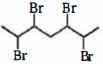
The maximum number of stereoisomers that could exist for the compound below ?
Among the triatomic molecules/ions, $BeCl _2, N _3^{-}, N _2 O , NO _2^{+}, O _3, SCl _2, ICl _2^{-}, I _3^{-}$and $XeF _2$, the total number of linear molecule$(s)$/ion$(s)$ where the hybridization of the central atom does not have contribution from the $d$-orbital(s) is

[Atomic number: $S =16, C 1=17, I =53$ and $Xe =54$ ]

Which of the following have $3C-2e^-$ bond
$I.$ $Al_2Cl_6$        $II.$ $B_2H_6$
$III.$ $Fe_2Cl_6$       $IV.$ $Si_2H_6$
Empirical formula of a compound is ${C_2}{H_5}O$ and its molecular weight is $90$. Molecular formula of the compound is
 $\begin{array}{*{20}{c}}
  {H\,\,\,\,\,\,\,H\,\,\,\,\,\,\,\,\,\,\,\,} \\ 
  {\,\,|\,\,\,\,\,\,\,\,\,\,\,\,|\,\,\,\,\,\,\,\,\,\,\,\,\,\,\,\,\,} \\ 
  {C{H_3}{ - ^2}C{ - ^3}CH{ - ^4}C{H_2} - H} \\ 
  {\,|\,\,\,\,\,\,\,\,\,\,\,\,\,\,\,\,\,\,\,\,\,\,\,\,\,\,\,} \\ 
  {\,\,{\,_1}C{H_2} - H\,\,\,\,\,\,\,\,\,\,\,\,\,\,\,\,\,} 
\end{array}$ $C_1-H, C_2-H, C_3-H$ and $C_4-H$ the homolytic bond dissociation energy is in the order