Question
Isotopes of an element contain:

Answer

  1. The same number of protons but different number of neutrons.
Explanation:
Isotopes of an element must have same atomic number (Z) but different mass number A.
Number of protons is equal to the atomic number.
So, isotopes of an element have same number of protons.
Mass number is equal to the sum of number of protons and neutrons i.e. A = p + n
As isotopes of an element have different mass number but same number of protons, thus they must have different number of neutrons.
Need a full question paper?

Generate a complete, print-ready paper with questions like this in minutes — across 16+ boards, with answer keys.

Start Generating Free

Similar questions

How did de – Broglie conclude the modification of Bohr’s II postulate?
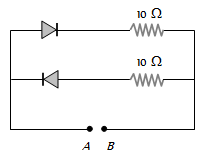
A $2V$ battery is connected across the points $A$ and $B$ as shown in the figure given below. Assuming that the resistance of each diode is zero in forward bias and infinity in reverse bias, the current supplied by the battery when its positive terminal is connected to $A$ is
The incident photon involved in the photoelectric effect experiment.(a) Completely disappears(b) Comes out with an increased frequency  (c) Comes out with a decreased frequency(d) Comes out without change in frequency


Plane of eddy currents makes an angle with the plane of magnetic lines of force equal to(a) 40°(b) 0°(c) 90°(d) 180°
       
A potentiometer has uniform potential gradient across it.  Two cells connected in series (i) to support each other and (ii) to oppose each other are balanced over 6m and 2m respectively on the potentiometer wire.  The e.m.f.’s of the cells are in the ratio of(a) 1 : 2(b) 1 : 1(c) 3 : 1(d) 2 : 1
       
A nucleus moving with a velocity $\vec{\text{v}}$ emits an $\alpha -$particle. Let the velocities of the $\alpha -$particle and the remaining nucleus be $\vec{\text{v}}_1$ and $\vec{\text{v}}_2$ and their masses be $m_1$ and $m_2.$
  1. $\vec{\text{v}},\ \vec{\text{v}}_1$ and $\vec{\text{v}}_2$ must be parallel to each other.
  2. None of the two of $\vec{\text{v}},\ \vec{\text{v}}_1$ and $\vec{\text{v}}_2$ should be parallel to each other.
  3. $\vec{\text{v}}_1+\vec{\text{v}}_2$ must be parallel to $\vec{\text{v}}.$
  4. $\text{m}_1\vec{\text{v}}_1+\text{m}_2\vec{\text{v}}_2$ must be parallel to $\vec{\text{v}}.$
A condenser of $2\ mF$ capacitance is charged steadily from $0$ to $5$ Coulomb. Which of the following graphs correctly represents the variation of potential difference across its plates with respect to the charge on the condenser
A medium is said to be dispersive, if(a) Light of different wavelengths propagate at different speeds(b) Light of different wavelengths propagate at same speed but has different frequencies(c) Light is gradually bent rather than sharply refracted at an interface between the medium and air(d) Light is never totally internally reflected


An electron is accelerated through a potential difference of $200$ volts. If $e/m$ for the electron be $1.6 \times 10^{11}$ coulomb/kg, the velocity acquired by the electron will be
Kirchhoff's current rule depends on: