The equation of a progressive wave is $y = 0.02\,\sin \,2\pi \left[ {\frac{t}{{0.01}} - \frac{x}{{0.30}}} \right]$ Here $x$ and $y$ are in metre and $t$ is in second. The velocity of propagation of the wave is .... $ms^{-1}$
AIIMS 2014, Medium
Download our app for free and get started
$\omega=\frac{2 \pi}{0.01}$ and $\mathrm{k}=\frac{2 \pi}{0.30}$
$v=\frac{\omega}{k}=\frac{2 \pi}{0.01} \times \frac{0.30}{2 \pi}=30 \mathrm{ms}^{-1}$

Download our appand get started for free
Experience the future of education. Simply download our apps or reach out to us for more information. Let's shape the future of learning together!No signup needed.*
Similar Questions
- 1A wire of density $9 \times 10^{-3} \,kg\, cm ^{-3}$ is stretched between two clamps $1\, m$ apart. The resulting strain in the wire is $4.9 \times 10^{-4}$. The lowest frequency of the transverse vibrations in the wire is......$HZ$View Solution
(Young's modulus of wire $Y =9 \times 10^{10}\, Nm ^{-2}$ ), (to the nearest integer),
- 2Two travelling waves ${y_1} = A\sin [k(x - c\,t)]$ and ${y_2} = A\sin [k(x + c\,t)]$ are superimposed on string. The distance between adjacent nodes isView Solution
- 3A piano string $1.5\,m$ long is made of steel of density $7.7 \times 10^3 \,kg/m^3$ and Young’s modulus $2 \times 10^{11} \,N/m^2$. It is maintained at a tension which produces an elastic strain of $1\%$ in the string. The fundamental frequency of transverse vibrations of string is ......... $Hz$View Solution
- 4View SolutionThe loudness and pitch of a sound depends on
- 5View SolutionWhat is the phase difference between the displacement wave and pressure wave in sound wave?
- 6An open organ pipe of length $l$ is sounded together with another organ pipe of length $l + x$ in their fundamental tones $(x < < l)$. The beat frequency heard will be (speed of sound is $v$) :View Solution
- 7When two tuning forks (fork $1$ and fork $2$ ) are sounded together, $4$ beats per second are heard. Now some tape is attached on the prong of the fork $2$. When the tuning forks are sounded again, $6$ beats per second are heard. If the frequency of fork $1$ is $200 \,Hz$, then the original frequency of fork $2$ is ........... $Hz$View Solution
- 8The amplitude of wave disturbance propagating in the positive $x$-direction is given by $y=\frac{1}{(1+x)^{2}}$ at time $t=0$ and $y=\frac{1}{1+(x-2)^{2}}$ at $t=1$ s, where $x$ and $y$ are in metres. The shape of wave does not change during the propagation. The velocity of the wave will be $...\,{m} / {s}.$View Solution
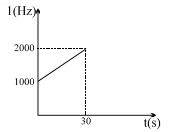
- 9A detector is released from rest over a source of sound of frequency $f = 10^3 \,\,Hz$. The frequency observed by the detector at time $t$ is plotted in the graph. The speed of sound in air is $(g = 10 \,\,m/s^2)$ ... $m/s$View Solution
- 10Two vibrating tuning forks produce progressive waves given by ${Y_1} = 4\sin 500\pi t$ and ${Y_2} = 2\sin 506\pi t.$ Number of beats produced per minute isView Solution