MCQ
It is easier to draw up a wooden block along an inclined plane than to haul it vertically, principally because
  • A
    The friction is reduced
  • B
    The mass becomes smaller
  • Only a part of the weight has to be overcome
  • D
    ‘g’ becomes smaller

Answer

Correct option: C.
Only a part of the weight has to be overcome
c
(c)Opposing force in vertical pulling $= mg$
But opposing force on an inclined plane is $mg\, sin \theta$, which is less than $mg$.

Need a full question paper?

Generate a complete, print-ready paper with questions like this in minutes — across 16+ boards, with answer keys.
Start Generating Free

Similar questions

A container holds $10^{26} molecules/m^3$ each of mass $3 \times 10^{-27}\,\,kg$. Assume that $1/6$ of the molecules move with velocity $2000 \,\,m/s$ directly towards one wall of the container while the remaining $5/6$ of the molecules move either away from the wall or in perpendicular direction, and all collisions of the molecules with the wall are elastic
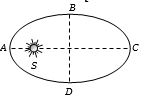
A planet is revolving around the sun as shown in elliptical path  the orbital velocity of the planet will be minimum at
Two tuning forks of frequencies $256$ and $258$ vibrations/sec are sounded together, then time interval between consecutive maxima heard by the observer is ..... $sec$
A metallic bar of Young's modulus, $0.5 \times 10^{11} \mathrm{~N} \mathrm{~m}^{-2}$ and coefficient of linear thermal expansion $10^{-5}{ }^{\circ} \mathrm{C}^{-1}$, length $1 \mathrm{~m}$ and area of cross-section $10^{-3} \mathrm{~m}^2$ is heated from $0^{\circ} \mathrm{C}$ to $100^{\circ} \mathrm{C}$ without expansion or bending. The compressive force developed in it is :
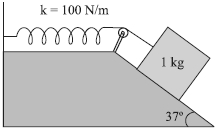
A $1\; kg$ block situated on a rough incline is connected to a spring of spring constant $100\;N m ^{-1}$ as shown in Figure. The block is released from rest with the spring in the unstretched position. The block moves $10 \;cm$ down the incline before coming to rest. Find the coefficient of friction between the block and the incline. Assume that the spring has a negligible mass and the pulley is frictionless.
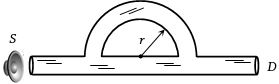
A sound wave of wavelength $32 cm$ enters the tube at $S$ as shown in the figure. Then the smallest radius $r$ so that a minimum of sound is heard at detector $D$ is  ... $cm$
The rate of change of velocity is:
If there is no external force acting on a non-rigid body, which of the following quantities must remain constant?
Which of the following time measuring devices is most precise? Give reason for your answer.
A particle moves along $x$-axis in such a way that its $x$-co-ordinate varies with time according to the equation $x=4-2 t+t^2$. The speed of the particle will vary with time as