MCQ
It is easier to roll a barrel than pull it along the road. This statement is
  • A
    False
  • True
  • C
    Uncertain
  • D
    Not possible

Answer

Correct option: B.
True
b
This phenomenon can be explained by the concept of friction.  It is easier to roll a barrel than to pull it on the road because while pulling the barrel because rolling friction is less than sliding friction

Need a full question paper?

Generate a complete, print-ready paper with questions like this in minutes — across 16+ boards, with answer keys.
Start Generating Free

Similar questions

A particle moves along a circle of radius $\left( {\frac{{20}}{\pi }} \right)\,m$ with constant tangential acceleration. If the velocity of the particle is $80 \,m/s$ at the end of the second revolution after motion has begin, the tangential acceleration is
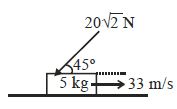
A block of mass $5\, kg$ is kept on a rough horizontal floor. It is given a velocity $33\, m/s$ towards right. A force of $20\sqrt {2\,} \,N$ continuously acts on the block as shown in the figure. If the coefficient of friction between block and floor is $0.5$ the velocity of block after $3\, seconds$ is ........ $m/s$  ($g = 10\, m/s^2$)
Block of mass $10 \,kg$ is moving on inclined plane with constant velocity $10 \,m / s$. The coefficient of kinetic friction between incline plane and block is ...........
When a conservative force does positive work on a body
A Young's double slit experiment is performed with white light:
  1. The central fringe will be white.
  2. There will not be a completely dark fringe.
  3. The fringe next to the central will be red.
  4. The fringe next to the central will be violet.
$A$ ball is thrown vertically downwards with velocity $\sqrt {2gh} $ from $a$ height $h$. After colliding with the ground it just reaches the starting point. Coefficient of restitution is
At what angle of elevation, should a projectile be projected with velocity $20 \,ms ^{-1}$, so as to reach a maximum height of $10 \,m$ ?
A solid sphere rolls down without slipping on a $30^o$ inclined plane. If $g = 10\,m/s^2$, the acceleration of the rolling sphere is
The terminal velocity of a small sphere of radius $a$ in a viscous liquid is proportional to
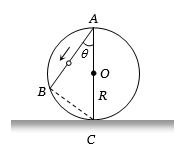
A frictionless wire $AB$ is fixed on a sphere of radius $R$. A very small spherical ball slips on this wire. The time taken by this ball to slip from $A $ to $B$ is