MCQ
It is easy to wash clothes in hot water because its
  • A
    Surface tension is more
  • Surface tension is less
  • C
    Consumes less soap
  • D
    None of these

Answer

Correct option: B.
Surface tension is less
b
(b)Surface tension of water decrease with rise in temperature.

Need a full question paper?

Generate a complete, print-ready paper with questions like this in minutes — across 16+ boards, with answer keys.
Start Generating Free

Similar questions

A projectile is thrown with velocity $u$ making angle $\theta$ with vertical. It just crosses the tops of two poles each of height $h$ after $1\,s$ and $3\,s$, respectively. The maximum height of projectile is ............ $m$
A box is lying on an inclined plane what is the coefficient of static friction if the box starts sliding when an angle of inclination is $60^o $
A particle which is experiencing a force, given by $\vec F = 3\vec i -12\vec j$, undergoes a displacement of $\vec d = 4\vec i$ . If the particle had a kinetic energy of $3\, J$ at the beginning of the displacement, what is its kinetic energy at the end of the displacement?
The Young's Modulus of elasticity is equal to that stress numerically which :
A 60kg man pushes a 40kg man by a force of 60N. The 40kg man has pushed the other man with a force of:
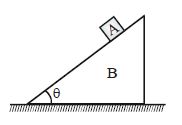
In the figure shown, $A$ & $B$ are free to move. All the surfaces are smooth. then $(0 < \theta < 90^o)$
A metallic rod $1\,cm$ long with a square cross-section is heated through $1^o C$. If Young’s modulus of elasticity of the metal is $E$ and the mean coefficient of linear expansion is $\alpha$ per degree Celsius, then the compressional force required to prevent the rod from expanding along its length is :(Neglect the change of cross-sectional area)
What is the number of significant figures in $3400$
An object of mass $5\, kg$ is thrown vertically upwards from the ground. The air resistance produces a constant retarding force of $10\, N$ throughout the motion. The ratio of time of ascent to the time of descent will be equal to $\left[\right.$Use $g =10 \,ms ^{-2}]$
An object may have:
  1. Varying speed without having varying velocity.
  2. Varying velocity without having varying speed.
  3. Nonzero acceleration without having varying velocity.
  4. Nonzero acceleration without having varying speed.