MCQ
It is found in phosphorus and nitrogen:
  • A
    Inorganic impurities
  • B
    Bacteria
  • Nutrients
  • D
    Other microbes

Answer

Correct option: C.
Nutrients
Nitrogen and phosphorous are nutrints that are natural parts of aquatic ecosystems. Nitrogen is also most abundant element in the air we breath nitrogen and phosphorous support the growth of a lgee and aquatic plants, which prouide food and habbit for fish and smaller organisma that line in water.

Need a full question paper?

Generate a complete, print-ready paper with questions like this in minutes — across 16+ boards, with answer keys.

Start Generating Free

Similar questions

Which of the following pairs of atom have the most similar radii ?
Considering acetic acid dissociates in water, its dissociation constant is $6.25 \times 10^{-5}$. If $5 \mathrm{~mL}$ of acetic acid is dissolved in $1$ litre water, the solution will freeze at $-\mathrm{x} \times 10^{-2}{ }^{\circ} \mathrm{C}$, provided pure water freezes at $0^{\circ} \mathrm{C}$.

$\mathrm{x}=$ . . . . . . . . . (Nearest integer)

Given : $\left(\mathrm{K}_{\mathrm{r}}\right)_{\text {water }}=1.86 \mathrm{~K} \mathrm{~kg} \mathrm{~mol}^{-1}$.

density of acetic acid is $1.2 \mathrm{~g} \mathrm{~mol}^{-1}$

molar mass of water $=18 \mathrm{~g} \mathrm{~mol}^{-1}$.

molar mass of acetic acid $=60 \mathrm{~g} \mathrm{~mol}^{-1}$.

density of water $=1 \mathrm{~g} \mathrm{~cm}^{-3}$

Acetic acid dissociates as

$\mathrm{CH}_3 \mathrm{COOH} \rightleftharpoons \mathrm{CH}_3 \mathrm{COO}^{\oplus}+\mathrm{H}^{\oplus}$
The unit for the electric current is
Galactose is converted into glucose in
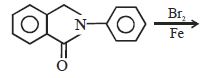
In the reaction the major product formed is
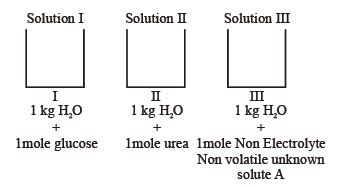
Order of $B.P$ of the solution formed is
In presence of $NaOH,$ phenol react with $CHC{l_3}$ to form $o-$hydroxy benzaldehyde. This reaction is called
The letter $‘D'$ in $D-$glucose signifies
Reduction of Aldehydes and Ketones to hydrocarbon take place in the presence of
Alkenes react with water in the presence of acid as catalyst to form alcohols :-

$\begin{array}{*{20}{c}}
  {C{H_3}CH = C{H_2} + {H_2}O\overset {{H^ + }} \longleftrightarrow C{H_3} - CH - C{H_3}} \\ 
  {\,\,\,\,\,\,\,\,\,\,\,\,\,\,\,\,\,\,\,\,\,\,\,\,\,\,\,\,\,\,\,\,\,\,\,\,\,\,\,\,\,\,\,\,\,\,\,\,\,\,\,\,\,\,\,\,\,\,\,\,\,\,\,\,\,\,\,\,\,|} \\ 
  {\,\,\,\,\,\,\,\,\,\,\,\,\,\,\,\,\,\,\,\,\,\,\,\,\,\,\,\,\,\,\,\,\,\,\,\,\,\,\,\,\,\,\,\,\,\,\,\,\,\,\,\,\,\,\,\,\,\,\,\,\,\,\,\,\,\,\,\,\,\,\,\,\,\,\,OH} 
\end{array}$

The reaction takes place in accordance with