Question
While doing an experiment with potentiometer (Fig.) it was found that the deflection is one sided and (i) the deflection decreased while moving from one end A of the wire to the end B; (ii) the deflection increased. while the jockey was moved towards the end B.
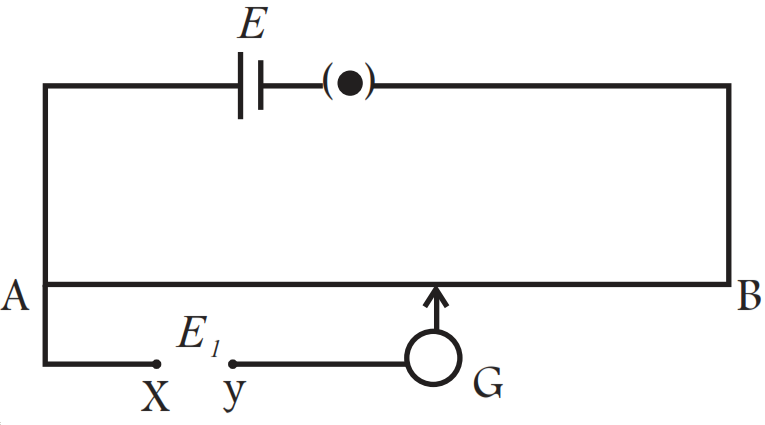
  1. Which terminal +or -ve of the cell $E_1,$ is connected at X in case (i) and how is $E_1$ related to E?
  2. Which terminal of the cell $E_1$ is connected at X in case (ii)?
Answer

  1. If the current in auxiliary circuit (lower circuit containing primary cell) decreases, and potential difference across A and jockey/increases. Then deflection in galvanometer is one sided and the deflection decreased, while moving from one end 'A' of the wire to the end 'S'. And clearly this is possible only when positive terminal of the cell $E_1$ is connected at X and $E_1 > E.$
  2. If the current in auxiliary circuit increases, and potential difference across A and jockey J increases. Then also deflection in galvanometer is one sided. And this is possible only when negative terminal of the cell $E_1$ is connected at X.

Need a full question paper?

Generate a complete, print-ready paper with questions like this in minutes — across 16+ boards, with answer keys.

Start Generating Free

Similar questions

It is found that yellow light does not eject photoelectrons from a metal. Is it advisable to try with orange light? With green light?
  1. With the help of a suitable ray diagram, derive the mirror formula for a concave mirror.
  2. The near point of a hypermetropic person is 50 cm from the eye. What is the power of the lens required to enable the person to read clearly a book held at 25 cm from the eye?
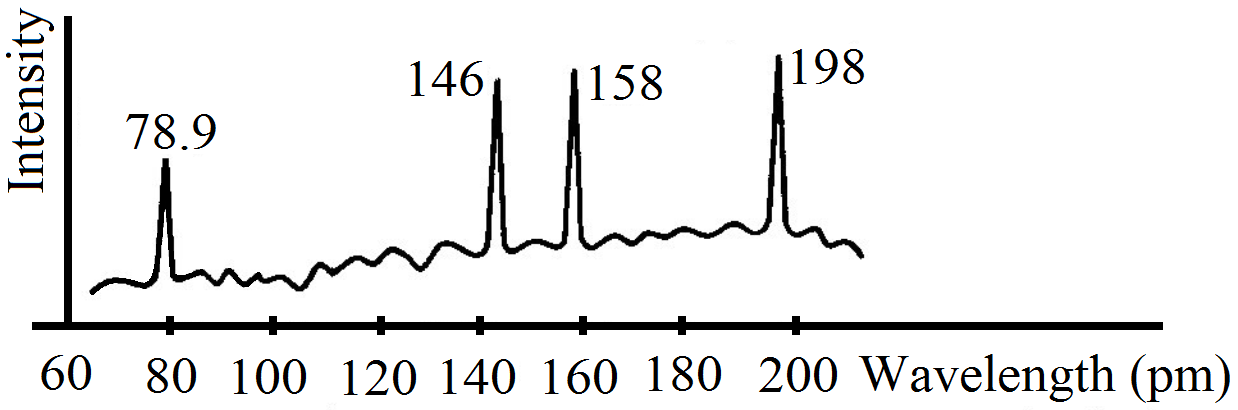
Continuous X-rays are made to strike a tissue paper soaked with polluted water. The incoming X-rays excite the atoms of the sample by knocking out the electrons from the inner shells. Characteristic X-rays are analysed and the intensity is plotted against the wavelength. Assuming that only $\text{K}_\alpha$ intensities are detected, list the elements present in the sample from the plot. Use Moseley's equation $v - (25 \times 10^{14}Hz)(Z - 1)^2.$
  1. Explain briefly the principle on which a transistor-amplifier works as an oscillator. Draw the necessary circuit diagram and explain its working.
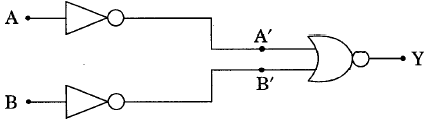
  2. Identify the equivalent gate for the following circuit and write its truth table.
With the help of a ray diagram, show the formation of image of a point object due to refraction of light at a spherical surface separating two media of refractive indices $n_1$ and $n_2 (n_2 > n_1)$ respectively. Using this diagram, derive the relation.
$\frac{\text{n}_2}{\text{v}}-\frac{\text{n}_1}{\text{u}}=\frac{\text{n}_1-\text{n}_2}{\text{R}}$
Write the sign conventions used. What happens to the focal length of convex lens when it is immersed in water?
A rectangular conducting loop consists of two wires on two opposite sides of length l joined together by rods of length d. The wires are each of the same material but with cross-sections differing by a factor of 2. The thicker wire has a resistance R and the rods are of low resistance, which in turn are connected to a constant voltage source $V_0.$ The loop is placed in uniform a magnetic field B at 45° to its plane. Find $\tau$, the torque exerted by the magnetic field on the loop about an axis through the centres of rods.
Calculate potential energy of a point charge -q placed along the axis due to a charge +Q uniformly distributed along a ring of radius R. Sketch P.E. as a function of axial distance z from the centre of the ring. Looking at graph, can you see what would happen if -q is displaced slightly from the centre of the ring (along the axis)?
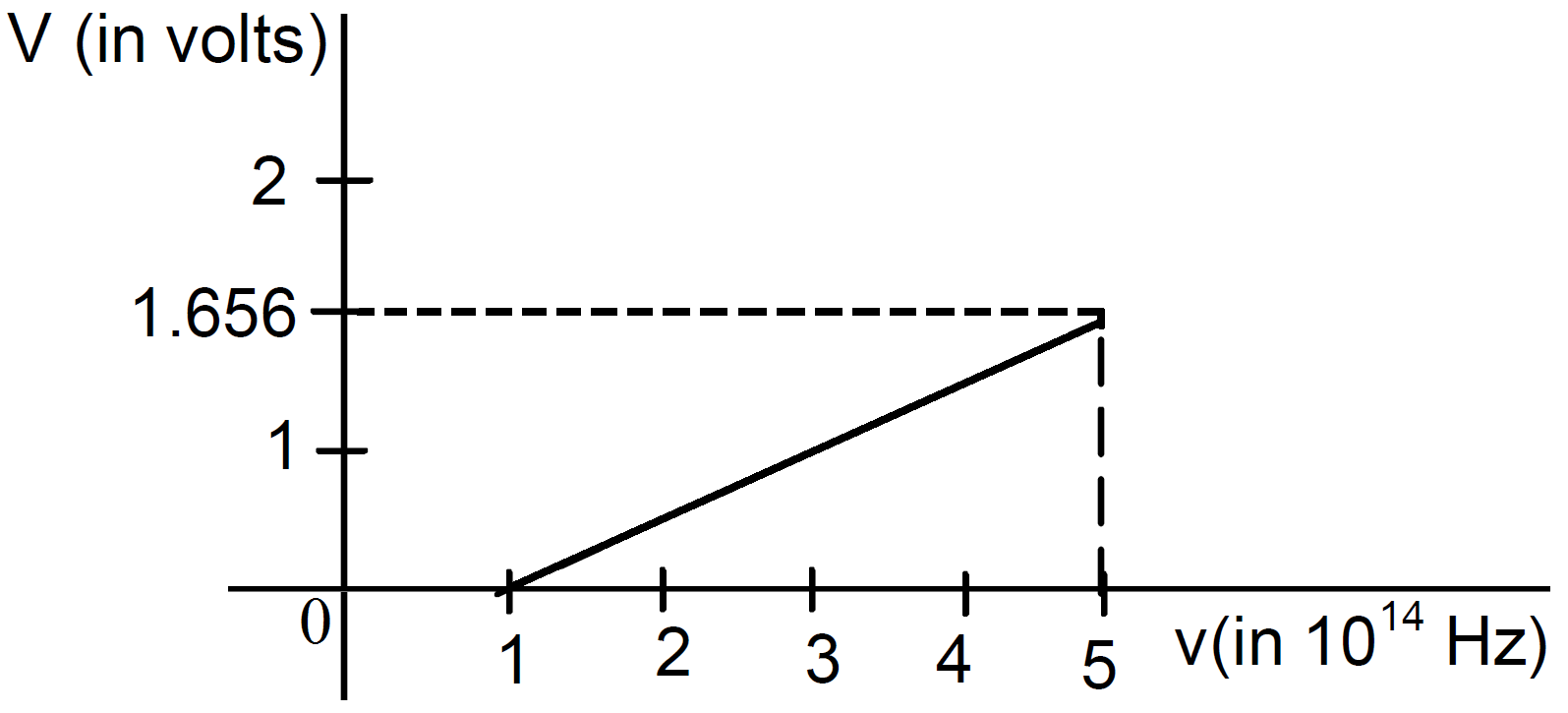
Figure is the plot of the stopping potential versus the frequency of the light used in an experiment on photoelectric effect. Find.
  1. The ratio h/e and.
  2. The work function.
A long, straight wire carries a current i. Let $B_1,$ be the magnetic field at a point Pat a distance d from the wire. Consider a section of length l of this wire such that the point P lies on a perpendicular bisector of the section. Let B2 be the magnetic field at this point due to this section only. Find the value of $\frac{\text{d}}{\text{l}}$ so that $B_2$ differs from $B_1$, by 1%.
  1. Derive an expression for the force between two long parallel current carrying conductors.
  2. Use this expression to define S.I. unit of current.
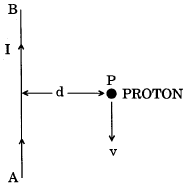
  3. A long straight wire AB carries a current I. A proton P travels with a speed v, parallel to the wire, at a distance d from it in a direction opposite to the current as shown in the figure. What is the force experienced by the proton and what is its direction?