Question
It is given that $X\left[\begin{array}{cc}3 & 2 \\ 1 & -1\end{array}\right]=\left[\begin{array}{ll}4 & 1 \\ 2 & 3\end{array}\right]$. Then matrix $X$ is :

Answer

Let $X=\left[\begin{array}{ll}a & b \\ c & d\end{array}\right]$
We have, $x\left[\begin{array}{cc}3 & 2 \\ 1 & -1\end{array}\right]=\left[\begin{array}{ll}4 & 1 \\ 2 & 3\end{array}\right]$
$ \Rightarrow\left[\begin{array}{ll} a & b \\ c & d \end{array}\right]\left[\begin{array}{cc}
3 & 2 \\ 1 & -1 \end{array}\right]=\left[\begin{array}{ll} 4 & 1 \\ 2 & 3 \end{array}\right] $
$ \Rightarrow\left[\begin{array}{ll} 3 a+b & 2 a-b \\ 3 c+d & 2 c-d \end{array}\right]=\left[\begin{array}{ll}
4 & 1 \\ 2 & 3 \end{array}\right]$
On comparing the element of matrices, we get
$ \begin{array}{l} 3 a+b=4 \\ 2 a-b=1 \\ 3 c+d=2 \\ 2 c-d=3 \end{array} $
Adding $(i)$ and $(ii),$ we get $5 a=5 \Rightarrow a=1$
Putting $a=1$ in $(i),$ we get $3(1)+b=4 \Rightarrow b=1$
Adding $(iii)$ and $(iv),$ we get $5 c=5 \Rightarrow c=1$
Putting $c=1$ in $(iii),$ we get $3+d=2 \Rightarrow d=-1$
$ \therefore X=\left[\begin{array}{cc} 1 & 1 \\ 1 & -1 \end{array}\right]$

Need a full question paper?

Generate a complete, print-ready paper with questions like this in minutes — across 16+ boards, with answer keys.
Start Generating Free

Similar questions

If $A$ is a $3 \times 3$ matrix such that $|A|=8$, then $|3 A|$ equals
The equation of the plane through the intersection of the planes $x + 2y + 3z = 4$ and $2x + y - z = -5$ and perpendicular to the plane $5x + 3y + 6z + 8 = 0$ is:
 The solution of the differential equation $\frac{\text{dy}}{\text{dx}}+\frac{2\text{y}}{\text{x}}=0$ with y(1) = 1 is given by.
  1. $\text{y}=\frac{1}{\text{x}^{2}}$
  2. $\text{x}=\frac{1}{\text{y}^{2}}$
  3. $\text{x}=\frac{1}{\text{y}}$
  4. $\text{y}=\frac{1}{\text{x}}$ 
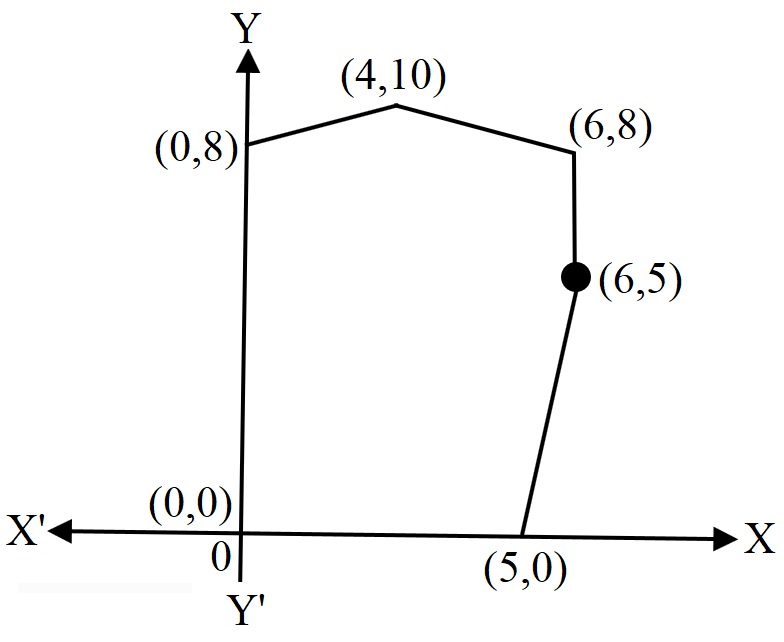
The feasible solution for a LPP is shown in the following figure. Let Z = 3x - 4y be the objective function.
Minimum of Z occurs at:
  1. (0, 0)
  2. (0, 8)
  3. (5, 0)
  4. (4, 10)
The solution of the differential equation $\frac{\text{dy}}{\text{dx}}=\frac{\text{ax}+\text{g}}{\text{by}+\text{f}}$ represents a circle when,
If $\text{y}=\text{ax}^{\text{n+1}}+\text{bx}^{-\text{n}}$ Then $\text{x}^2\frac{\text{d}^2\text{y}}{\text{dx}^2} =$
If $\text{P(A)}=\frac{2}{5},\text{P(B)}=\frac{3}{10}$ and $\text{P}(\text{A}\cap\text{B})=\frac{1}{5},$ then, $\text{P}(\overline{\text{A}}|\overline{\text{B}}) \text{ P}(\overline{\text{B}}|\overline{\text{A}})$ is equal to
The direction ratios of the line of intersection of the planes 3x + 2y - z = 5 and x - y + 2z = 3 are:
  1. 3, 2, -1
  2. -3, 7, 5
  3. 1, -1, 2
  4. -11, 4, -5
If $A=\left[a_{i j}\right]$ is a square matrix of order $2$ such that $a_{i j}=\left\{\begin{array}{l}1, \text { when } i \neq j \\ 0, \text { when } i=j\end{array}\right.$, then $A^2$ is
Find the principal values of: $\cot ^{-1}(1)$