Question
It is known that, if the interest is compounded continuously, the principal changes at the rate equal to the product of the rate of bank interest per annum and the principal. Let $P$ denotes the principal at any time $t$ and rate of interest be $r\%$ per annum.

Based on the above information, answer the following question.
  1. Find the value of $\frac{\text{dP}}{\text{dt}}.$
  1. $\frac{\text{Pr}}{1000}$
  2. $\frac{\text{Pr}}{100}$
  3. $\frac{\text{Pr}}{10}$
  4. $\text{Pr}$
  1. If $P_0$ be the initial principal, then find the solution of differential equation formed in given situation.
  1. $\log\Big(\frac{\text{P}}{\text{P}_0}\Big)=\frac{\text{rt}}{100}$
  2. $\log\Big(\frac{\text{P}}{\text{P}_0}\Big)=\frac{\text{rt}}{10}$
  3. $\log\Big(\frac{\text{P}}{\text{P}_0}\Big)=\text{rt}$
  4. $\log\Big(\frac{\text{P}}{\text{P}_0}\Big)=100\text{rt}$
  1. If the interest is compounded continuously at $5\%$ per annum, in how many years will $₹\ 100$ double itself?
  1. $12.728$ years
  2. $14.789$ years
  3. $13.862$ years
  4. $15.872$ years
  1. At what interest rate will $₹\ 100$ double itself in $10$ years? $(\log_\text{e}2 = 0.6931 ).$
  1. $9.66\%$
  2. $8.239\%$
  3. $7.341\%$
  4. $6.931\%$
  1. How much will $₹\ 1000$ be worth at $5\%$ interest after $10$ years? $(e^{0.5} = 1.648)$.
  1. $₹\ 1648$
  2. $₹\ 1500$
  3. $₹\ 1664$
  4. $₹\ 1572$

Answer

  1. $(b) \frac{\text{Pr}}{100}$
Here, $P$ denotes the principal at any time $t$ and the rate of interest be $r\%$ per annum compounded continuously, then according to the law given in the problem, we get
$\frac{\text{dP}}{\text{dt}}=\frac{\text{Pr}}{100}$
  1. $(a) \log\Big(\frac{\text{P}}{\text{P}_0}\Big)=\frac{\text{rt}}{100}$
We have, $\frac{\text{dP}}{\text{dt}}=\frac{\text{Pr}}{100}$
$\Rightarrow\frac{\text{dP}}{\text{P}}=\frac{\text{r}}{100}\text{dt}$
$\Rightarrow\int\frac{\text{1}}{\text{P}}\text{dP}=\frac{\text{r}}{100}\int\text{dt}$
$\Rightarrow\log\text{P}=\frac{\text{rt}}{100}+\text{C}...\text{(i)}$
$\text{At t}=0,\ \ \text{P}=\text{P}_0.$
$\therefore\ \ \text{C}=\log\text{P}_0$
So, $\log\text{P}=\frac{\text{rt}}{100}+\log\text{p}_0$
$\Rightarrow\log\Big(\frac{\text{P}}{\text{P}_0}\Big)=\frac{\text{rt}}{100}...\text{(ii)}$
  1. $(c) 13.862$ years
We have, $r = 5, P_{0 }= ₹\ 100$ and $P = ₹\ 200 = 2P_0$ Substituting these values in $(2),$ we get
$\log2=\frac{5}{100}\text{t}$
$\Rightarrow\text{t}=20\log_\text{e}$
$2 = 20 \times 0.6931\ \text{years} = 13.862\ \text{years}$
  1. $(d) 6.931\%$
We have,
$P_0 = ₹\ 100, P = ₹\ 200 = 2P_{0 }$ and $t = 10$ years Substituting these values in $(2),$ we get
$\log2\frac{10\text{r}}{100}\Rightarrow\text{r}=10\log2=10\times0.6931=6.931$
  1. $(a)\ ₹ 1648$
We have $P_0 = ₹\ 1000, r = 5$ and $t = 10$ Substituting these values in $(2),$ we get
$\log\Big(\frac{\text{P}}{1000}\Big)=\frac{5\times10}{100}=\frac{1}{2}=0.5$
$\Rightarrow\frac{\text{P}}{1000}=\text{e}^{0.5}$
$\Rightarrow\text{ P} = 1000 × 1.648 = ₹ \ 1648$

Need a full question paper?

Generate a complete, print-ready paper with questions like this in minutes — across 16+ boards, with answer keys.

Start Generating Free

Similar questions

If a relation between $x$ and $y$ is such that y cannot be expressed in terms of $x,$ then $y$ is called an implicit function of $x.$ When a given relation expresses $y$ as an implicit function of $x$ and we want to find $\frac{\text{dy}}{\text{dx}},$ then we differentiate every term of the given relation $w.r.t. x,$ remembering that a tenn in $y$ is first differentiated $w.r.t. y$ and then multiplied by $\frac{\text{dy}}{\text{dx}}.$
Based on the ab:ve information, find the value of $\frac{\text{dy}}{\text{dx}}$ in each of the following questions.
  1. $\ce{x^3 + x^2y + xy^2 + y^3 = 81}$
  1. $\frac{(3\text{x}^2+2\text{xy}+\text{y}^2)}{\text{x}^2+2\text{xy}+3\text{y}^2}$
  2. $\frac{-(3\text{x}^2+2\text{xy}+\text{y}^2)}{\text{x}^2+2\text{xy}+3\text{y}^2}$
  3. $\frac{(3\text{x}^2+2\text{xy}-\text{y}^2)}{\text{x}^2-2\text{xy}+3\text{y}^2}$
  4. $\frac{3\text{x}^2+\text{xy}+\text{y}^2}{\text{x}^2+\text{xy}+3\text{y}^2}$
  1. $\ce{x^y = e^{x-y}}$
  1. $\frac{\text{x}-\text{y}}{(1+\log\text{x})}$
  2. $\frac{\text{x}+\text{y}}{(1+\log\text{x})}$
  3. $\frac{\text{x}-\text{y}}{\text{x}(1+\log\text{x})}$
  4. $\frac{\text{x}+\text{y}}{\text{x}(1+\log\text{x})}$
  1. $\text{e}^{\sin\text{y}}=\text{xy}$
  1. $\frac{-\text{y}}{\text{x}(\text{y}\cos\text{y}-1)}$
  2. $\frac{\text{y}}{\text{y}\cos\text{y}-1}$
  3. $\frac{\text{y}}{\text{y}\cos\text{y}+1}$
  4. $\frac{\text{y}}{\text{x}(\text{y}\cos\text{y}-1)}$
  1. $\sin^2\text{x}+\cos^2\text{y}=1$
  1. $\frac{\sin2\text{y}}{\sin2\text{x}}$
  2. $-\frac{\sin2\text{x}}{\sin2\text{y}}$
  3. $-\frac{\sin2\text{y}}{\sin2\text{x}}$
  4. $\frac{\sin2\text{x}}{\sin2\text{y}}$
  1. $\text{y}=(\sqrt{\text{x}})^{\sqrt{\text{x}}^\sqrt{\text{x}}...\infty}$
  1. $\frac{-\text{y}^2}{\text{x}(2-\text{y}\log\text{x})}$
  2. $\frac{\text{y}^2}{2+\text{y}\log\text{x}}$
  3. $\frac{\text{y}^2}{\text{x}(2+\text{y}\log\text{x})}$
  4. $\frac{\text{y}^2}{\text{x}(2-\text{y}\log\text{x})}$
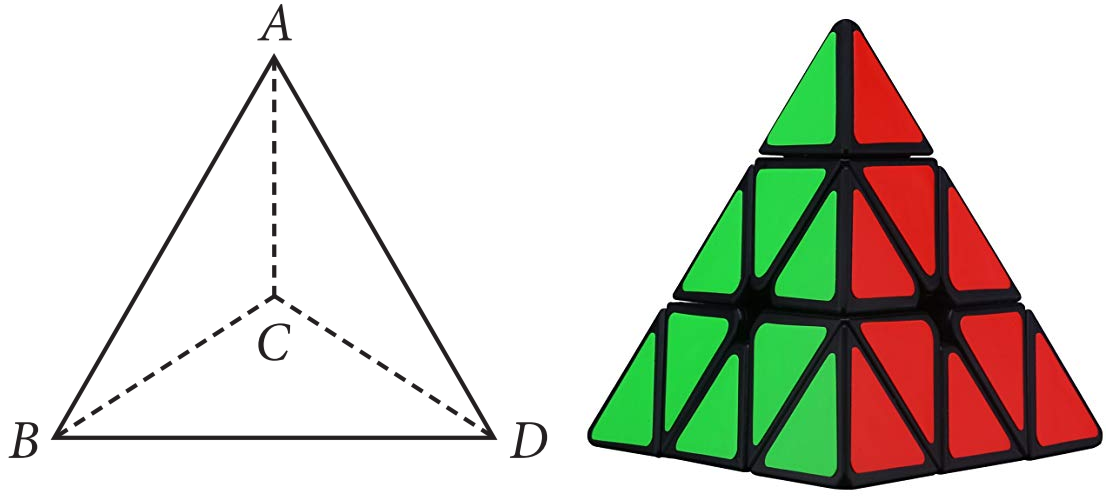
A building is to be constructed in the form of a triangular pyramid, ABCD as shown in the figure.

Let its angular points are A(0, 1, 2), B(3, 0, 1), C(4, 3, 6), and D(2, 3, 2), and G be the point of intersection of the medians of $\triangle\text{BCD}.$
Based on the above information, answer the following questions.
  1. The coordinates of point Gare:
  1. (2, 3, 3)
  2. (3, 3, 2)
  3. (3, 2, 3)
  4. (0, 2, 3)
  1. The length of vector $\overline{\text{AG}}$ is:
  1. $\sqrt{17}\text{ units}$
  2. $\sqrt{11}\text{ units}$
  3. $\sqrt{13}\text{ units}$
  4. $\sqrt{19}\text{ units}$
  1. Area of $\triangle\text{ABC}$ (in sq. units) is:
  1. $\sqrt{10}$
  2. $2\sqrt{10}$
  3. $3\sqrt{10}$
  4. $5\sqrt{10}$
  1. The sum of lengths of $\overline{\text{AB}}$ and $\overline{\text{AC}}$ is:
  1. 5 units
  2. 9.32 units
  3. 10 units
  4. 11 units
  1. The length of the perpendicular from the vertex D on the opposite face is:
  1. $\frac{6}{\sqrt{10}}\text{ units}$
  2. $\frac{2}{\sqrt{10}}\text{ units}$
  3. $\frac{3}{\sqrt{10}}\text{ units}$
  4. $8\sqrt{10}\text{ units}$
If the area of a circle increases at a uniform rate, then prove that perimeter varies inversely as the radius.
Read the following text carefully and answer the questions that follow:
Akash and Prakash appeared for first round of an interview for two vacancies. The probability of Nisha's selection is $\frac{1}{3}$ and that of Ayushi's selection is $\frac{1}{2}$.
Image
$i.$ Find the probability that both of them are selected. $(1)$
$ii.$ The probability that none of them is selected. $(1)$
$iii.$ Find the probability that only one of them is selected.$(2)$
$OR$
Find the probability that atleast one of them is selected. $(2)$
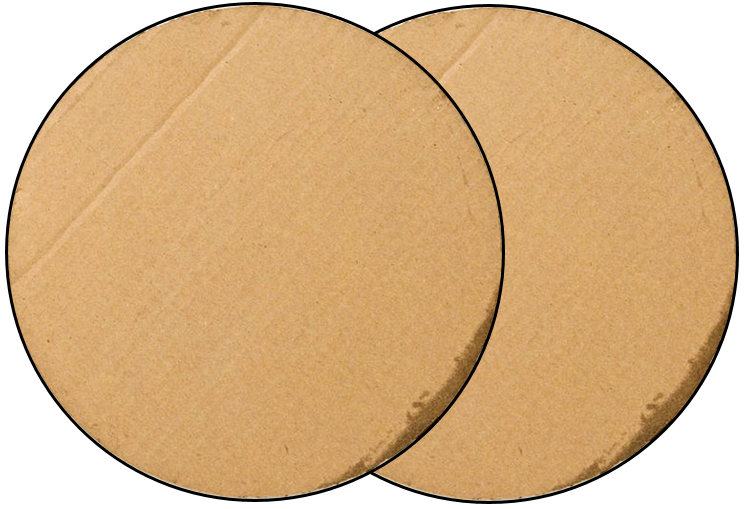
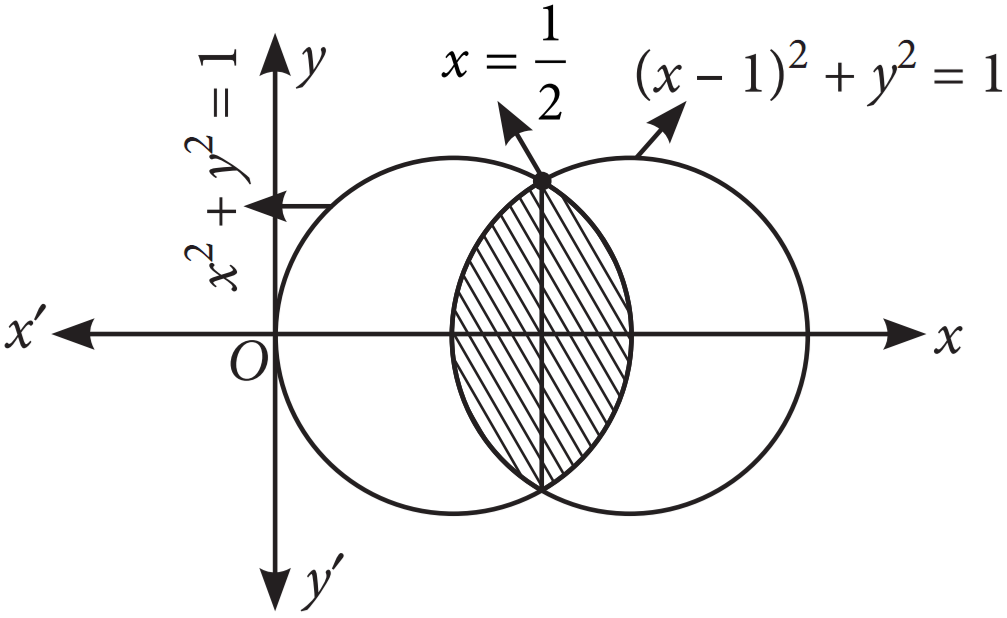
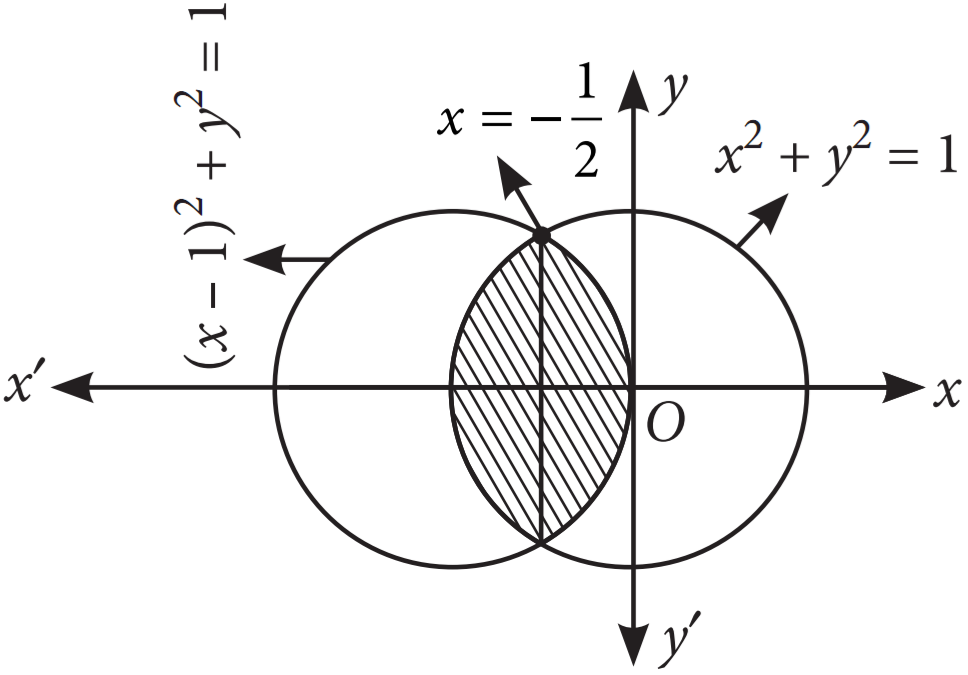
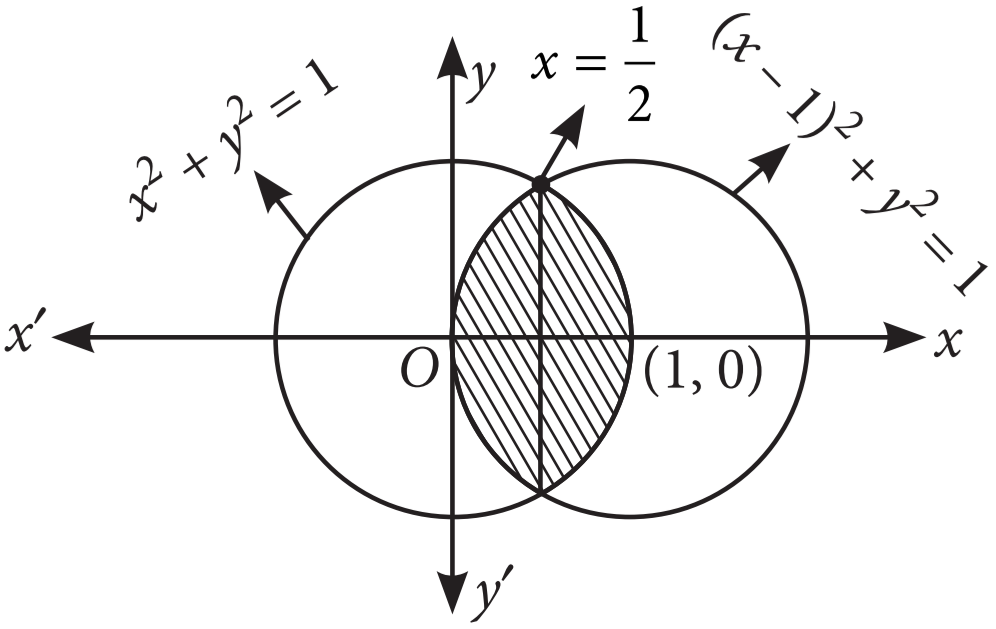
Ajay cut two circular pieces of cardboard and placed one upon other as shown in figure. One of the circle represents the equation $(x - 1)^2 + y^2 = 1,$ while other circle represents the equation $x^2 + y^2 = 1.$

Based on the above information, answer the following questions.
  1. Both the circular pieces of cardboard meet each other at
  1. $\text{x}=1$
  2. $\text{x}=\frac{1}{2}$
  3. $\text{x}=\frac{1}{3}$
  4. $\text{x}=\frac{1}{4}$
  1. Graph of given two curves can be drawn as.
  1. None of these
  1. Value of $\int\limits_{0}^{\frac{1}{2}}\sqrt{1-(\text{x}-1)^2}\text{dx}$ is.
  1. $\frac{\pi}{6}-\frac{\sqrt{3}}{8}$
  2. $\frac{\pi}{6}+\frac{\sqrt{3}}{8}$
  3. $\frac{\pi}{2}+\frac{\sqrt{3}}{4}$
  4. $\frac{\pi}{2}-\frac{\sqrt{3}}{4}$
  1. Value of $\int\limits_{\frac{1}{2}}^{1}\sqrt{1-\text{x}^2}\text{dx}$ is.
  1. $\frac{\pi}{6}+\frac{\sqrt{3}}{4}$
  2. $\frac{\pi}{6}+\frac{\sqrt{3}}{8}$
  3. $\frac{\pi}{6}-\frac{\sqrt{3}}{8}$
  4. $\frac{\pi}{2}-\frac{\sqrt{3}}{4}$
  1. Area of hidden portion of lower circle is.
  1. $\bigg(\frac{2\pi}{3}+\frac{\sqrt{3}}{2}\bigg)\text{ sq.units}$
  2. $\bigg(\frac{\pi}{3}-\frac{\sqrt{3}}{8}\bigg)\text{ sq.units}$
  3. $\bigg(\frac{\pi}{3}+\frac{\sqrt{3}}{8}\bigg)\text{ sq.units}$
  4. $\bigg(\frac{2\pi}{3}-\frac{\sqrt{3}}{2}\bigg)\text{ sq.units}$
Show that for $\text{a}\geq1,\text{ f(x)}=\sqrt{3}\sin\text{x}-\cos\text{x}-2\text{ax}+\text{b}$ is decreasing in R.
A differential equation is said to be in the variable separable form if it is expressible in the form $f(x) dx = g(y) dy.$
The solution of this equation is given by
$\int\text{f(x)dx}=\int\text{g(y)dy}+\text{c},$ where $c$ is the constant of integration.
Based on the above information, answer the following questions.
  1. If the solution of the differential equation $\frac{\text{dy}}{\text{dx}}=\frac{\text{ax+3}}{\text{2y+f}}$ represents a circle, then the value of $'a\ '$ is:
  1. $2$
  2. $-2$
  3. $3$
  4. $-4$
  1. The differential equation $\frac{\text{dy}}{\text{dx}}=\frac{\sqrt{1-\text{y}^2}}{\text{y}}$ determines a family of circle with.
  1. Variable radii and fixed centre $(0, 1)$
  2. Variable radii and fixed centre $(0, -1)$
  3. Fixed radius $1$ and variable centre on $x-$ axis
  4. Fixed radius $1$ and variable centre on $y-$ axis
  1. If $= y'+ 1, y(0) = 1,$ then $y (In 2) =$
  1. $1$
  2. $2$
  3. $3$
  4. $4$
  1. The solution of the differential equation $\frac{\text{dy}}{\text{dx}}=\text{e}^\text{x-y}+\text{x}^2\text{e}^\text{-y}$ is:
  1. $\text{e}^\text{x}=\frac{\text{y}^3}{3}+\text{e}^\text{y}+\text{c}$
  2. $\text{e}^\text{y}=\frac{\text{x}^2}{3}+\text{e}^\text{x}+\text{c}$
  3. $\text{e}^\text{y}=\frac{\text{x}^3}{3}+\text{e}^\text{x}+\text{c}$
  4. None of these
  1. If $\frac{\text{dy}}{\text{dx}}=\text{y}\sin2\text{x},\ \text{y}(0)=1,$ then its solution is:
  1. $\text{y}=\text{e}^{\sin^2}\text{x}$
  2. $\text{y}={\sin^2}\text{x}$
  3. $\text{y}={\cos^2}\text{x}$
  4. $\text{y}=\text{e}^{\cos^2}\text{x}$
Mr. Ajay is taking up subjects of mathematics, physics, and chemistry in the examination. His probabilities of getting a grade $\mathrm{A}$ in these subjects are $0.2,0.3$, and 0.5 respectively.

Image

(i) Find the probability that Ajay gets Grade A in all subjects.
(ii) Find the probability that he gets Grade A in no subjects.

Ajay enrolled himself in an online practice test portal provided by his school for better practice. Out of 5 questions in a set-I, he was able to solve 4 of them and got stuck in the one which is as shown below.
If A and Bare independent events, P(A) = 0.6 and P(B) = 0.8, then answer the following questions.
  1. $\text{P}(\text{A}\cap\text{B})=$
  1. 0.2
  2. 0.9
  3. 0.48
  4. 0.6
  1. $\text{P}(\text{A}\cup\text{B})=$
  1. 0.92
  2. 0.08
  3. 0.48
  4. 0.64
  1. $\text{P}(\text{B}|\text{A})=$
  1. 0.14
  2. 0.2
  3. 0.6
  4. 0.8
  1. $\text{P}(\text{A}|\text{B})=$
  1. 0.6
  2. 0.9
  3. 0.19
  4. 0.11
  1. P (not A and not B)
  1. 0.01
  2. 0.48
  3. 0.08
  4. 0.91 
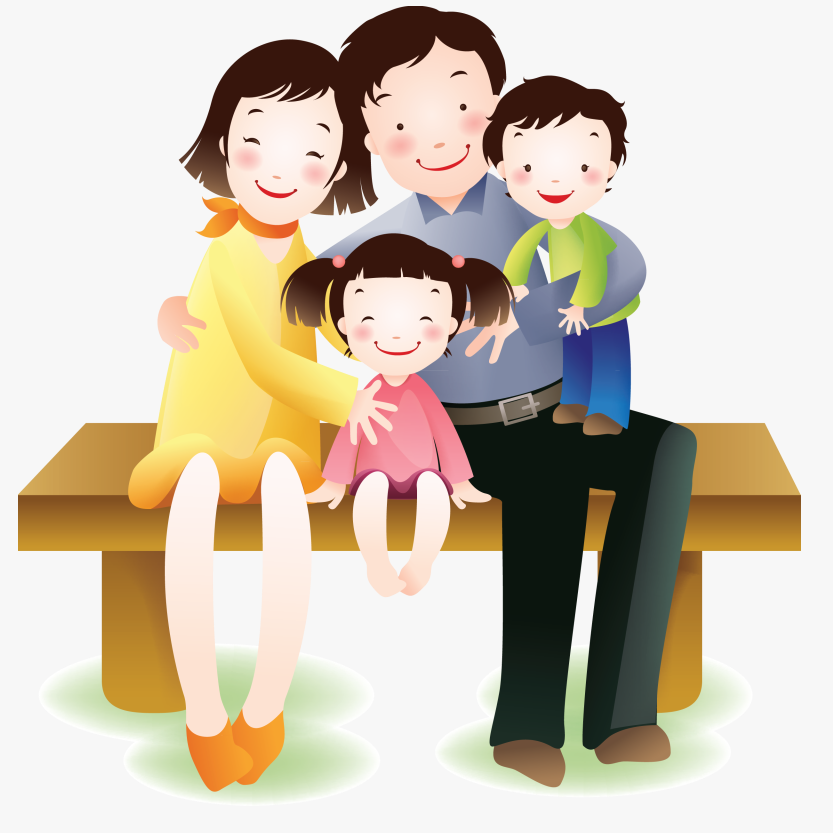
 In a wedding ceremony, consists of father, mother, daughter and son line up at random for a family photograph, as shown in figure.
Based on the above information, answer the following questions.
  1. Find the probability that daughter is at one end, given that father and mother are in the middle.
  1. $1$
  2. $\frac{1}{2}$
  3. $\frac{1}{3}$
  4. $\frac{2}{3}$
  1. Find the probability that mother is at right end, given that son and daughter are together.
  1. $\frac{1}{2}$
  2. $\frac{1}{3}$
  3. $\frac{1}{4}$
  4. $0$
  1. Find the probability that father and mother are in the middle, given that son is at right end.
  1. $\frac{1}{4}$
  2. $\frac{1}{2}$
  3. $\frac{1}{3}$
  4. $\frac{2}{3}$
  1. Find the probability that father and son are standing together, given that mother and daughter are standing together.
  1. $0$
  2. $1$
  3. $\frac{1}{2}$
  4. $\frac{2}{3}$
  1. Find the probability that father and mother are on either of the ends, given that son is at second position from the right end.
  1. $\frac{1}{3}$
  2. $\frac{2}{3}$
  3. $\frac{1}{4}$
  4. $\frac{2}{5}$