Question

✓
Answer
- (b) $\frac{\text{Pr}}{100}$
Solution:
Here, P denotes the principal at any time t and the rate of interest be r% per annum compounded continuously, then according to the law given in the problem, we get
$\frac{\text{dP}}{\text{dt}}=\frac{\text{Pr}}{100}$
- (a) $\log\Big(\frac{\text{P}}{\text{P}_0}\Big)=\frac{\text{rt}}{100}$
Solution:
We have, $\frac{\text{dP}}{\text{dt}}=\frac{\text{Pr}}{100}$
$\Rightarrow\frac{\text{dP}}{\text{P}}=\frac{\text{r}}{100}\text{dt}$
$\Rightarrow\int\frac{\text{1}}{\text{P}}\text{dP}=\frac{\text{r}}{100}\int\text{dt}$
$\Rightarrow\log\text{P}=\frac{\text{rt}}{100}+\text{C}...\text{(i)}$
$\text{At t}=0,\ \ \text{P}=\text{P}_0.$
$\therefore\ \ \text{C}=\log\text{P}_0$
So, $\log\text{P}=\frac{\text{rt}}{100}+\log\text{p}_0$
$\Rightarrow\log\Big(\frac{\text{P}}{\text{P}_0}\Big)=\frac{\text{rt}}{100}...\text{(ii)}$
- (c) 13.862 years
Solution:
We have, r = 5, P0 = ₹ 100 and P = ₹ 200 = 2P0 Substituting these values in (2), we get
$\log2=\frac{5}{100}\text{t}$
$\Rightarrow\text{t}=20\log_\text{e}$
$2 = 20 × 0.6931\ \text{years} = 13.862\ \text{years}$
- (d) 6.931%
Solution:
We have,
P0 = ₹ 100, P = ₹ 200 = 2P0 and t = 10 years Substituting these values in (2), we get
$\log2\frac{10\text{r}}{100}\Rightarrow\text{r}=10\log2=10\times0.6931=6.931$
- (a) ₹ 1648
Solution:
We have P0 = ₹ 1000, r = 5 and t = 10 Substituting these values in (2), we get
$\log\Big(\frac{\text{P}}{1000}\Big)=\frac{5\times10}{100}=\frac{1}{2}=0.5$
$\Rightarrow\frac{\text{P}}{1000}=\text{e}^{0.5}$
$\Rightarrow\text{ P} = 1000 × 1.648 = ₹ \ 1648$
Need a full question paper?
Generate a complete, print-ready paper with questions like this in minutes — across 16+ boards, with answer keys.
Explore more
Similar questions
A real estate company is going to build a new residential complex. The land they have purchased can hold at most 4500 apartments. Also, if they make x apartments, then the monthly maintenance cost for the whole complex would be as follows: Fixed cost = ₹ 50,00,000. Variable cost = (160x - 0.04x2)
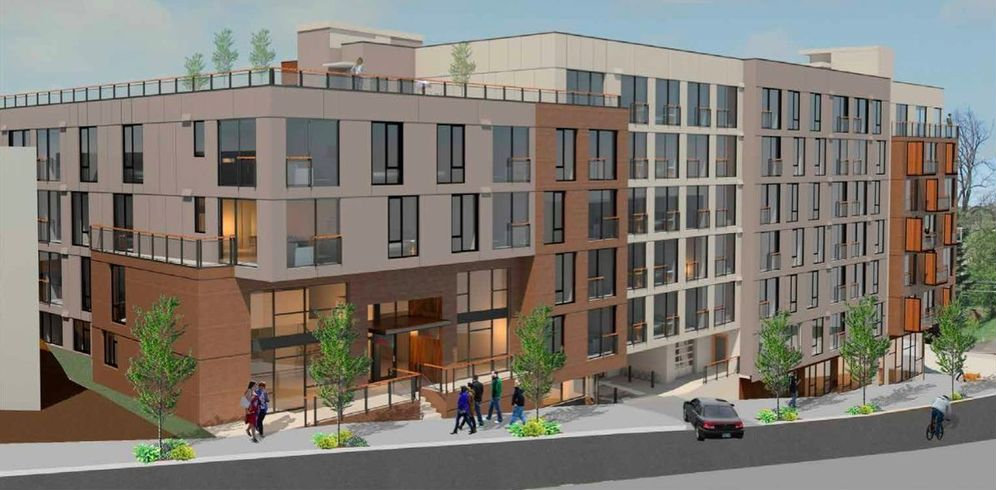
Based on the above information, answer the following questions.
Based on the above information, answer the following questions.
- The maintenance cost as a function of x will be.
- 160x - 0.04x2
- 5000000
- 5000000 + 160x - 0.04x2
- None of these
- If C(x) denote the maintenance cost function, then maximum value of C(x) occur at x =
- 0
- 2000
- 4500
- 5000
- The maximum value of C(x) would be.
- ₹ 5225000
- ₹ 5160000
- ₹ 5000000
- ₹ 4000000
- The number of apartments, that the complex should have in order to minimize the maintenance cost, is.
- 4500
- 5000
- 1750
- 3500
- If the minimum maintenance cost is attain, then the maintenance cost for each apartment would be.
- ₹ 1091.11
- ₹ 1200
- ₹ 1000
- ₹ 2000
The Indian Coast Guard (ICG) while patrolling, saw a suspicious boat with four men. They were nowhere looking like fishermen. The soldiers were closely observing the movement of the boat for an opportunity to seize the boat. They observe that the boat is moving along a planar surface. At an instant of time, the coordinates of the position of coast guard helicopter and boat are (2, 3, 5) and (1, 4, 2) respectively. 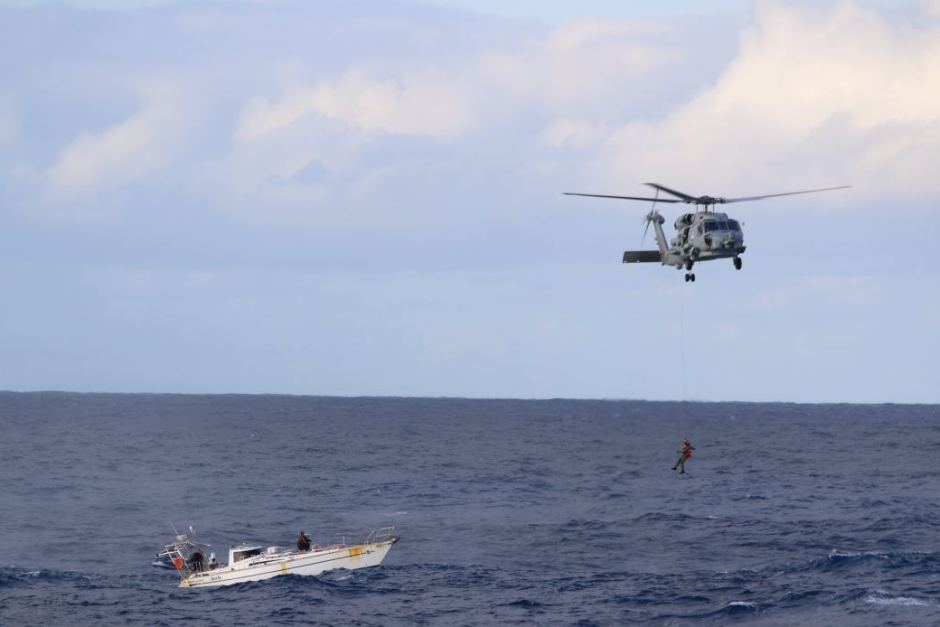 Based on the above information, answer the following questions.
→ Based on the above information, answer the following questions. - If the line joining the positions of the helicopter and boat is perpendicular to the plane in which boat moves, then equation of plane is:
- x - y + 3z = 2
- x + y + 3z = 2
- x - y + 3z = 3
- x + y + 3z = 3
- If the soldier decides to shoot the boat at given instant of time, where the distance measured in metres then what is the distance that bullet has to travel?
-
$\sqrt{5}\text{m}$
-
$\sqrt{8}\text{m}$
-
$\sqrt{10}\text{m}$
-
$\sqrt{11}\text{m}$
- If the speed of bullet is 30m/ sec, then how much time will the bullet take to hit the boat after the shot is fired?
- 30 seconds
- 1 second
-
$\frac{1}{2}\text{second}$
-
$\frac{\sqrt{11}}{30}\text{seconds}$
- At the given instant of time, the equation of line passing through the positions of helicopter and boat is:
-
$\frac{\text{x}}{1}=\frac{\text{y}}{-1}=\frac{\text{z}}{3}$
-
$\frac{\text{x}-1}{1}=\frac{\text{y}-4}{-1}=\frac{\text{z}-2}{3}$
-
$\frac{\text{x}}{1}=\frac{\text{y}}{1}=\frac{\text{z}}{-3}$
-
$\frac{\text{x}-1}{1}=\frac{\text{y}-4}{1}=\frac{\text{z}-2}{-3}$
- At a different instant of time, the boat moves to a different position along the planar surface. What should be the coordinates of the location of the boat for the bullet to hit the boat if soldier shoots the bullet along the line whose equation is $\frac{\text{x}-1}{1}=\frac{\text{y}-1}{-2}=\frac{\text{z}-2}{3}?$
-
$\Big(\frac{1}{2},\frac{1}{2},\frac{1}{2}\Big)$
-
$\Big(\frac{3}{4},\frac{3}{2},\frac{5}{4}\Big)$
-
$\Big(\frac{1}{3},\frac{1}{4},\frac{1}{5}\Big)$
- None of these
Mr. Ajay is taking up subjects of mathematics, physics, and chemistry in the examination. His probabilities of getting a grade $\mathrm{A}$ in these subjects are $0.2,0.3$, and 0.5 respectively.
→
(i) Find the probability that Ajay gets Grade A in all subjects.
(ii) Find the probability that he gets Grade A in no subjects.
In a diamond exhibition, a diamond is covered in cubical glass box having coordinates O(0, 0, 0), A(1, 0, 0), B(1, 2, 0), C(0, 2, 0), O'(0, 0, 3), A'(1, 0, 3), B'(1, 2, 3) and C'(0, 2, 3). 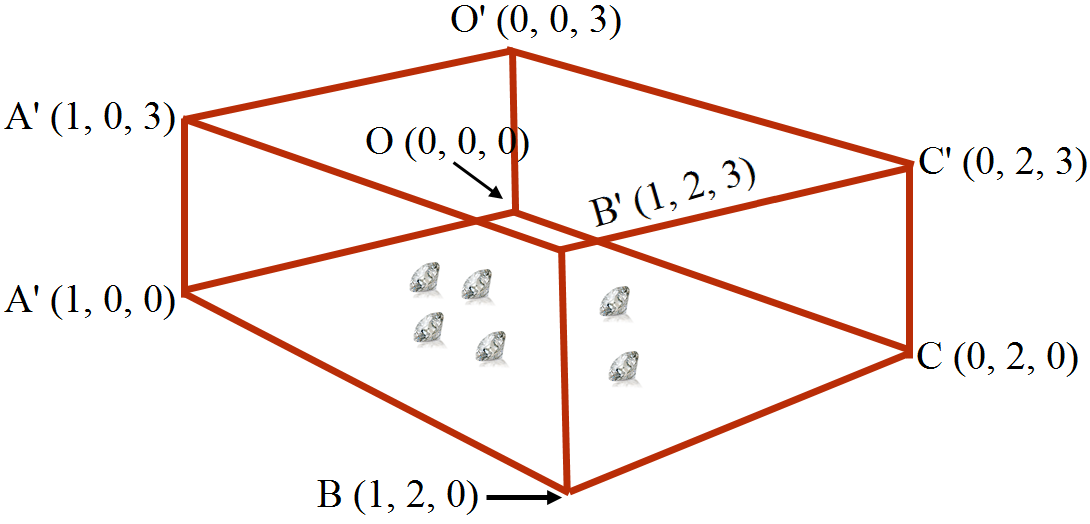 Based on the above information, answer the following questions.
→ Based on the above information, answer the following questions. - Direction ratios of OA are:
- < 0, 1, 0 >
- < 1, 0, 0 >
- < 0, 0, 1 >
- None of these
- Equation of diagonal OB' is:
-
$\frac{\text{x}}{1}=\frac{\text{y}}{2}=\frac{\text{z}}{3}$
-
$\frac{\text{x}}{0}=\frac{\text{y}}{1}=\frac{\text{z}}{2}$
-
$\frac{\text{x}}{1}=\frac{\text{y}}{0}=\frac{\text{z}}{2}$
- None of these
- Equation of plane OABC is:
- x = 0
- y = 0
- z = 0
- None of these
- Equation of plane O' A' B' C' is:
- x = 3
- y = 3
- z = 3
- z = 2
- Equation of plane ABB' A' is:
- x = 1
- y = 1
- z = 2
- x = 3
A differential equation is said to be in the variable separable form if it is expressible in the form f(x) dx = g(y) dy.
The solution of this equation is given by
$\int\text{f(x)dx}=\int\text{g(y)dy}+\text{c},$ where c is the constant of integration.
Based on the above information, answer the following questions.
→The solution of this equation is given by
$\int\text{f(x)dx}=\int\text{g(y)dy}+\text{c},$ where c is the constant of integration.
Based on the above information, answer the following questions.
- If the solution of the differential equation $\frac{\text{dy}}{\text{dx}}=\frac{\text{ax+3}}{\text{2y+f}}$ represents a circle, then the value of 'a' is:
- 2
- -2
- 3
- -4
- The differential equation $\frac{\text{dy}}{\text{dx}}=\frac{\sqrt{1-\text{y}^2}}{\text{y}}$ determines a family of circle with.
- Variable radii and fixed centre (0, 1)
- Variable radii and fixed centre (0, -1)
- Fixed radius 1 and variable centre on x-axis
- Fixed radius 1 and variable centre on y-axis
- If = y'+ 1, y(0) = 1, then y (In 2) =
- 1
- 2
- 3
- 4
- The solution of the differential equation $\frac{\text{dy}}{\text{dx}}=\text{e}^\text{x-y}+\text{x}^2\text{e}^\text{-y}$ is:
- $\text{e}^\text{x}=\frac{\text{y}^3}{3}+\text{e}^\text{y}+\text{c}$
- $\text{e}^\text{y}=\frac{\text{x}^2}{3}+\text{e}^\text{x}+\text{c}$
- $\text{e}^\text{y}=\frac{\text{x}^3}{3}+\text{e}^\text{x}+\text{c}$
- None of these
- If $\frac{\text{dy}}{\text{dx}}=\text{y}\sin2\text{x},\ \text{y}(0)=1,$ then its solution is:
- $\text{y}=\text{e}^{\sin^2}\text{x}$
- $\text{y}={\sin^2}\text{x}$
- $\text{y}={\cos^2}\text{x}$
- $\text{y}=\text{e}^{\cos^2}\text{x}$
If the equation is of the form $\frac{\text{dy}}{\text{dx}}=\text{py}=\text{Q},$ where P, Q are functions of x, then the solution of the differential equation is given by $\text{ye}^{\int\text{pdx}}=\int\text{Q e}^{\int\text{pdx}}\text{dx}+\text{c},$ where $\text{e}^{\int\text{pdx}}$ is called the integrating factor (I.F.).
Based on the above information, answer the following questions.
→Based on the above information, answer the following questions.
- The integrating factor of the differential equation $\sin\text{x}\frac{\text{dy}}{\text{dx}}+2\text{y}\cos\text{x}=1$ is $(\sin\text{x})^\lambda,$ where $\lambda=$
- 0
- 1
- 2
- 3
- Integrating factor of the differential equation $(1-\text{x}^2)\frac{\text{dy}}{\text{dx}}-\text{xy}=1$ is:
- $-\text{x}$
- $\frac{\text{x}}{1+\text{x}^2}$
- $\sqrt{1-\text{x}^2}$
- $\frac{1}{2}\log(1-\text{x}^2)$
- The solution of $\frac{\text{dy}}{\text{dx}}+\text{y}=\text{e}^{-\text{x}},\text{ y}(0)=0,$ is:
- $\text{y}=\text{e}^\text{x}(\text{x}-1)$
- $\text{y}=\text{xe}^{-\text{x}}$
- $\text{y}=\text{xe}^{-\text{x}}+1$
- $\text{y}=(\text{x}+1)\text{e}^{-\text{x}}$
- General solution of $\frac{\text{dy}}{\text{dx}}+\text{y}\tan\text{x}=\sec\text{x}$ is:
- $\text{y}\sec\text{y}=\tan\text{x}+\text{c}$
- $\text{y}\tan\text{x}=\sec\text{x}+\text{c}$
- $\tan\text{x}=\text{y}\tan\text{x}+\text{c}$
- $\text{x}\sec\text{x}=\tan\text{y}+\text{c}$
- The integrating factor of differential equation $\frac{\text{dy}}{\text{dx}}-3\text{y}=\sin2\text{x}$ is:
- $\text{e}^{3\text{x}}$
- $\text{e}^{-2\text{x}}$
- $\text{e}^{-3\text{x}}$
- $\text{xe}^{-3\text{x}}$
If the equation is of the form $\frac{\text{dy}}{\text{dx}}=\text{py}=\text{Q},$ where P, Q are functions of x, then the solution of the differential equation is given by $\text{ye}^{\int\text{pdx}}=\int\text{Q e}^{\int\text{pdx}}\text{dx}+\text{c},$ where $\text{e}^{\int\text{pdx}}$ is called the integrating factor (I.F.).
Based on the above information, answer the following questions.
→Based on the above information, answer the following questions.
- The integrating factor of the differential equation $\sin\text{x}\frac{\text{dy}}{\text{dx}}+2\text{y}\cos\text{x}=1$ is $(\sin\text{x})^\lambda,$ where $\lambda=$
- 0
- 1
- 2
- 3
- Integrating factor of the differential equation $(1-\text{x}^2)\frac{\text{dy}}{\text{dx}}-\text{xy}=1$ is:
- $-\text{x}$
- $\frac{\text{x}}{1+\text{x}^2}$
- $\sqrt{1-\text{x}^2}$
- $\frac{1}{2}\log(1-\text{x}^2)$
- The solution of $\frac{\text{dy}}{\text{dx}}+\text{y}=\text{e}^{-\text{x}},\text{ y}(0)=0,$ is:
- $\text{y}=\text{e}^\text{x}(\text{x}-1)$
- $\text{y}=\text{xe}^{-\text{x}}$
- $\text{y}=\text{xe}^{-\text{x}}+1$
- $\text{y}=(\text{x}+1)\text{e}^{-\text{x}}$
- General solution of $\frac{\text{dy}}{\text{dx}}+\text{y}\tan\text{x}=\sec\text{x}$ is:
- $\text{y}\sec\text{y}=\tan\text{x}+\text{c}$
- $\text{y}\tan\text{x}=\sec\text{x}+\text{c}$
- $\tan\text{x}=\text{y}\tan\text{x}+\text{c}$
- $\text{x}\sec\text{x}=\tan\text{y}+\text{c}$
- The integrating factor of differential equation $\frac{\text{dy}}{\text{dx}}-3\text{y}=\sin2\text{x}$ is:
- $\text{e}^{3\text{x}}$
- $\text{e}^{-2\text{x}}$
- $\text{e}^{-3\text{x}}$
- $\text{xe}^{-3\text{x}}$
Ritika starts walking from his house to shopping mall. Instead of going to the mall directly, she first goes to a ATM, from there to her daughter's school and then reaches the mall. ln the diagram, A, B, C, and D represent the coordinates of House, ATM, School and Mall respectively.
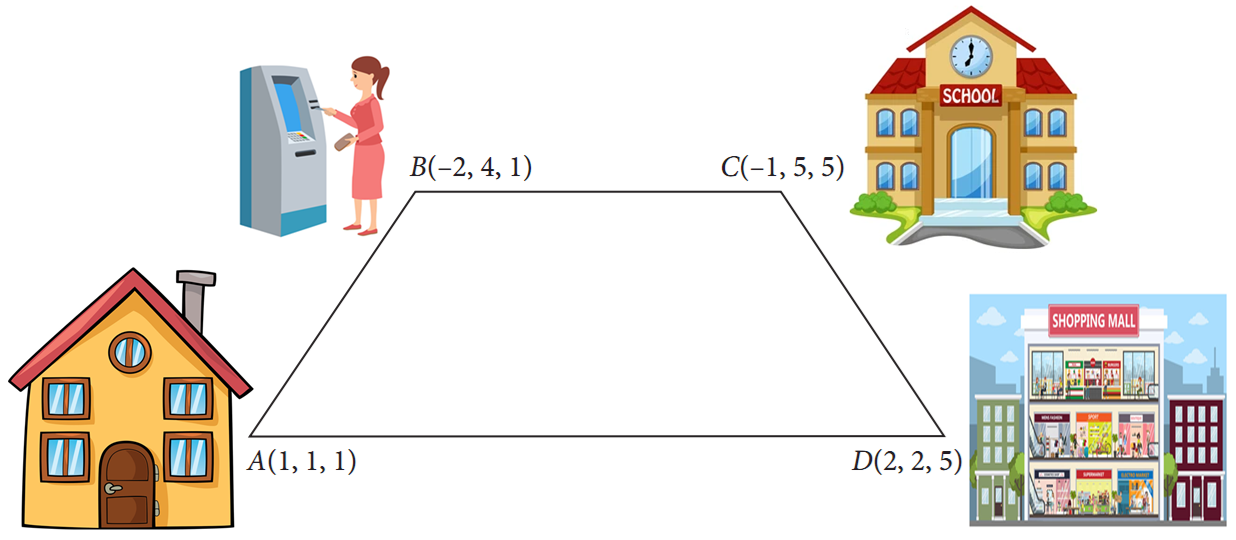
Based on the above information, answer the following questions.
→Based on the above information, answer the following questions.
- Distance between House (A) and ATM (B) is:
- $3\text{ units}$
- $3\sqrt{2}\text{ units}$
- $\sqrt{2}\text{ units}$
- $4\sqrt{2}\text{ units}$
- Distance between ATM (B) and School (C) is:
- $\sqrt{2}\text{ units}$
- $2\sqrt{2}\text{ units}$
- $3\sqrt{2}\text{ units}$
- $4\sqrt{2}\text{ units}$
- Distance between School (C) and Shopping mall (D) is:
- $3\sqrt{2}\text{ units}$
- $5\sqrt{2}\text{ units}$
- $7\sqrt{2}\text{ units}$
- $10\sqrt{2}\text{ units}$
- What is the total distance travelled by Ritika:
- $4\sqrt{2}\text{ units}$
- $6\sqrt{2}\text{ units}$
- $8\sqrt{2}\text{ units}$
- $9\sqrt{2}\text{ units}$
- What is the extra distance travelled by Ritika in reaching the shopping mall?
- $3\sqrt{2}\text{ units}$
- $5\sqrt{2}\text{ units}$
- $6\sqrt{2}\text{ units}$
- $7\sqrt{2}\text{ units}$
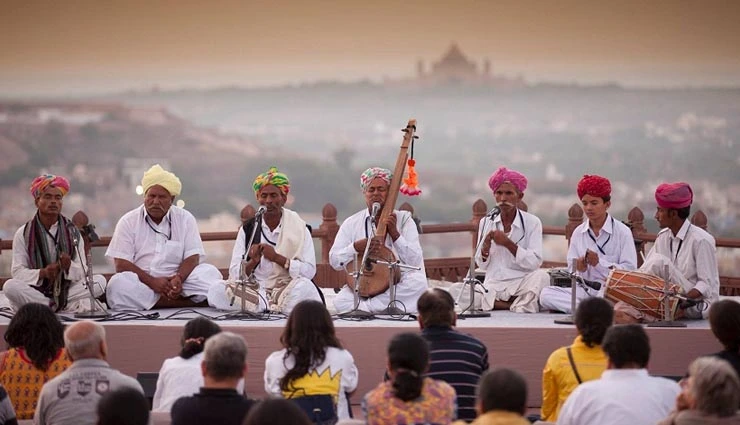
One day, a sangeet mahotsav is to be organised in an open area of Rajasthan. ln recent years, it has rained only 6 days each year. Also, it is given that when it actually rains, the weatherman correctly forecasts rain 80% of the time. When it doesn't rain, he incorrectly forecasts rain 20% of the time.
→
If leap year is considered, then answer the following questions.
- The probability that it rains on chosen day is:
-
$\frac{1}{366}$
-
$\frac{1}{73}$
-
$\frac{1}{60}$
-
$\frac{1}{61}$
- The probability that it does not rain on chosen day is:
-
$\frac{1}{366}$
-
$\frac{5}{366}$
-
$\frac{360}{366}$
-
None of these.
- The probability that the weatherman predicts correctly is:
-
$\frac{5}{6}$
-
$\frac{7}{8}$
-
$\frac{4}{5}$
-
$\frac{1}{5}$
- The probability that it will rain on the chosen day, if weatherman predict rain for that day, is:
- 0.0625
- 0.0725
- 0.0825
- 0.0925
- The probability that it will not rain on the chosen day, if weatherman predict rain for that day, is:
- 0.94
- 0.84
- 0.74
- 0.64
On her birthday, Seema decided to donate some money to the children of an orphanage home. If there were 8 children less, everyone would have got ₹10 more. However, if there were 16 children more, everyone would have got ₹10 less. Let the number of children be $\mathrm{x}$ and the amount distributed by Seema for one child be $\mathrm{y}$ (in ₹).
→
(i) Represent given information in matrix algebra.
(ii) Find the adjoint of Matrix containing information about of number of children and amount she paid?
(iii) Find the number of children who were given some money by Seema?
OR
How much amount does Seema spend in distributing the money to all the students of the Orphanage?