MCQ
It is not possible to write directly on blotting paper or newspaper with ink pen
  • A
    Because of viscosity
  • B
    Because of inertia
  • C
    Because of friction
  • Because of capillarity

Answer

Correct option: D.
Because of capillarity
d
(d)Due to capillarity it absorbs the ink.

Need a full question paper?

Generate a complete, print-ready paper with questions like this in minutes — across 16+ boards, with answer keys.

Start Generating Free

Similar questions

The amplitude of a simple pendulum, oscillating in air with a small spherical bob, decreases from $10\, cm$ to $8\, cm$ in $40\, seconds$ . Assuming that Stokes law is valid, and ratio of the coefficient of viscosity of air to that of carbon dioxide is $1.3$ . The time in which amplitude of this pendulum will reduce from $10\, cm$ to $5\, cm$ in carbon dioxide will be close to ..... $s$ $(ln\, 5 = 1.601,ln\, 2 = 0 .693)$
A box contains a mixture of ${H_2}$ and $He$ gases. Which of the following statements are corrects
A block of mass $10\; \mathrm{kg}$ is in contact against the inner wall of a hollow cylindow cylindrical drum of radius $1 \;\mathrm{m}$. The coeffident of friction between the block and the inner wall of the cylinder is $0.1$. The minimum angular velocity needed for the cylinder to keep the block stationary when the cylinder is vertical and rotating about its axis, will be: ......$rad/s$ $\left(g-10 m / s^{2}\right)$
Which of the following sets cannot enter into the list of fundamental quantities in any system of units?
The force $F$ is given in terms of time $t$ and displacement $x$ by the equation $F = A\,cos\,Bx + C\,sin\,Dt.$ The dimensional formulae of $D/B$ is
The range of a projectile for a given initial velocity is maximum when the angle of projection is ${45^o}$. The range will be minimum, if the angle of projection is ......... $^o$
A block with mass $M$ is connected by a massless spring with stiffiess constant $k$ to a rigid wall and moves without friction on a horizontal surface. The block oscillates with small amplitude $A$ about an equilibrium position $x_0$. Consider two cases: ($i$) when the block is at $x_0$; and ($ii$) when the block is at $x=x_0+A$. In both the cases, a perticle with mass $m$ is placed on the mass $M$ ?

($A$) The amplitude of oscillation in the first case changes by a factor of $\sqrt{\frac{M}{m+M}}$, whereas in the second case it remains unchanged

($B$) The final time period of oscillation in both the cases is same

($C$) The total energy decreases in both the cases

($D$) The instantaneous speed at $x_0$ of the combined masses decreases in both the cases
A uniform metal chain is placed on a rough table such that one end of it hangs down over the edge of the table. When one third of its length hangs over the edge, the chain starts sliding. Then the coefficient of static friction is:
The position of a projectile launched from the origin at $t=0$ is given by $\vec{r}=(40 \hat{i}+50 \hat{j}) m$ at $t=$ $2 s$. If the projectile was launched at an angle $\theta$ from the horizontal, then $\theta$ is (take $g =10\,ms ^{-2}$ )
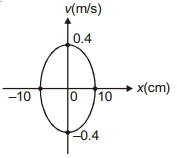
The plot of velocity $(v)$ versus displacement $(x)$ of a particle executing simple harmonic motion is shown in figure. The time period of oscillation of particle is .........