MCQ
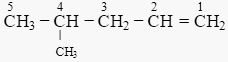
$IUPAC$ name of $C{H_3} - \mathop {\mathop {CH - C{H_2}}\limits_{|\,\,\,\,\,\,\,\,\,\,\,\,\,\,\,\,\,\,} }\limits_{C{H_3}\,\,\,\,\,\,\,\,\,\,\,} - CH = C{H_2}$ is
  • A
    $2-$ methyl pentene
  • $4-$ methyl pentene $-1$
  • C
    $1-$ hexene
  • D
    $2-$  methyl pentene $-1$

Answer

Correct option: B.
$4-$ methyl pentene $-1$
b
since it contains double bond hence it is alkene and it also has methyl group attached to the fourth carbon atom, Thus its IUPAC name of the compound will be:

$4$- methyl -$1$- pentene

Need a full question paper?

Generate a complete, print-ready paper with questions like this in minutes — across 16+ boards, with answer keys.

Start Generating Free

Similar questions

If interionic distance between  $Na^+$  and  $F^-$  ions is  $2.31\,\mathop A\limits^o $ then radii of  $Na^+$  and   $F^-$  are
At $90\,^oC$ , pure water has $[H^+] = 10^{-6}\,M$ , if $100\, mL$ of $0.2\, M\, HCl$ is added to $200\, mL$ of $0.1\, M\, KOH$ at $90\,^oC$ then $pH$ of the resulting solution will be
$\mathop {C{H_2} = CH - CH = CH{ - ^ \oplus }N{H_3};}\limits_{(I)} \,\,\mathop {{\,^ \oplus }C{H_2}-CH = CH{ - ^\circleddash }CH{ - ^ \oplus }N{H_3}}\limits_{(II)} $

$\mathop {^ \oplus C{H_2} - CH = CH - CH = N{H_3}}\limits_{(III)} $

Which of these structures is not a valid canonical structure ?

$\mathrm{CH}_2=\mathrm{CH}-\mathrm{CH}=\mathrm{CH}-{ }^{\oplus} \mathrm{NH}_3 ;{ }^{\oplus} \mathrm{CH}_2-\mathrm{CH}=$

Graphite conducts electricity due to the:
The reaction $CH_{4(g)} + Cl_{2(g)} \to CH_3Cl_{(g)}+ HCl_{(g)}$ has $\Delta H = -25 \,kcal$
$BE(C-Cl) = 84\, kcal, BE \,(H-Cl) = 103\, kcal$
$BE \,(C-H) = X$ and $BE\, (Cl-Cl) = y$
If $\frac{x}{y} = \frac{9}{5}$ then find $y$
has correct $IUPAC$ name
The concentration of hydronium $({H_3}{O^ + })$ ion in water is
Benzene and naphthalene form an ideal solution at room temperature. For this process, the true statement$(s)$ is (are)

$(A)$ $\Delta G$ is positive $(B)$ $\Delta S _{\text {system }}$ is positive

$(C)$ $\Delta S _{\text {surroundings }}=0$ $(D)$ $\Delta H =0$

The minimum uncertainty in the speed of an electron in an one dimensional region of length $2 a _{ o }$

(Where $a _{0}=$ Bohr radius $52.9 pm$ ) is $km s ^{-1}$

(Given : Mass of electron $=9.1 \times 10^{-31} kg$, Planck's constant $h =6.63 \times 10^{-34} \;Js$ )

Which of the following gives propyne on hydrolysis?